WSU team unlocks biological process behind coho die-offs
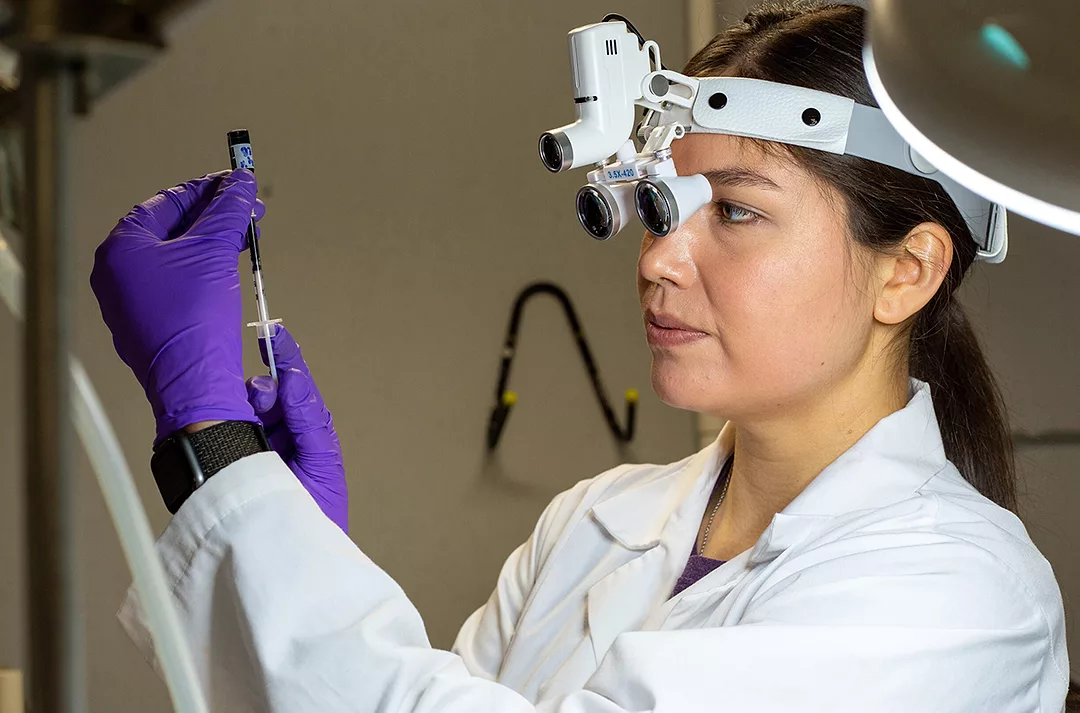
Stephanie Blair, a PhD student at WSU's Puyallup Research & Extension Center, works in the lab on a study examining the causes of coho salmon die-offs in Puget Sound area streams.
Jason Berg, Washington Stormwater CenterBy Shawn Vestal, WSU News & Media Relations
For years, scientists at Washington State University’s Puyallup Research & Extension Center have been working to untangle a mystery: Why do coho salmon in Puget Sound creeks seem to suffocate after rainstorms – rising to the surface, gaping, and swimming in circles before dying?
In 2018, the die-offs were linked to bits of car tires shed by friction and washed into the stormwater runoff. In 2020, researchers zeroed in on one particular chemical culprit, a tire preservative known as 6PPD.
Now, research led by WSU PhD student Stephanie I. Blair has established the biological mechanism for how that toxin kills the fish, laying the groundwork for tests to find an alternative to 6PPD.
When 6PPD interacts with ozone, it becomes a toxic chemical known as 6PPD-quinone. Blair, working with a team from WSU and the University of Washington, demonstrated that 6PPD-quinone breaches the cellular walls that protect the brain and vascular system, known as the blood-brain barrier and the blood-gill barrier, causing oxygen deprivation.
“Prior to publication of this study nobody really knew what the event was that drove what they call ‘coho urban runoff mortality syndrome,’” said Blair, the lead author of the paper published in the journal Environmental Science & Technology. “This is the first paper that gives a clear answer as to what’s happening.”
Understanding this makes it possible to design tests for potential alternatives to 6PPD, which is in virtually every automobile tire. The need for an alternative is growing with concerns over the environmental impact of the chemical. Studies are increasingly showing that, while coho are one of the most sensitive to 6PPD-quinone, it is also toxic for other fish and mammals, with possible effects on human health.
“We need those tools to be available so we can start screening for alternatives to 6PPD,” Blair said. “This tells us how to evaluate a potential substitute.”
Blair is in the home stretch of her PhD program at WSU. She is also working for the Confederated Tribes of the Umatilla Reservation; an enrolled member of the Sault Ste. Marie Tribe of Chippewa Indians, she also uses her Ojibwe name, Negonnekodoqua.
Co-authors on the paper included Jenifer McIntyre, an associate professor of aquatic toxicology whose lab at the WSU Puyallup Research & Extension Center has been at the forefront of this issue. McIntyre works closely with collaborators at UW and the U.S. Geological Survey Western Fisheries Research Center to understand the harmful impacts of 6PPD-quinone and work towards a replacement for 6PPD.
Coho, or silver salmon, are an iconic Northwest species: Born in freshwater streams, they swim hundreds of miles to the ocean, where they spend most of their lives. A tiny percentage make the arduous journey back upstream to spawn before dying.
Several coho populations are listed as threatened or endangered, which has implications for the environment, economy, politics and treaty fishing rights of Northwest tribes.
Blair, who began working in the lab in 2018, has focused on trying to understand the cardiovascular response behind the die-offs. In lab experiments on fish exposed to stormwater runoff, she and McIntyre used fluorescent markers to demonstrate there were certain points at the blood-brain and blood-gill barriers that were “leaky” — something was crossing through the cardiovascular firewall.
They suspected that 6PPD-quinone was the cause, and the current paper confirms it. Researchers exposed fish to runoff collected from a state highway near Tacoma and, separately, to concentrations of 6PDD-quinone typical for a runoff event. Fish exposed to both exhibited the behaviors associated with the die-offs, and subsequent examinations showed substantial disruption of the brain-blood and gill-blood barriers.
“Every single time the coho show the surfacing symptoms and the loss of equilibrium, it always has blood-gill and blood-brain barrier disruption,” Blair said. “You will always find that. Every single time you have a sick fish from exposure to 6PPD-quinone, this is very causally linked.”