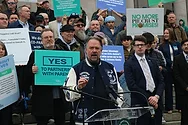
It’s a landmark moment for the endeavor known as WA Cares, envisioned as a means to help Washington’s workforce afford long-term care and services as they age.
The 26-member council, which includes Columbia Basin College president Rebekah Woods, will serve as a venue for “candid discussions,” Ferguson said, adding that he plans to attend every quarterly meeting. The Democratic governor said Washington hasn’t convened such a panel in two decades.
Even with the changes, revenues for the state’s two-year transportation budget are expected to be millions of dollars lower than previously forecastas demand for gas declines, fee collections drop, and there is continuing uncertainty around how much federal transportation funding for states will be available.
State worker unions expected tough salary conversations this year, even before Gov. Bob Ferguson warned of difficult spending decisions in Washington’s next budget.
Let’s Go Washington, the initiative sponsor, has until July 2 to turn in at least 308,911 valid signatures of registered voters to qualify for the ballot. State election officials suggest submitting at least 390,000 to account for invalid ones.
Washington’s Supreme Court on May 4 denied a conservative political committee’s request to pursue an attempt to repeal the state’s new income tax law with a referendum this fall.
Washington got a clear warning that its reliance on reserves and one-time maneuvers to balance the budget endangers the state’s strong credit rating, which could worsen financial challenges.
Opponents of Washington’s new income tax on high earners filed a lawsuit April 9, arguing the controversial law is unconstitutional and in conflict with nearly a century of state Supreme Court precedent.
Opponents of Washington’s new income tax asked the state Supreme Court on April 3 to allow them to pursue a referendum in hopes of giving voters a shot at repealing the controversial new law this November.
The $16.6 billion supplemental budget expends about $1.2 billion more than the two-year transportation spending blueprint lawmakers approved last year. Under another bill, Washington will do more borrowing to cover added transportation spending.