Large-scale solar farm in central WA gets green light from governor
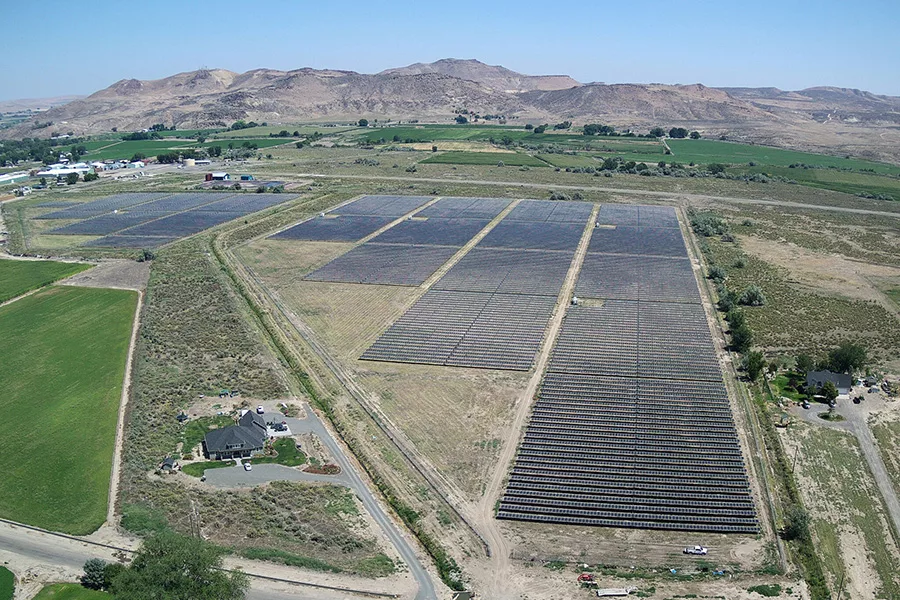
Cypress Creek Renewables, the company proposing to build the Carriger Solar project in eastern Washington, currently operates this solar farm in Vale, Oregon. It is a 13-megawatt farm compared to Carriger, which would generate 160 megawatts of electricity.
Courtesy of Cypress Creek RenewablesGov. Bob Ferguson has approved a 1,300-acre solar farm in south-central Washington, over the protests of the Yakama Nation, calling the project a “win for our state.”
The Carriger Solar project in Klickitat County near Goldendale is expected to generate enough power for thousands of homes. Ferguson informed the Energy Facility Site Evaluation Council on Dec. 2 that he was giving it the go-ahead. This is the first large-scale energy project Ferguson has acted on since taking office.
“Building more clean energy will provide affordable, carbon-free electricity to Washingtonians, create much needed construction jobs, boost economic development and keep our air clean,” Ferguson, a first-term Democrat, said in a statement.
The announcement earned condemnation from Yakama Nation leaders, who have said the project will encroach upon sites where tribal members traditionally gather food and medicine.
“It is alarming and bitterly discouraging to see that Governor Ferguson is continuing former Governor Inslee’s approach to championing new industrial-scale alternative energy development at the expense of our land, our water, our wildlife, and our sacred places – instead of taking Yakama Nation up on our multiple requests to discuss how we can work together toward a more just energy transition,” said Gerald Lewis, chairman of the Yakama Nation Tribal Council, in a statement.
Ferguson’s decision isn’t a surprise. When he turned down the council’s initial recommendation to proceed with the Carriger project in August, he made clear that he viewed the undertaking as “consistent with state policies.”
And he stressed the importance of moving swiftly so developers could secure federal clean energy tax credits before they are ended by the Trump administration. Solar and wind projects must begin construction by July 4, 2026 to fully qualify for the credits.
But Ferguson told the council to talk further with Yakama Nation leaders about their concerns that protections for cultural resources were not strict enough.
What emerged was the revised site certification agreement inked by Ferguson. It requires the developers provide $100,000 in one-time grant funding to the Yakama Nation Cultural Resources Program once the project is operational. Tribal access to traditional and cultural properties must be maintained during construction.
Despite those revisions, the tribe remains opposed to the project.
“Even within EFSEC’s artificially-limited and expedited review process of the Project, Yakama Nation documented multiple concerns about the Project’s negative impacts, which were dismissed through performative ‘mitigation measures’ by both EFSEC and now the Governor’s Office,” Lewis said.
Ferguson, in his Dec. 2 letter to the Energy Facility Site Evaluation Council, said the final agreement “balances the need for affordable clean energy with mitigation requirements that protect Washington’s environment.”
He also reiterated the urgency of acting to take advantage of the federal credits.
“Our state already faces real challenges in building renewable electricity, and we now contend with a federal government that is hostile to renewable electricity development,” he wrote. “All of these elements factored into my decision.”
Cypress Creek Renewables, based in Santa Monica, California, plans to build the solar farm north of State Route 142 along Knight Road, about two miles west of Goldendale in unincorporated Klickitat County. The firm applied for state approval for the project in February 2023.
The company is “grateful” for Ferguson’s support, a spokesperson said Thursday.
“We are proud to play a role in advancing the state’s clean energy goals,” Angeli Chandler, Cypress Creek’s director of communications, said in an email.
“We are moving with urgency to ensure we retain federal tax treatment, which is critical to keeping this project on track,” she said. The project is expected to begin delivering power in the summer of 2028, she said.
When completed, Carriger Solar will have 160 megawatts of solar generating potential, enough to power up to 32,500 homes, according to the company’s website. The project, which also includes a 63 megawatt battery energy storage system, will tie into the Bonneville Power Administration transmission system.
It will occupy 1,326 acres within a 2,108-acre development site that is mostly agricultural and rural residential lands.
The Carriger Solar project isn’t the only state-supported clean energy project opposed by the Yakama Nation. The tribe, along with the Benton County Board of Commissioners and nonprofit Tri-Cities C.A.R.E.S. is suing to stop construction of the Horse Heaven Hills Energy Complex, a wind and solar energy facility being pursued by Scout Energy.
The Tri-Cities Area Journal of Business contributed to this report.
This story is republished from the Washington State Standard, a nonprofit, nonpartisan news outlet that provides original reporting, analysis and commentary on Washington state government and politics.