DOE explores methods to treat waste that could cut expenses
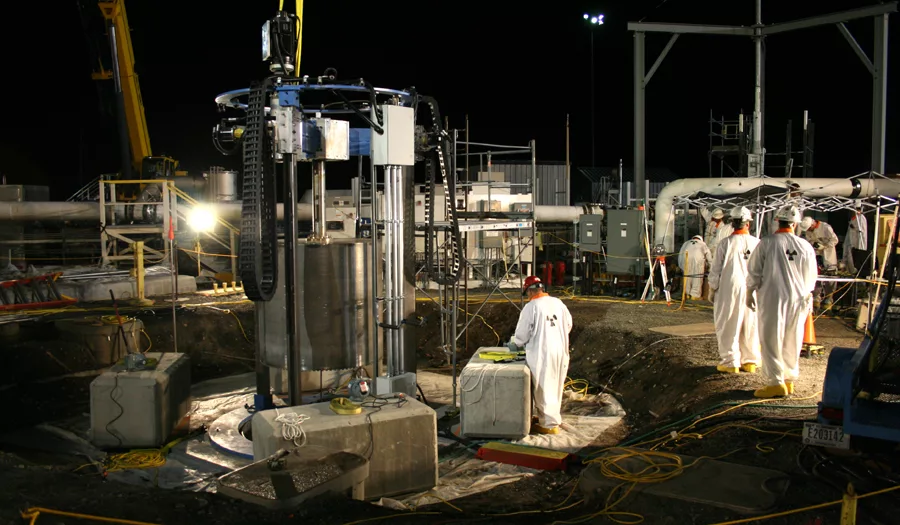
Cleanup of the nuclear waste-contaminated Hanford site will
cost another $323.2 billion to $677 billion and continue until at least 2078,
according to the latest projections released by the U.S. Department of Energy.
That’s why the Department of Energy is exploring new
approaches that could reduce both the timeline and costs associated with the
cleanup of the 586-square-mile site, said Geoff Tyree, external engagement lead
with the Department of Energy at Hanford.
“We’re looking for ways that we can reduce the cost of
cleanup while making sure we’re meeting the regulatory requirements and that
it’s still safe and protective of people and the environment,” Tyree said.
The Department of Energy reported the projections in its
2019 Hanford Lifecycle Scope, Schedule and Cost Report, a document released in
February that serves as the foundation for preparing federal budget requests
and informational briefings to affected tribal governments and Hanford
stakeholders. The report is required annually under the Tri-Party Agreement
between the U.S. Department of Energy, Washington State Department of Ecology
and the U.S. Environmental Protection Agency.
Costs associated with the nearly 30 years of cleanup that
have taken place thus far totaled $53 billion as of September 2018. Work
completed during that time included the movement of 2,300 tons of spent nuclear
fuel from near the Columbia River to dry storage, stabilization of 20 tons of
leftover plutonium that was shipped off site and treatment of 20 billion
gallons of contaminated groundwater.
The footprint of active cleanup now stands at 76 square
miles compared to 586 square miles in 1989.
The Department of Energy’s previous lifecycle report
released in 2016 estimated the remaining cleanup cost at $107.7 billion and saw
most of the work being done by 2060. The increased cost and delayed schedule
included in the latest report were not unexpected, but they highlight the need
to look at things differently, Tyree said.
“(The report) definitely shows that the current approach
will leave waste in the tanks for too long, it will expose workers to unnecessary
risk and require taxpayers to pay too much, and so the report supports the
department’s exploration of other approaches to treating tank waste to complete
the Hanford cleanup,” Tyree said.
One of the alternatives the Department of Energy is exploring
is a process known as the test bed initiative, which looks to mix some of the
less radioactive tank waste with a grout-like mixture for it to be disposed of
as low-level waste outside of Washington.
The Department of Energy is also considering new ways for
treating the more radioactive, high-level waste, Tyree said.
At the same time, Bechtel National Inc.’s construction of
the vitrification plant remains on schedule to begin turning the 56 million
gallons of high-level waste in Hanford’s 177 underground tanks into glass by
2023.
“I know the (Department of Energy) is looking at a number of
different options, and I think all of those options, from my perspective, are
worth a lot more examination and might be a really good direction to move in,”
said David Reeploeg, vice president of federal programs for the Tri-City
Development Council.
However, dealing with nuclear waste policy and disposal
inherently holds a wealth of challenges, one of the most significant being
securing the necessary funding for it, Reeploeg said.
The Department of Energy’s 2020
congressional budget proposal designates $2.1 billion toward the Hanford
cleanup, an amount that is $417 million less than what was allotted for the
cleanup in 2019.
“This is an era of limits on how much Congress is going to
be able to afford to spend every year and how much work, realistically, can be
accomplished every year,” Reeploeg said.
Further complicating the situation is the fact that the
longer it takes to complete the cleanup, the more expensive it becomes to
maintain the site for nuclear safety, said Alex Smith, program manager of the
state Department of Ecology’s Nuclear Waste Program.
“We’re getting to a tipping point where just the costs to
maintain the site are eventually going to eclipse the whole budget for the
site,” Smith said.
The Department of Ecology supports the Department of
Energy’s efforts to shorten the timeline and reduce the costs associated with
the Hanford cleanup but also has concerns about new methods that may be used to
do so, she said.
“Although we agree that it needs to be cleaned up—and the
faster it’s cleaned up the better all-around—we’re worried that methods that
aren’t as protective of health and the environment will be used in order to do
it more quickly rather than to do it right,” said Randy Bradbury,
communications manager for the Department of Ecology’s nuclear waste program.
The Department of Ecology is working with the Department of
Energy to advance the test bed initiative, while at the same time closely
monitoring that it doesn’t pull money or attention away from the central
mission of vitrifying the high-level waste that it believes needs to be
vitrified.
“To the extent we can do it without sacrificing
environmental protection in our jurisdiction, we’re happy to support those
efforts but not if they come at the expense of (DOE) meeting its obligations,”
Smith said.
Completing the cleanup to a standard that all stakeholders
are comfortable with but at a cost that is affordable for Congress and
palatable to the community is a challenge that will require open minds on all
sides, said TRIDEC’s Reeploeg.
“As a nation, we have this legal and moral obligation to
clean up the Hanford site. That being said, we also recognize that we are in an
era where there are limitations to funding. The budgetary environment is not
one where there’s a whole lot of extra money lying around, so the lifecycle
report certainly presents some new challenges,” Reeploeg said.
Another challenge will be getting all parties to reach
agreement on the proper balance between quantity of work and standard of work,
he said.
“Is it better to get a lot of work done to one standard — to
at least get waste out of the tanks and get
waste solidified — or to have a much higher standard but you only get a fraction
of that waste solidified or pulled out of the tanks? I don’t know that anybody
knows what the exact right answer to that is. None of these are easy answers,
but I think those are some of the conversations that are beginning to take
place and that we probably need more of,” Reeploeg said.
The Department of Energy is still early in its process of
analyzing alternative waste-treatment options, so any potential new path and
related cost reductions likely will not be reported for a couple of years, Tyree
said.
“We’re not trying to rush this. We want to make sure we take
the time to talk about these options and to be able to demonstrate that they
will still be protective of people and of the environment,” he said.