Cherry farmers brace for uncertainties
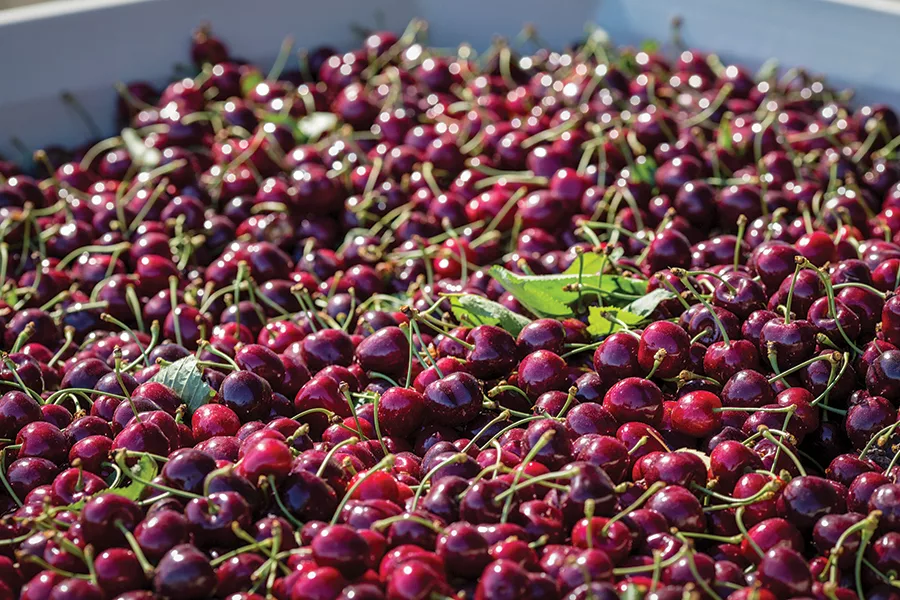
After a 2022 season challenged growers with unseasonably cool temperatures and late snow that damaged blossoms and discouraged honeybees from leaving their hives, cherry farmers are looking forward to more cooperative weather.
“So far, the indications are looking pretty good,” said Jon DeVaney, president of the Washington State Tree Fruit Association, in early April. “There’s no forecast predicting problems at this point, as long as the wet weather pattern doesn’t last too long.”
The 2022 season saw a drop in production of roughly a third over the previous year – more than 12 million 20-pound boxes of cherries compared to the prior year’s 18.5 million.
“That hurt a lot of cherry growers. They did get better pricing on the fruit they did have. The conditions didn’t affect fruit quality, just the quantity,” DeVaney said.
In 2023, they hope for a normal crop size that allows the market to maintain good pricing.
“We want to make sure that consumers pressured by other cost increases are still going to be able to spend money on top quality Northwest cherries. We’re hoping for a soft landing for the economy,” he said.
He said consumers tend to view cherries as an “affordable luxury,” and their seasonality contributes to their demand.
However, increasing economic pressures on consumer wallets and farmers’ budgets alike pose additional challenges to the industry.
Narrow margins
In 2023, the American Farm Bureau forecasted that farmers will see a 20% decrease in returns.
“Growers saw higher prices on their cherries, but also higher prices for farm labor, fuel, equipment, ag chemicals. Just about every input they were using to move their crop was significantly more expensive,” DeVaney said.
With all the turmoil in the world, the higher cost of doing business isn’t going away.
DeVaney said farmers will experience additional strain on already slim margins as the overtime pay requirement phases to 48 hours from 55 in 2022. After 48 hours, workers must be paid time-and-a-half.
“Cherries are one of the most labor-intensive crops in the state. It was easier to work around with the smaller crop (in 2022), but going to 48 hours in 2023 and potentially having larger crops, a lot of growers have concerns about getting all the work done that needs to happen before triggering the increase,” DeVaney said.
That means potentially leaving prime fruit on trees to be picked another day.
In Washington, the minimum wage for foreign H-2A program workers hired by farmers who can’t recruit enough domestic workers is $17.97 per hour.
“That’s the lowest people are required to be paid, but in some cases the rate can be higher due to piece rate rules,” DeVaney explained. “A lot of cherry workers who are experienced can do quite well, upwards of $30-plus per hour … We’ve had higher wage inflation in agriculture over the last 10 years over other sectors and still we’re losing workers.”
Compounding the issue is the low unemployment rate.
“When the labor market is tight, we see movement out of agriculture into other industries offering permanent, full-time employment indoors, and we can see that in the H-2A numbers.” DeVaney added that the number of temporary foreign H-2A workers has been increasing year over year for over a decade.
The Washington Farm Bureau reported in late March 2023 that the state’s agriculture sector was short about 25,000 workers. Very few domestic workers are applying for agricultural jobs, with only 11 domestic workers placed in the more than 33,000 jobs listed in 2022 through the state Employment Security Department (ESD), the bureau said.
From 2007-19, the number of H-2A temporary agricultural workers coming into the state for agricultural work grew by more than 1,000%, the ESD reported.
International headwinds
Fortunately for Northwest cherry growers, the majority of exports stay within North America, though a significant amount goes to Asia as well.
Trade is still on for now with China, an important cherry export market. In 2022, almost 400,000 20-pound boxes were shipped there, accounting for 14% of total exports.
“There’s uncertainty around the trade negotiation environment in Asia, and also the security aspect, but the bigger issue is the cost to transport products … it continues to remain high since most cherries are transported by air cargo to ensure freshness,” DeVaney said.
Posturing between the U.S. and China over Taiwan, Russia’s ongoing war on Ukraine and other unstable conditions around the world also are having an effect.
“When there’s international uncertainty, a lot of money tends to flow into the U.S. to strengthen the dollar since it’s the most secure currency available,” DeVaney said. “That in turn, though, causes the dollar to appreciate against all foreign currencies, making anything we’re exporting from the U.S. more expensive in foreign markets. If you’re a U.S. producer trying to export goods, it means an involuntary price increase to customers.”
Uncertain future
In response to all of these challenges, growers are focusing on what they can do to prepare for a highly turbulent and unpredictable future.
Growers are increasingly using data management tools to track temperatures, degree days and other insights. What used to be like clockwork – seasons varying little year after year – has become day by day planning with farmers stocking up on inputs to guard against potential worst-case scenarios.
The Washington Tree Fruit Association encourages growers to test for the incurable little cherry disease by making use of Washington State University grant assistance to catch the disease before it spreads and condemns an entire orchard.
Cutting down infected trees remains the only solution to stop disease spread.
The industry expects again to see rules relating to heat and smoke exposure stemming from sweltering summer weather and smoky conditions during wildfire season. The state Department of Labor and Industries stipulates cooling breaks and masking to reduce smoke inhalation while working in orchards under these conditions.
“‘Normal weather’ is a term that growers say with scare quotes around it because every year lately has had something unexpected and challenging, whether it’s the heat dome or the cool patterns last year,” DeVaney said. “Weather patterns are really unsettled, and it was even a topic covered at the annual meeting last year: how to be resilient amidst climate changes and weather.”
In the meantime, farmers must wait out the storms.