Next-gen energy
Fusion startup picks Tri-Cities for advanced nuclear plant
Avalanche Energy plans to invest at least $1 billion in project
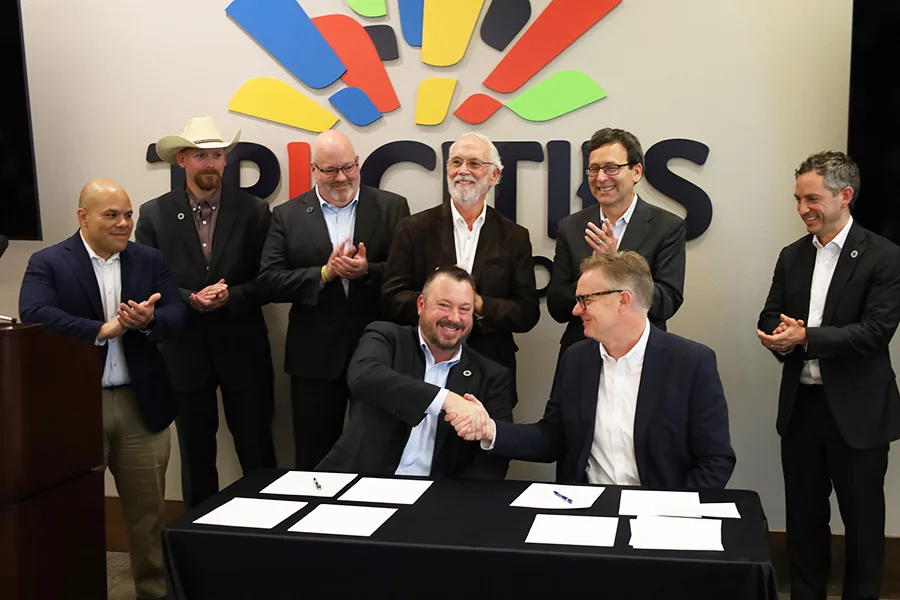
Avalanche CEO Robin Langtry, left, and Karl Dye, president and CEO of Tri-City Development Council, shake hands after ceremonially signing letters committing them to work together to site and build Avalanche’s first global manufacturing facility for its fusion reactors.
Photo by Nathan FinkeA year and a half ago, a Seattle-based nuclear startup got the keys to a Port of Benton facility it hoped would be its first test bed for its cutting-edge fusion reactors.
Turns out that wasn’t ambitious enough.
Avalanche Energy has selected the Tri-Cities after a nationwide site evaluation to be the home for its first global production facility that will manufacture energy-generating devices, the company announced at a Kennewick press conference on Oct. 8.
The Seattle-based company plans to invest at least $1 billion in the region, build a facility with upward of 1,000 workers to handle all aspects of manufacturing and development of its fusion reactors, and employ hundreds of workers to operate it.
Company officials have said they anticipate using the technology to power satellites or unmanned submersibles. It could also power data centers or cargo shipping. Avalanche already has a contract with the U.S. Department of Defense to develop next-gen technology for compact, resilient, nuclear batteries.
“Washington has been a huge opportunity for me so I’m happy to be here to repay that,” said Avalanche co-founder and CEO Robin Langtry.
FusionWERX, Avalanche’s research and development facility at 2345 Stevens Drive, is not yet up and running to test that future prototype but officials expect it will be soon.
“We came here looking for a facility – what we actually found was a community that cares about advanced nuclear,” Langtry said.
The project is at least two years away from breaking ground and hinges on Avalanche developing a prototype that is ready for deployment, said Alex Campbell, Avalanche’s head of commercial markets, in an interview with the Tri-Cities Area Journal of Business.
The company has consistently hit its milestones, and there is strong interest in what it could bring to the table for carbon-free energy, company and government officials said. That behooves Avalanche to be ready to make the leap to commercial production as soon as it can.
“The thing you don’t want to have happen in commercialization is to hit a milestone and not have something ready to build,” Campbell said.
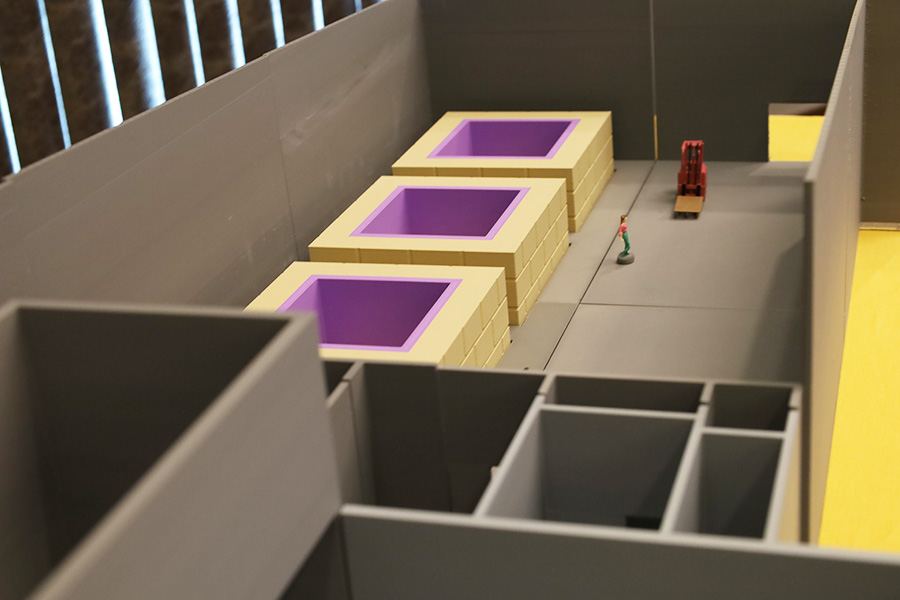
A model of Avalanche Energy’s FusionWERX test facility at 2345 Stevens Drive, Richland, was on display when the company announced its plans to site a future production facility in the Tri-Cities.
| Photo by Nathan FinkeFusion vs. fission
Fusion reactors differ from the fission reactors currently used in the nuclear power industry. Fusion combines two atoms, which releases energy, while fission splits atoms apart to generate power. Fusion produces more energy and does not generate the nuclear waste associated with fission reactors, though fusion reactors must operate at extraordinarily high temperatures and pressures.
Avalanche specifically works on small reactor models. Early prototypes measured 12 centimeters in diameter and produced a very small amount of energy. The goal is to expand the devices to a meter-and-a-half in diameter and be capable of generating hundreds of watts of energy, ultimately scaling to kilowatts and megawatts.
FusionWERX, which is currently being retrofitted at a Port of Benton facility in the Research District of north Richland, is expected to be where those devices will be tested. The company expects to finish renovations in early summer before it undergoes commissioning.
Even without that facility, Avalanche continues to make progress in its research and development. This past summer, Avalanche’s Jyn device, small enough to fit on a truck, reached ion temperatures above 11 million degrees Celsius, comparable to the heat found in the Sun’s core, which also generates its energy via fusion.
Fanfare
The company’s Oct. 8 event included the fanfare of signing a formal agreement alongside the Tri-City Development Council, or TRIDEC, to work together on making the manufacturing facility a reality. This includes TRIDEC helping the company find the property to build the plant, assisting with permitting and regulatory processes, and workforce development and recruitment.
“We’re obviously really excited about it,” David Reeploeg, TRIDEC’s vice president for federal programs, told the Journal. “It’s a great example of how the Tri-Cities really is a hub for energy, innovation and advancing energy technology development.”
Gov. Bob Ferguson, U.S. Rep. Dan Newhouse, R-Washington, and representatives from the offices of U.S. Sens. Patty Murray and Maria Cantwell, both D-Washington, all spoke about how transformative a nuclear fusion industry could be.
“Geopolitically this would be a breakthrough, not just for our state or nation, but for the world,” Ferguson said.
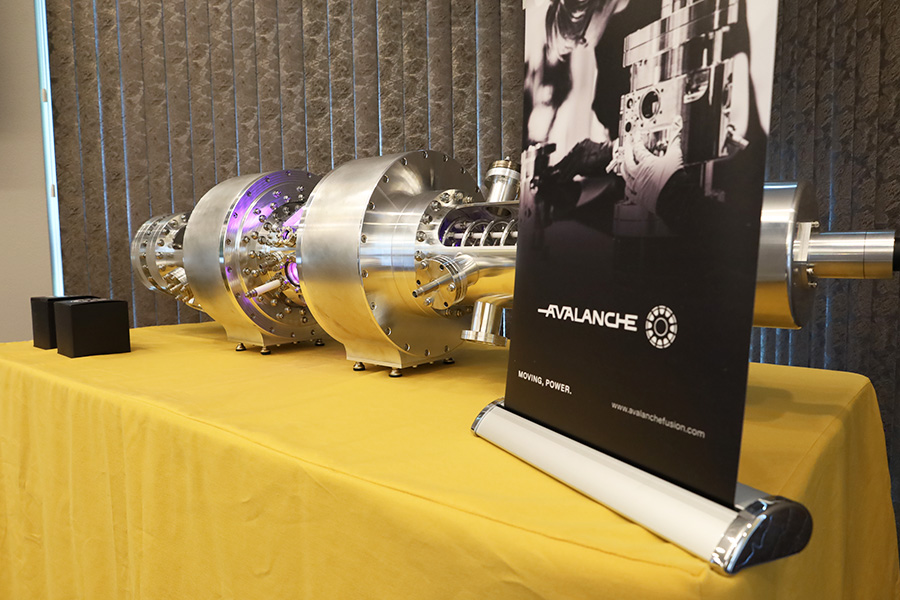
A model of Avalanche Energy’s compact fusion reactor is displayed at the Oct. 8 press conference in Kennewick to announce the company’s plans for manufacturing the energy-generating devices.
| Photo by Nathan FinkeLangtry presented special circular alloys to Ferguson and Newhouse, which are among those the future manufacturing facility will produce. The company also had on display the latest version of its Jyn reactor, as well as a simple model of the FusionWERX facility.
It’s too early to say what the manufacturing facility will look like but TRIDEC and Avalanche officials said it will be a fully vertically-integrated facility supporting every aspect of the manufacturing process. That means it will handle the raw material for the devices, make the alloys necessary, machine the parts and assemble them - all on site.
As for timelines, Avalanche anticipates taking at least a year to secure the land. Permitting and regulatory processes will take another year. It will be roughly the end of 2028 by that time, which is when the company anticipates achieving net energy gain with one of its reactors, setting it up to begin production.
Staying in Washington
Campbell said Avalanche deliberately stayed in Washington state because of its leadership in regulating and supporting the emerging fusion industry.
There were three primary reasons Avalanche chose the Tri-Cities for its future manufacturing facility. Two of them — an experienced nuclear workforce and institutions such as Pacific Northwest National Laboratory and Washington State University Tri-Cities — also led the company to site FusionWERX here.
The third reason? Access to extensive rail and waterway transportation networks.
“The ability to have rail and port access to ship these machines to not only domestic markets but international markets is a unique attribute that not many places have,” Campbell said.
But he stressed that the relationships the company has built with TRIDEC and other local leaders over the past year and a half also demonstrated this was where they wanted to be for the long haul.
“The community understanding what we’re going to do is important,” Campbell said, later adding, “This facility will become a cornerstone of the fusion industry of the world. It’s an incredible thing to consider.”