Hanford grout’s clay-like appearance draws scrutiny
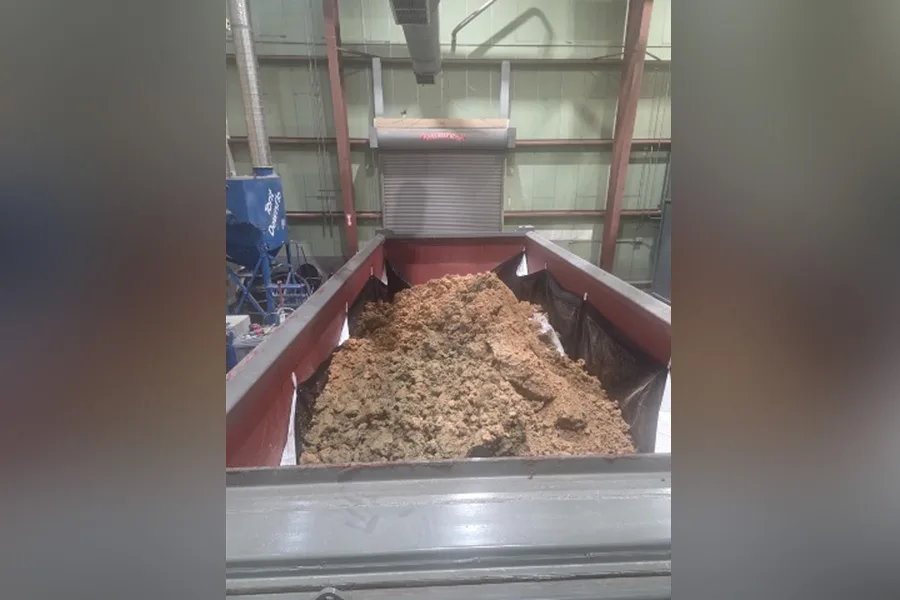
Grout currently being produced from hazardous waste byproduct material from Hanford’s cleanup processes is coming out with a consistency more akin to loose sand or clay and not as a concrete or stone like material as some observers had expected.
Courtesy Hanford ChallengeAs recently as this spring, the U.S. Government Accountability Office described grout as hazardous waste or waste byproducts “immobilized in a concrete-like mixture.”
In that same report, called “Hanford Cleanup: DOE’s Plans to Grout and Dispose of Millions of Gallons of Tank Waste,” a graphic includes an image of a squat solid concrete-looking cylinder above the word “grouting.”
But the grout currently being produced from material from Hanford’s cleanup processes doesn’t appear to be rock solid.
A photograph shared with the Tri-Cities Area Journal of Business depicting grout recently created from waste byproduct depicts a material closer in appearance to loose sand or clay.
“(The material) is not solid. It will never turn into a solid,” said Nikolas Peterson, executive director of watchdog Hanford Challenge. “This is what we should expect all of the shipments to look like.”
Cerise Peck, spokeswoman for DOE’s Hanford Field Office, told the Journal in an email the photo depicts “an acceptable form of treated waste.”
“A solid does not have to be a hard block like cured concrete,” Peck stated. “Sand and soil are solids too. The material shown in the photo is not a liquid, and the treatment standard does not require it to become a solid block.”
But it’s a discovery that has led Peterson to call prior federal characterizations of grout “misleading” and raises questions about the stability and safety of shipping the grout out-of-state for long-term storage. State ecology officials also are looking further into how grout is being made since it is not “an expected solid form.”
Push to expand grouting
While much of the focus in recent years has been on the vitrification process being deployed to treat high-level waste at the Waste Treatment and Immobilization Plant, or vit plant, grout has stepped into the limelight in recent months.
Grouting was first considered in the 1980s and 1990s as a more affordable approach to cleanup, though it was abandoned after initial applications demonstrated technical challenges. It also faced opposition for environmental and safety concerns.
But grouting continued to be employed extensively at Savannah River, another contaminated site being cleaned up by DOE’s Office of Environmental Management. That process and the material resulting from it have been frequently referenced by DOE and GAO in reports for years.
Beginning in 2016, DOE began reevaluating grout alongside other waste treatment methods at Hanford as part of its Test Bed Initiative. In 2025, the federal agency shipped about 2,000 gallons of pretreated liquid low-activity waste from Hanford to commercial facilities in Utah and Texas via truck for grouting and permanent disposal, which federal officials considered successful, according to the GAO.
Ecology, in partnership with DOE and the U.S. Environmental Protection Agency, already approved dual application of grouting and vitrifying of some tank waste at the site under the Holistic Agreement finalized in early 2025.
But this past summer DOE unveiled its broader “dual path” strategy to grout even more waste even as vitrification continues.
“This approach would get up to a million gallons of additional tank waste grouted and shipped out of Washington state for disposal by the end of next year – that’s on top of the amount we will immobilize in glass and store on site,” said Ray Geimer, the Hanford Field Office manager, in a statement at the time. “It redefines what the site could look like within our lifetimes.”
In mid-August, Perma-Fix Pacific Northwest, EnergySolutions and Waste Control Specialists were awarded $4 billion in subcontracts to assist with treating, transporting and storing grouted waste from the site.
Meeting requirements
It’s because of the past examples of grout from Savannah River that Peterson said he was so thrown by the photo showing grouted waste created at Perma-Fix. Outfits such as Hanford Challenge and environmental groups and tribes were already skeptical of grout, saying it does not stabilize hazardous waste as securely as glass.
“We’re kind of left with, if they knew this whole time, why didn’t they tell us?” he said.
Peck said grout mixtures can vary depending on the specific makeup of the waste being treated. The grouted waste being created at Perma-Fix has advantages for disposal “because it can be placed more efficiently and takes up less volume than large, solid blocks.”
“What matters is not what the material looks like in a photograph, what matters is whether it meets the requirements for treatment, transportation and disposal,” DOE’s Peck said in an email. “The treated waste is tested to confirm it meets those requirements before disposal.”
But Peterson said the revelation does not inspire trust, especially as DOE is pushing to grout more waste.
“What if it falls off the truck and spills and it’s a rainy day, what’s the risk of it leaching out?” he said.
In its statement addressing the appearance of the grouted waste, Ecology said it takes “the treatment of disposal of any waste seriously, and will ensure it is done in a compliant, legal manner that is protective of human health and the environment.”
Peck said DOE has heard concerns from some stakeholders about shipping liquid waste, and the agency stands by that it will not ship liquid waste without stakeholder feedback and public engagement.
And she stressed that the grout is not liquid.
“Suggesting that this material is unsafe to transport simply because it does not look like cured concrete creates an inaccurate impression,” Peck said in her email. “Before a shipment leaves, the waste is characterized, the appropriate packaging is selected and trained personnel verify the packaging, loading, labeling, radiological controls and shipping documents. The material is transported in sealed industrial packaging that meets the applicable requirements.”
She added: “Importantly, before the waste is mixed with grout, the tank side system removes 99.9% of the radioactivity – meaning the material being shipped has already undergone significant treatment to reduce risk.”