
DOE pushes for expanded Hanford grouting, awards $4B in contracts
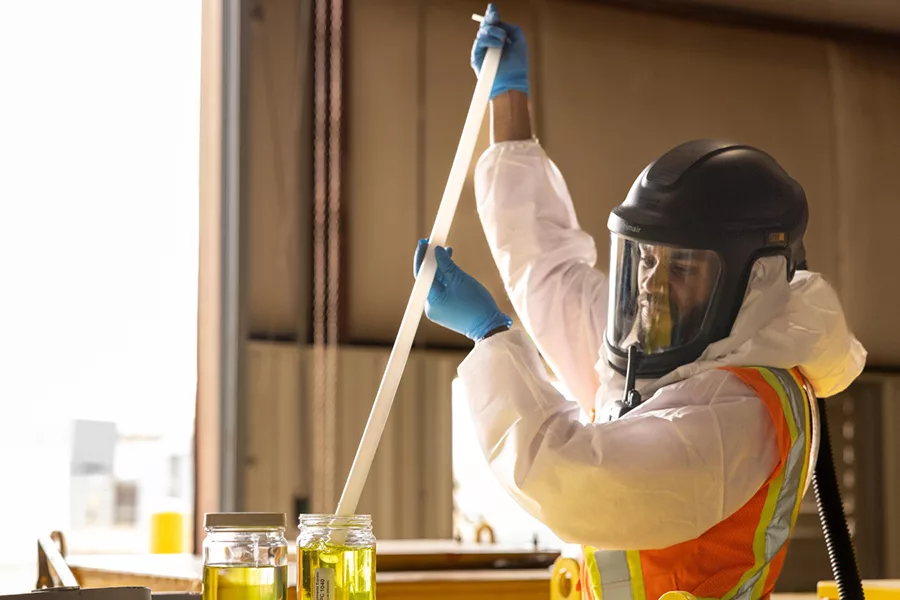
A worker with EnergySolutions collects a sample to confirm the Hanford Site tank waste meets requirements before it is grouted.
Courtesy U.S. Department of EnergyThe U.S. Department of Energy has awarded $4 billion in subcontracts and officially reclassified some Hanford tank waste, clearing the way for it to be treated by grouting instead of vitrification.
And the agency is wasting no time pressing the state to allow the expansion of that cleanup approach for even more tank waste.
The agency’s Hanford Field Office announced Aug. 10 that it had submitted two requests to modify its cleanup permits to the Washington Department of Ecology that, if approved, would allow treated tank waste to be grouted – converted to a cement-like mixture – instead of becoming glass from vitrification. The move follows on DOE’s recent initiative for a glass-and-grout effort to accelerate the cleanup that would also cut costs.
DOE officials insist the new approach will not sideline the multibillion-dollar Waste Treatment and Immobilization Plant, also known as the vit plant.
“The WTP will be fed first,” said Hanford Field Office Manager Ray Geimer, in a statement. “This permit ask is about excess waste beyond WTP capabilities. Hanford’s dual path strategy is about safely dispositioning more waste, sooner.
“This approach would get up to a million gallons of additional tank waste grouted and shipped out of Washington state for disposal by the end of next year – that’s on top of the amount we will immobilize in glass and store on site. It redefines what the site could look like within our lifetimes.”
DOE will kick off the public comment and review of its permit modifications at a meeting on Aug. 26 at the Richland Public Library.
Ecology officials confirmed to the Tri-Cities Area Journal of Business that they have received permit modification requests for the vit plant and tank farms. Both DOE and Ecology will have to go through public comment and review periods before any modifications are determined.
New waste classification, contracts
Ecology, in partnership with DOE and the U.S. Environmental Protection Agency, already approved dual application of grouting and vitrifying of some tank waste at the site under the Holistic Agreement finalized in early 2025.
“We continue to engage with Energy on advancing this commitment and await several key decisions and information from Energy needed to support permitting actions from our agency,” Ecology said in a statement.
That agreement is what allows DOE’s recent waste reclassification decision for the S, SX and U tank farms to facilitate that waste to be grouted and shipped off the site for long-term storage.
“Finalizing the determination supports continued progress in Hanford’s tank waste mission,” DOE’s Hanford Field Office said in a statement. “It provides a clear path for the safe management of treated waste while maintaining rigorous standards for protecting workers, the public and the environment.”
In addition, Hanford site contractor Hanford Tank Waste Operations and Closure, or H2C, on Aug. 11 announced that Perma-Fix, EnergySolutions and Waste Control Specialists will support future tank-side treated waste operations connected to the 200 West Area. Together, the contracts establish grouting capacity that can be deployed as cleanup needs evolve. The subcontractors will also be able to grout byproducts from the Effluent Management Facility beginning in 2027, while supporting planning for additional treated waste streams and future transport methods.
“Successful cleanup requires the flexibility to apply the right solution to the right waste stream,” Geimer said. “These subcontract awards expand our options and strengthen our ability to safely manage treated waste as the mission progresses.”
A dual solution
However, grouting is opposed by environmental and other Hanford watchdog groups for not providing the safety and environmental protections of vitrification. Those same groups have accused federal officials of wanting to cut corners to accelerate the cleanup process.
But DOE has said relying strictly on vitrification isn’t feasible. The vit plant is still ramping up to full production and that’s left the storage tanks of pre-treated waste full since March. Upward of 400,000 gallons of waste could have gone through pretreatment if not for the backlog, DOE officials said.
“The people of Washington deserve an all-of-the-above approach,” said David Brunnert, chief operating officer for DOE’s Office of Environmental Management, in a statement. "That includes proven glass and grout solutions that have been safely and successfully used for decades across DOE and around the globe.”