DOE approves new waste classification for Hanford tank cleanup
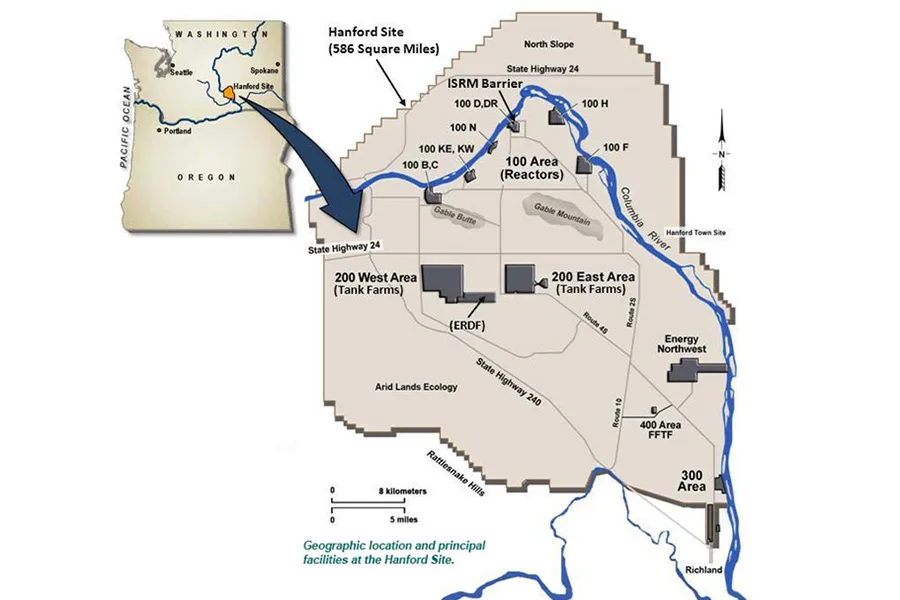
This map shows the principal sites at Hanford.
Courtesy DOEThe U.S. Department of Energy has officially reclassified some waste being stored in tanks at the Hanford site, paving the way for it to be treated by a means different than vitrification.
The decision, called the Waste Incidental to Reprocessing (WIR) determination by DOE, is for selected tank waste in Hanford’s 200 West Area, according to a release. Waste from the S, SX and U tank farms may be managed as low-level radioactive waste in accordance with DOE requirements.
That means waste from those tanks no longer must be fed through the site’s Waste Treatment and Immobilization Plant, or vit plant. Instead of being vitrified, or stabilized in a glass form, the reclassified waste can be grouted, or stabilized in a cement-like mixture before being shipped off the site for long-term storage elsewhere.
“Finalizing the determination supports continued progress in Hanford’s tank waste mission,” DOE’s Hanford Field Office said in a statement. “It provides a clear path for the safe management of treated waste while maintaining rigorous standards for protecting workers, the public and the environment.”
Grouting is opposed by environmental and other Hanford watchdog groups for not providing the safety and environmental protections of vitrification.
However, grouting rather than vitrifying some waste is allowed under agreements between DOE, U.S. Environmental Protection Agency and Washington Department of Ecology.
“We’re glad to see the U.S. Department of Energy complete the appropriate existing regulatory process to reclassify tank waste,” said Ryan Miller, a spokesman for Ecology’s Nuclear Waste Program, in a statement. “This represents another positive step in advancing the tank waste mission in Hanford’s 200 West Area.”