‘Lab of the future’
A rare look at the lab driving Hanford’s cleanup
222-S Laboratory turns 75 amid growing workload as current operator contract nears end
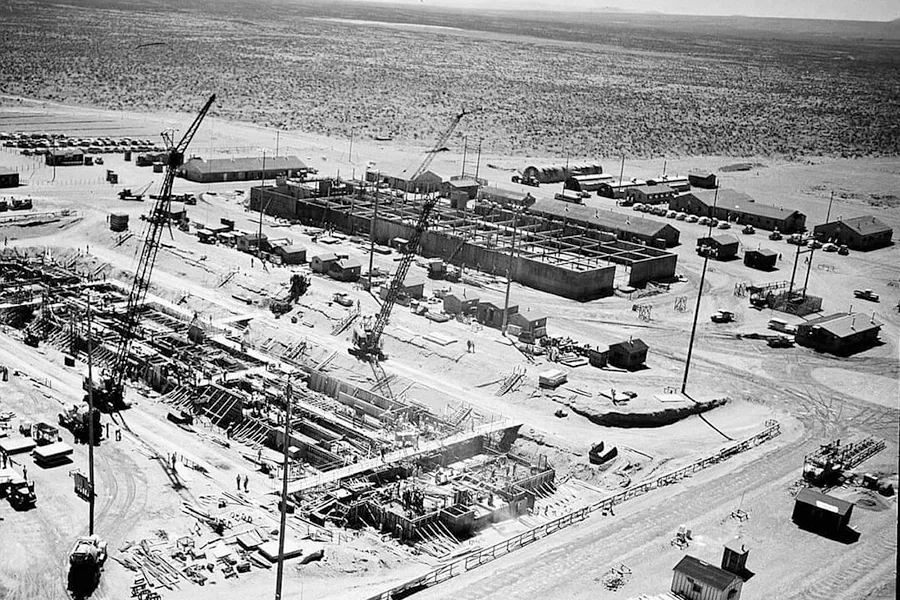
Construction of the 222-S Laboratory at Hanford. The facility opened its doors in 1951, marking the beginning of 75 years of scientific support to the evolving Hanford mission.
Courtesy Navarro-ATLHanford’s 222-S Laboratory just turned 75, but its busiest years may still be ahead. With waste vitrification now underway and sample analyses expected to jump 400%, the lab that once tested plutonium is poised for its next era.
Officials, current employees and retirees, or alumni, of the laboratory, operated by Navarro-ATL, gathered June 16 to celebrate the milestone anniversary. Former lab workers chuckled to see videos featuring their interviews, while rare tours of the lab space showcased the vital role the lab plays in waste cleanup at the nuclear site.
It’s “fun to see the history, but just also how we’re poised for the future,” said Heather Anastos, organic laboratory manager, who has worked at the lab since 1993, shortly after it switched focus from supporting plutonium production to cleanup efforts.

Heather Anastos
The celebration comes at a time when the U.S. Department of Energy’s Office of Environmental Management released a draft request for proposals for the lab’s next contractor.
Navarro-ATL’s contract to operate the lab was valued at $389 million when it was awarded in 2020, with a five-year base period and two one-year extension periods, with one more left to go.
The 70,000-square-foot lab first began operations in 1951 as a part of Hanford’s mission to produce plutonium, and the original structure is still intact today – with some additions.
The lab handles the research side of Hanford cleanup, analyzing samples from the waste tanks as well as some air, water and soil samples.
Laboratory space
The lab supports both grouting and vitrification, the two ways of processing Hanford’s nuclear waste.
The lab’s testing ensures safe transfers of waste as well as making sure the treatment process goes as planned. Their characterization of the waste provides data to guide safe decisions going forward.
The work done at 222-S is vital to Hanford’s cleanup mission: “Without us, it can’t be done,” said Mark Hughey, general manager of Navarro-ATL.
While the lab has seen remodels and additions since it was built 75 years ago, the main building is still there, and several of the labs have hoods and infrastructure that are largely original.

Mark Hughey
Part of the lab was built in the early ’90s to handle Hanford tank waste, designed with larger hot cells – a chamber that’s protected against radiation – and windows
into the cells. The cells are heavy-duty, composed of concrete walls, and double-paned leaded glass.
In this space, core samples from the waste tanks are brought in long tubes that are extruded into the hot cells, allowing workers to see the layers of waste in the tank.
Workers use outside controls to manipulate robotic arms inside the hot cells so that they can safely handle the tank waste. They have to work in pairs, or sometimes even in threes, with one person handling each robotic arm.
There’s an archive storage of tank waste, too, so that if any questions come up, they can access older waste materials.
Lab alumni
The history of the lab isn’t just one about the lab’s work, but its people.
“You’ve established, built the foundation, the backbone for what we know about Hanford and how we operate and clean up Hanford,” said Ricky Bang, deputy assistant manager for tank waste operations for DOE Hanford Field Office, in remarks at the celebration.
Lucinda Borneman, a retired 222-S Lab member who worked at the lab from 1999 to 2015, joined in the anniversary festivities along with almost 30 other lab “alumni.”
“I think it’s important to take a moment, take a beat, with some of these historic, long run missions, just really sit back, appreciate it, and see how far you’ve come,” Borneman told the Tri-Cities Area Journal of Business. “I’m totally enjoying reconnecting with former colleagues, and just to see the physicality of the place.”
She said she was involved with some of the earlier renovations to the lab, and it’s been fun to see how the building has held up. During her time at the lab, her work focused on environmental work, including time as the environmental safety, health and radcon manager.
Although the lab work sometimes made it hard to look past the analysis at hand, she said she connected to Hanford’s cleanup mission. After leaving the lab, she continued to work at the Hanford site until 2019, and she also has worked as a subcontractor with TerraGraphics on Hanford’s sitewide permit.
Anastos, a current lab employee, feels a connection to Hanford’s mission, too. She feels “we’re part of something important,” she said. She finds it fun to solve the problems and technical challenges they face, collaborating to find solutions.
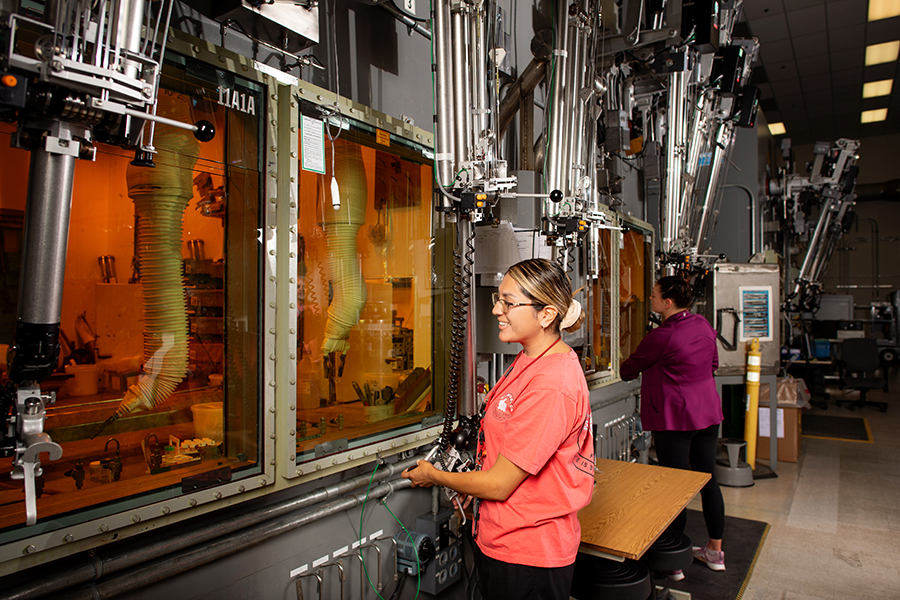
Navarro-ATL has upgraded the 222-S Laboratory’s Cold War-era hot cells and manipulators, enabling support for the current Hanford tank waste mission.
| Courtesy Kim Fetrow Photography/Navarro-ATLVisions for the future
The lab has been ramping up its efforts the past several years as Hanford moved toward waste vitrification, a process that finally began in October 2025.
Since 2021, after Navarro-ATL began managing the lab, 36 instruments have been upgraded or replaced and four of eight laboratory spaces have been remodeled. Turnaround time has also been reduced by 50%, and a new method of analyzing organic compounds in tank waste, called the Twister Stir Bar, improves efficiency at the lab.
They’ve had a wave of retirements in recent years, with 75% of the lab’s analytical staff joining in the last five years. Yet, the lab maintains its high performance, Anastos said.
The lab is gearing up for a 400% predicted increase in sample analyses in the coming years, and plans include modernizing the labs and creating more room for lab work.
Several areas of the lab are scheduled to be repurposed or rearranged, shifting some operations to outer buildings to increase the room inside the lab.
Officials at the anniversary celebration spoke of the lab’s potential as much as its history. Bang invited attendees to think about what the lab will look like over the next 75 years as it evolves.
Lab operator contract
As part of that evolution, the lab could get a new operator as DOE seeks draft bid requests to operate it.
The agency has released a draft request for proposals to gather feedback from industry ahead of issuing a final version, anticipated in the first quarter of fiscal year 2027. According to a June 25 cover letter, DOE is seeking comments on several topics through July 31. Go to: emcbc.doe.gov/SEB/Hanford222S.
The new contract, like the current one, will be limited to companies with 1,000 or fewer employees. Its length is the same as the existing one with a five-year base period, including a transition period, plus two one-year options.
Hughey said Hanford’s mission means the lab is expected to remain operational for another 50 years – and he intends to make sure it does, even if he’s not there to see it.
At 222-S, they’re “creating the lab of the future,” Anastos said.