Healthcare
Demand prompts Prosser to pursue $81M medical center
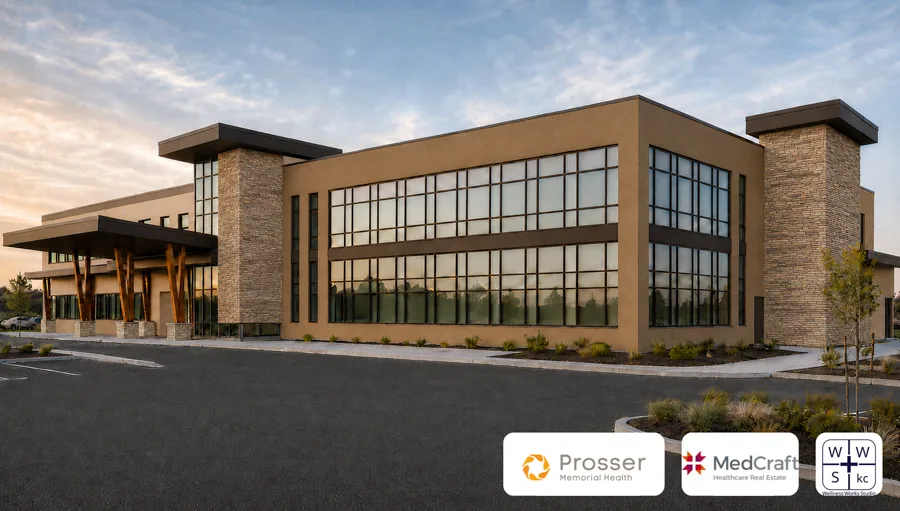
Prosser Public Hospital District recently gave the green light to move forward with a new medical office building which will be built on agravel lot just west of the new Prosser Memorial Health Hospital near the Interstate 82-Gap Road interchange.
Courtesy Prosser Memorial HealthThree operating rooms. State-of-the-art imaging equipment. An onsite pharmacy. Enough room for 40 healthcare providers and specialists.
Prosser Memorial Health’s latest $81 million construction project isn’t another hospital, but officials expect it to significantly enhance care for the Prosser community and beyond, much like the hospital that opened less than two years ago.
The Prosser Public Hospital District recently gave the green light to move forward with the project, which will be built on a gravel lot west of the new Prosser Memorial Health Hospital near the Interstate 82-Gap Road interchange.
CEO Tim Reed said the goal is to break ground in the first quarter of 2027, with the building tentatively opening in the spring of 2028.
“This is going to be a big investment for us but the best thing for the greater community,” he said.
Specialty care focus
The hospital district opened its new hospital in February 2025 after years of design and construction. It provided badly needed space for a burgeoning healthcare institution, which saw patient demand grow by 20% annually for the five years prior.
A medical office building was a planned project for the new hospital campus, Reed said, but one that wasn’t expected to be needed for several years. However, the hospital’s provider recruitment efforts have fared better than anticipated, with a pulmonologist, rheumatologist and other hard-to-hire specialists coming on board over the past two years.
Currently, Prosser Memorial’s specialists are in clinics scattered around Prosser and across the lower Yakima Valley. That makes it harder to coordinate care for patients with complex health concerns and affects the efficiency of the hospital district’s operations, something a centralized facility will address.
“It’s really focused on specialty care and our hub-and-spoke clinic system that connects to the hospital,” Reed said.
Mega clinic
The 56,000-square-foot building will be two stories, with a design that complements the new hospital. Patient services, such as an imaging center, cardiac rehabilitation clinic, procedure rooms and an outpatient pharmacy, are currently planned for the ground floor.
The top floor, which Reed said is nicknamed the “mega clinic,” will be where many of the specialists will have their offices and exam rooms.
Prosser Memorial has hired Medcraft, a national healthcare real estate firm, to manage the project as an owner’s representative. The contractor will be Aldrich VKP Construction, which formed from the merger of Bothell-based Aldrich + Associates Inc. and Yakima-based VK Powell Construction LLC. The pair worked on projects together prior to the merger, including Columbia Basin Health Association’s new clinic in Pasco.
Reed said the selection of both firms was driven by the hospital district’s interest in expediting construction, acknowledging the hospital has an aggressive construction timeline. That is all driven by necessity.
“We can’t get this building built fast enough. We’re maxed out for available space,” he said.
Funding the project
Along with pushing to get the building built quickly, the hospital district is also pursuing some novel financing to get the project funded.
Roughly a third of the medical office building will be paid directly by the hospital’s capital construction budget. Another third will be paid for through more standard financing from one or more financial institutions. The final piece will come from MedCraft, with Prosser Memorial paying the firm a lease.
A similar arrangement was pursued when Trios Southridge Hospital was built about a decade ago. In that case, it was fully financed by the firm that constructed it, precipitating a financial crisis that led to the Kennewick Public Hospital District’s bankruptcy in 2017.
Reed said he and other hospital officials are cognizant of how a similar arrangement impacted another hospital in the region. However, they are confident that they are approaching the project prudently and without overleveraging the hospital.
“What we’re trying to do is not overbuild beyond what we actually anticipate needing so that it is economically viable,” Reed said.