
Prosser hospital becomes regional destination for care
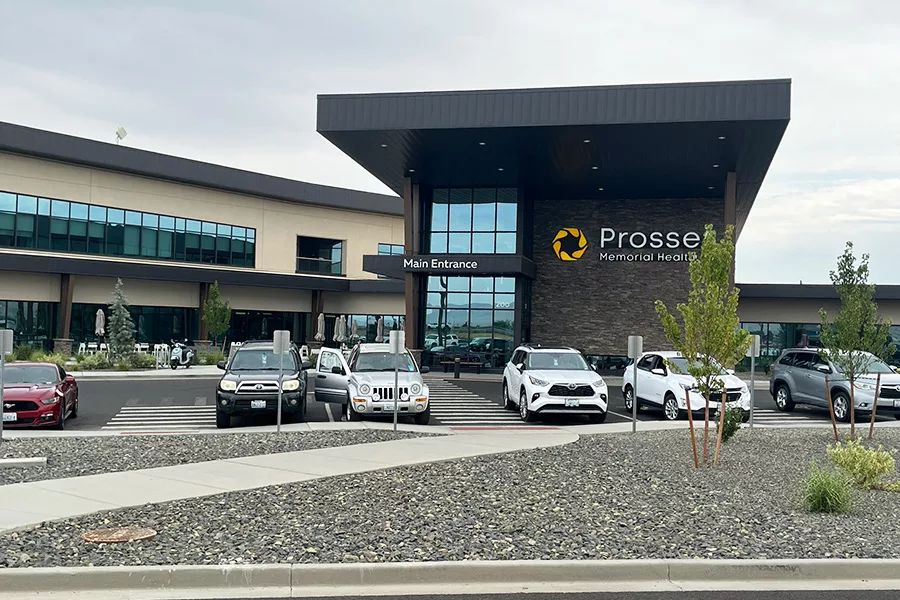
Since opening Feb. 1, Prosser Memorial Health’s new hospital has seen more births on average each month as expectant mothers take advantage of its large and comfortable birthing suites. Its emergency room is on track to record nearly 27,000 admittances this year, thousands more than in 2024.
Photo by Ty BeaverWhen Prosser Memorial Health opened its new hospital six months ago, its leaders weren’t expecting cows to be a challenge.
Located alongside Interstate 82 at the exit for Gap Road, the 88,000-square-foot and state-of-the-art facility borders a bucolic pasture. And since moving in, the herd that grazes there has breached the fence several times to get to the lush landscaping.
“Our surgeons are on cow watch,” said hospital spokeswoman Shannon Hitchcock while noting the new hospital’s surgical offices offer views of that side of the campus.
While the cows were among the first curious visitors, they’re far from the only ones. In the months since the opening on Feb. 1, patients from across region have steadily found their way to the new hospital for the care it was built to provide.
The rural hospital in the city with a population of 6,650 has seen more births on average each month as expectant mothers take advantage of its large and comfortable birthing suites. The hospital projects it will deliver 765 babies this year, or 4.4% more than the previous year. Its emergency room is on track to record nearly 27,000 admittances this year, thousands more than in 2024.
And Prosser Memorial Health’s board recently heard about the need for an additional 120 parking spots to accommodate patient volumes. Plans for that project are still being determined.
Hospital officials acknowledge that having the newest hospital in the region has been a draw for some new patients. But patient loads and demand for services have been climbing steadily since before construction began.
Prior to the new hospital’s opening, Prosser Memorial saw demand for services grow by 20% annually for the past five years. The rural hospital system also has grown from 300 staff to 800 across its operations in the past seven years.
And that growth has not diminished the hospital's quality of care; the federal Centers for Medicare and Medicaid Services, recently awarded Prosser a 5-star rating for Overall Hospital Quality, one of only two critical access hospitals in the state to receive that top rating.
Tim Reed, Prosser Memorial chief financial officer, said the hospital’s strategy remains rooted in patient care rather than market competition.
“We’re not trying to put anyone out of business, we’re just trying to be patient-focused,” he said.
Decade in making
A decade in the making, the new hospital – which cost $125 million including the land – replaces a hospital campus that after 75 years had run out of room to grow and upgrade to meet community needs. And the new hospital, which has a more welcoming feel than a traditional hospital, is more than just a larger building with private patient rooms, larger operating rooms and an expanded emergency department.
Each room in its birthing unit offers jetted bathtubs for water births.
The cardio rehabilitation clinic has exercise equipment manufactured in Italy – and is only used in a handful of hospitals across the country – that allows each to be digitally tailored to a given patient’s health program.
The hospital’s first full-service cafeteria provides dining options for staff but also patient family and friends who wish to stay close by when they need a meal.
Looking ahead
A planned medical building next to the new hospital has yet to begin construction and will provide some additional space for clinical services. That project is currently estimated at $24.7 million to $42 million to build and wouldn’t start until next year.
However, Reed said the hospital isn’t planning any additional major capital construction. Rather, conversations have focused on how better to use the space they now have.
“The solution is rarely just build more,” he said.
One example of that is Prosser Memorial’s gastrointestinal department, which is still housed at the old hospital in town. After recently bringing on three additional providers, it didn’t have enough operating rooms for all of them during the work week.
When the newest of the three providers offered to instead work Saturdays and Sundays, when operating rooms were typically not in use, hospital leaders were skeptical, Hitchcock said. Who would want to have surgery on a weekend?
Turns out, a lot of people, specifically those wanting to limit their days out of work or dependent on when family or friends are available to provide support and care afterward.
“It was a huge patient pleaser,” Hitchcock said.
Hospital officials say they will look for similar innovations and efficiencies going forward. That could also help limit the impacts of recent cuts to Medicaid, which provides roughly 15% of its annual revenues, or between $2.6 million to $4 million.
But Reed said the inclusion of $50 billion for rural health care along with those cuts could mitigate the impacts, allowing Prosser Memorial to continue doing what it needs to provide the best care possible.
And if that approach continues to lead to new patients driving down I-82 from up in the Yakima Valley or down in the Tri-Cities, the more the merrier.
“I’m actually pretty optimistic about the future for Prosser,” Reed said.