PNNL helps turn waste into medical radioisotope supply
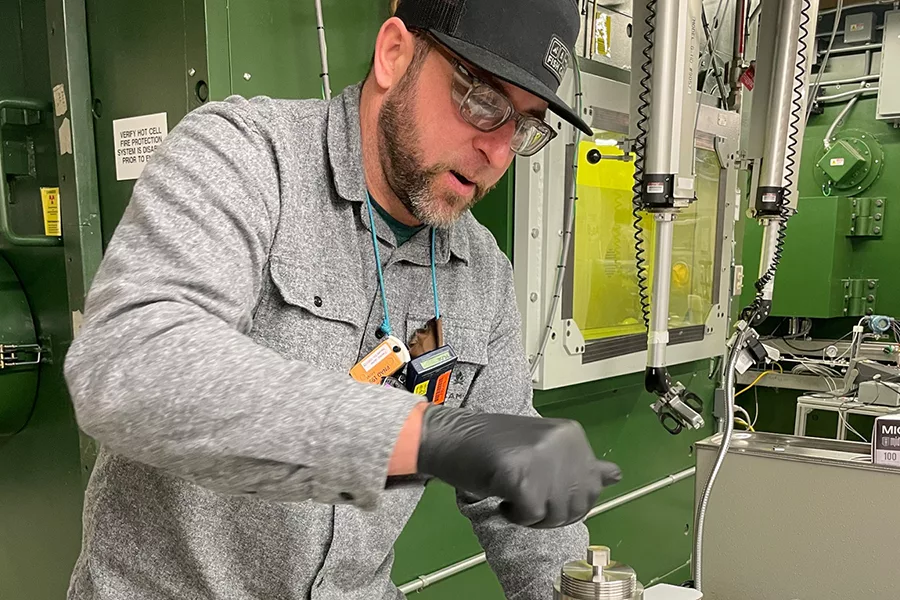
PNNL’s Jamin Trevino practicing the choreographed steps for handling the special form capsule that holds the radium-226.
Courtesy Jamin Trevino | Pacific Northwest National LaboratoryPacific Northwest National Laboratory, in partnership with two national organizations, is repurposing waste materials to be used for medical radioisotope production.
The U.S. Department of Energy’s (DOE) Office of Isotope R&D and Production (IRP) and the U.S. Department of Commerce’s National Institute of Standards and Technology (NIST) have converted radiological waste stored at NIST facilities into a valuable feedstock material used for radioisotope production, radium-226.
Securing a domestic supply of Ra-226 is a strategic priority for the U.S., as supplies of key medical isotopes can help power next-generation cancer therapies and other applications. Repurposing waste also helps to reduce legacy radiological waste materials in storage across the country.
“By working in partnership with NIST and leveraging the capabilities of (PNNL) and the National Laboratory system, we are converting previously unused materials into a strategic resource that supports U.S. leadership in cancer therapy and radioisotope production while improving safety for workers and removing long term hazards for facilities,” said Christopher Landers, director of IRP, in a statement.
Under the direction of IRP, PNNL developed the technical capabilities to recover the material across a variety of sites and material forms, including safe handling, packaging and transportation of the Ra-226. Now, the laboratory can process the material and use it as feedstock.
“The therapeutic promise of actinium-225 is significant, and the limits on supply have direct impacts on the ability for cancer patients to access life-saving treatments. By leveraging existing Ra-226, we can increase the domestic production capacity of actinium-225,” said Matt Fountain, PNNL’s project manager on the effort, in a statement.