From waste to space
Project Omega’s nuclear tech gets scientific boost from PNNL collaboration
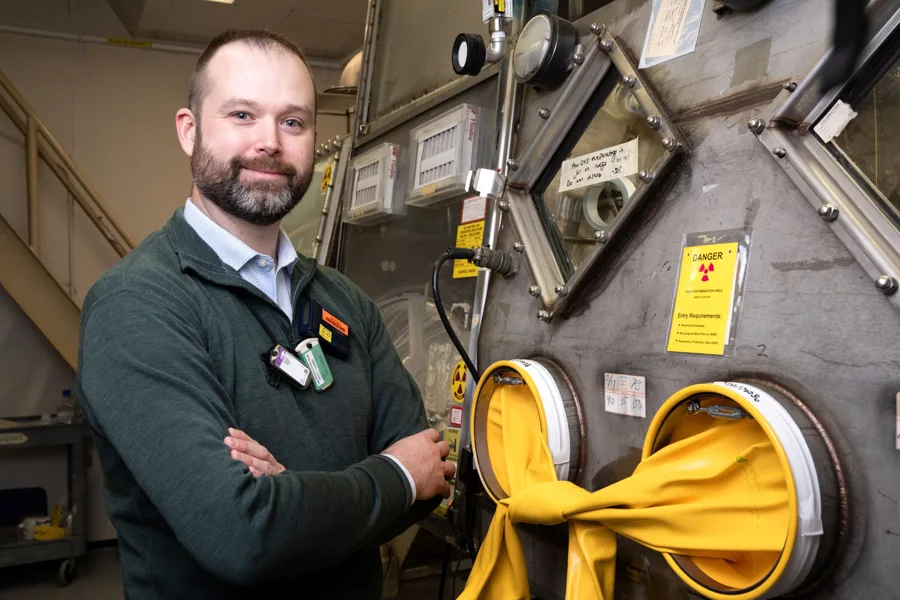
David Koch stands in a laboratory flanked by shielded gloveboxes at PNNL’s Radiochemical Processing Laboratory, where researchers do radiological research and development.
Photo by Andrea Starr | Pacific Northwest National LaboratoryA private East Coast enterprise is teaming up with Pacific Northwest National Laboratory to recycle spent nuclear fuel – and the results could power endeavors like space exploration while making spent nuclear fuel easier to manage.
Newport, Rhode Island-based Project Omega came out of stealth mode in February, when the company announced its goal to help rebuild the nuclear fuel cycle in the U.S.
Nuclear reactors in the U.S. have generated more than 90,000 metric tons of spent fuel – and these leavings often get a bad reputation, Stafford Sheehan, Project Omega’s CEO, told the Tri-Cities Area Journal of Business.
Sheehan, who has a Ph.D. in chemical physics and spent time developing technology for a green hydrogen company as well as spending the last seven years running a sustainable aviation fuel business, launched Project Omega in the summer of 2025.
His vision is to “revolutionize the energy industry” by making use of the spent nuclear fuel for electricity.
The venture-backed technology company has a team of about 15 and has raised $12 million in funding.
“We’ve pulled together a really strong group of partners and investors, and we’ve been off to the races,” Sheehan said.
Fuel reprocessing
Other countries throughout the world process spent nuclear fuel, but that type of recycling isn’t common in the U.S.
“We used to try to recycle nuclear fuel in the U.S. back (in the 70s),” Sheehan said. “It was discouraged because people were concerned about proliferation of materials like plutonium that could be used for nefarious activity.”
Unlike technology used in countries like France, Russia and China, Sheehan said Project Omega’s technology won’t separate out plutonium. Instead of using water or acids like other countries, Project Omega will treat spent fuel like an ore, a cleaner process.
“Fuel reprocessing is a technology that’s been proven around the world and been heavily used,” and France in particular has a strong program, said David Koch, a senior scientist at PNNL. He’s leading a 20-person, multidisciplinary team tackling power in space exploration and working with Project Omega’s technology.
But although that technology is well understood, the critical step is developing commercial pipelines to use the isotopes they pull out.
PNNL partnership
Project Omega is partnering up with PNNL, along with other groups, to advance its technology.
Scientists at PNNL have been working to establish the viability of Project Omega’s designs. So far, they’ve achieved proof of concept, or they have showed that the science behind the system works as intended, Koch said. Project Omega is one of several companies PNNL is working with to provide the science needed to advance nuclear power systems.
Koch said that Project Omega initially approached PNNL about a partnership after learning about the strontium-90 radioisotope heater unit the lab developed for the company Zeno.
“It was the first … novel radioisotope system built with strontium-90 for 40 years in the United States,” he said.
Project Omega’s technology is still in the early stage of testing, Koch said, and there’s a lot to be developed, especially for space applications.
“We envision working with PNNL for a long time,” Sheehan said.
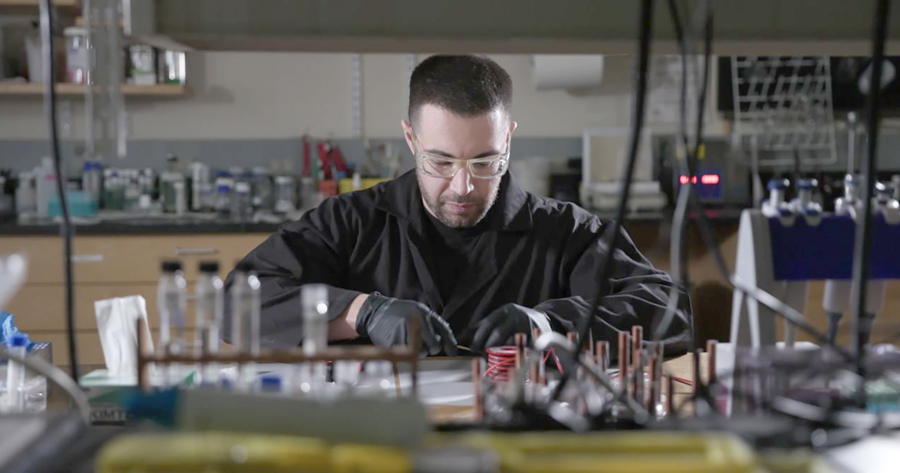
Stafford Sheehan, CEO of Project Omega, launched the company last summer with a goal of recycling and reusing spent nuclear fuel.
| Courtesy Project OmegaPowering space exploration
Reprocessing nuclear fuel comes with two benefits: powering other projects and making nuclear waste easier to deal with.
“When most people think of nuclear, we often think about fission – commercial nuclear reactors,” Koch said. “But there’s an entirely other type of nuclear power out there, and that’s where we convert the decay heat from a radioactive isotope into electricity.”
These radioisotope systems have traditionally powered space exploration. They can provide electricity without sunlight and also produce the necessary heat to keep critical instruments warm in extreme cold.
In the past, plutonium-238 was used to power space exploration. That’s different from plutonium-239, which is considered to be weapons plutonium, and it’s actually produced as a waste product of the nuclear weapons program, Koch said.
The isotopes used to run these systems for space exploration are most commonly found in spent nuclear fuel, so many are looking to that as a resource, Koch said.
By reprocessing the nuclear fuel, isotopes like strontium-90 and americium-241 can be extracted.
“These are isotopes that, conveniently, are both some of the biggest issues to storing spent nuclear fuel long-term because they’re hot, they generate a lot of heat. But that also makes them very effective, if we remove them, for use in deep space missions,” Koch said.
The result is a two-fold effect: waste becomes more manageable with some of the more dangerous isotopes removed, and at the same time, those isotopes can also be used to further space exploration.
“My real hope here is that we can transform the conversation around spent nuclear fuel from one of waste management to one of a national resource that can actually enable this type of cutting-edge science,” Koch said.
Other applications
While PNNL is focused on the science and experimentation aspect of the project, answering the challenging questions so that the concept can move forward into production, Project Omega will focus on scaling the technology.
“We have to make a larger power cell that is able to power larger applications,” Sheehan said.
Space exploration isn’t the only application the company is interested in, either. Sheehan compared nuclear fuel recycling to an oil refinery. When crude material goes in, a lot of different products can come out. The same is true of nuclear fuel. In addition to the strontium-90 that can be used for space exploration, there’s lots of reprocessed uranium that can be re-enriched and put back in the fuel cycle.
“We’re working together with some groups in the War Department to essentially understand what their highest-value application is going to be, so that we can make a power cell or power source that fits into that application perfectly,” he said.
Project Omega is working with other partners, including Idaho National Laboratory, ARPA-E, and other groups in the U.S. Department of Energy, Sheehan said. “PNNL has a lot of the capabilities to utilize certain pieces of the spent fuel, and for us to do the R and D to understand how to utilize those pieces of spent fuel. INL is where they actually take the spent fuel and do that separation, though,” he said.
The main goal is bringing nuclear fuel process capabilities back to the U.S.
While Sheehan hopes that new nuclear projects like small modular reactors will be successful, there’s still a lot of spent nuclear fuel to address, both from past nuclear projects and from new ones.
He said it’s like “selling the picks and shovels with the gold rush.” While new initiatives for nuclear power are great, “there’s a lot of things that have to happen in the U.S. nuclear industry, and that includes having a more mature fuel cycle with spent fuel management. And that’s what we’re doing.”
“Right now is the right time for this technology,” Sheehan said. “This is the time for the nuclear fuel cycle, this is the time for nuclear deployment.”