
AI fatigue
Business owner pushes back on automatic AI rollouts
Petition urges tech companies to offer AI opt-out
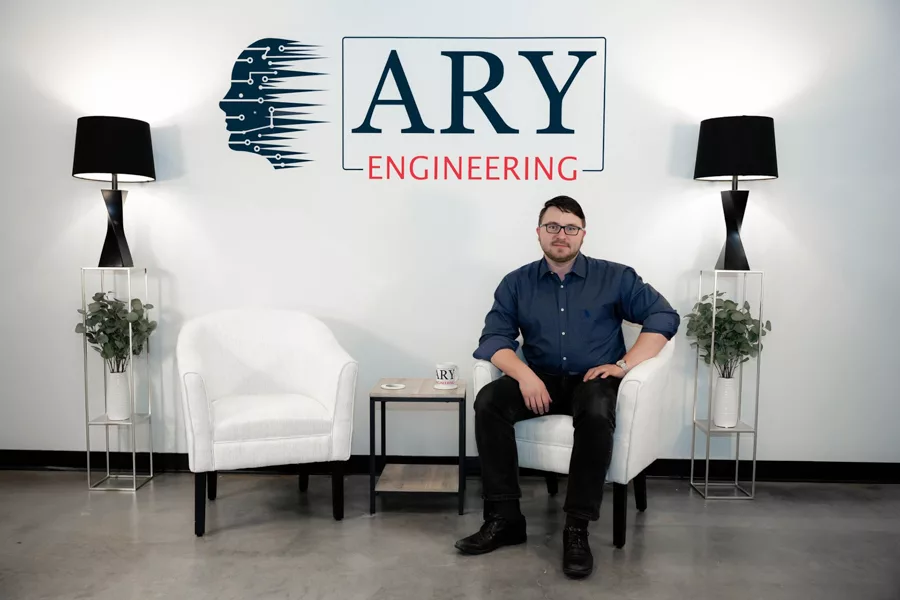
Arthur Baranovskiy, CEO and founder of ARY Engineering, has launched an effort to demand more user control over artificial intelligence.
Photo by Angela ThomasHow many times a day do artificial intelligence summaries of emails or Google searches pop up, unasked for and without the option to turn them off?
How often do users engage with images and videos generated by AI with no tags to identify the content as fake?
For one local business owner, the answer is: too much.
“I’ve never before seen such a big disconnect between the optimistic tech world and the consumers who are disenchanted with the tech,” said Arthur Baranovskiy, founder of the nonprofit ai-Fatigue.org. “What we’ve found is that this particular movement – the kind of wanting caution around AI – it spans every possible demographic. There isn’t a particular age or trade or skill.”
Baranovskiy, who is CEO and founder of Richland-based ARY Engineering, has launched an effort asking technology companies to give users more control over AI usage on their devices.
He isn’t against AI. In fact, the majority of his professional work at ARY is dedicated to data centers.
ARY supports heavy industry with blueprints and diagrams. Often, old facilities have outdated diagrams, and ARY works to update the drawings and can even provide 3D scans of facilities, enabling a virtual walk-through akin to Google Maps’ street view.
Data centers, along with food production, paper plants and other industries, are at the heart of the work ARY does.
But another part of his work is handling sensitive information. Because the projects the 17-person company works on are often proprietary or classified, ARY’s second-highest expense is on security.
When Baranovskiy noticed there were a lot of AI features on the company’s computers that they didn’t choose to install and had no way of removing, he began to be concerned about the safety of that data.
Seeking control
Investing his personal time and money, Baranovskiy began working on a tool called ai-Delete in late 2025. Aimed primarily at Microsoft, he intended to help Windows 11 users turn off AI functions on their computer.
It wasn’t really about “deleting” AI, but giving users the ability to disable the features if they chose.
While the product worked well at first, Microsoft began to make updates as ai-Delete was being developed to make the software nonfunctional, and guidance the company put out to turn off the AI features didn’t work, either, he said. He had to abandon the project as it became too expensive to maintain.
When Baranovskiy wrote about this process in a LinkedIn post, he received a lot of attention, inspiring him to take his frustrations in a new direction: ai-Fatigue.org.
Rather than working on a tool to give users control over AI on their devices, he’s made a petition to major technology companies, like Microsoft, Google, Apple and Meta, to let users take charge.
The goals of the movement are summed up in the acronym CTRL: consent, transparency, removal and lever.
Consent means that companies must get permission from users before using their data to train AI.
Transparency means clearly labeling AI-generated or -modified content.
Removal means giving the option to remove AI features that were added after the purchase of a device.
And lever asks companies to let users completely opt out of AI features.
Just two weeks after launching ai-Fatigue.org on Feb. 3, 600 people had already signed the petition. A week after that, it reached 1,000.
The movement itself isn’t anti-AI, though some petitioners express that point of view, and it isn’t political, either.
Baranovskiy has found AI very useful for drawing conclusions from big chunks of data or in brainstorming sessions, and though it’s prone to hallucinations and not yet useful for drafting, he still thinks that AI and other technology should continue to be developed.
“There is a significant amount of users who do truly use and appreciate AI, but as it stands now, we believe that there is a slight overreach, because people don’t have the choice,” he said.
Passion project
The initiative is a 501(c)(3) nonprofit which Baranovskiy spends his evenings and weekends working on while maintaining his dedication to ARY.
Originally from Moldova, Baranovskiy moved to the Tri-Cities at the age of 3 and is a graduate of Delta High School in Pasco and Washington State University Tri-Cities with degrees in engineering and math. He spent time working at the Pacific Northwest National Laboratory before launching ARY seven years ago.
The company continues to grow, and just opened a location in Boise, Idaho, in January.
Though Baranovskiy has started six different businesses, he hasn’t worked in the nonprofit sphere before. Fortunately, he’s had growing support from the East Coast and is assembling a team that will eventually join the nonprofit’s board.
Voice of the people
The petition isn’t necessarily being sent anywhere – rather, the hope is that, with enough support, the technology companies will take notice and make changes on their own.
Baranovskiy’s goal is to expose the insulated technology companies to what the average consumer thinks.
To that end, a dashboard updated several times each day shows not only the number of petition signers, but how many people from each state have signed, along with a curated list of comments and complaints from signers.
Those who have commented express frustration with everything from the proliferation of fake, inaccurate or deceptive information and images from AI to concerns over water usage, job security and privacy.
“We’re trying to collect kind of the voices of America,” Baranovskiy said. “…The voice of the people is being blatantly ignored right now, and we’ve never seen this in tech, where the feedback from consumers is so apathetically ignored by tech.”
While he hopes that seeing what consumers really think will encourage technology companies to listen and adapt, ai-Fatigue.org cites several relevant legal cases where technology companies overstepped and were fined or required to give users a real choice.
“There’s a lot of legal precedent for things like this happening,” Baranovskiy said. “Users being frustrated by tech overreach, and then eventually we meet in the middle. … This isn’t about limiting innovation. It’s about supporting rights and giving consumers a chance to opt in or opt out.”
Baranovskiy hopes to get the word out about ai-Fatigue.org in every way that he can, seeking engagement with schools, the arts community and more. College students have the option to launch a campus affiliate chapter to help spread the word in their community.
In addition to signing the petition, ai-Fatigue.org has options for donations. While Baranovskiy said the priorities for donations are currently website maintenance and advertising, as the movement grows, he hopes to use the funding to continue work on projects like ai-Delete.