
Hermiston among communities cited in study on data centers, energy use
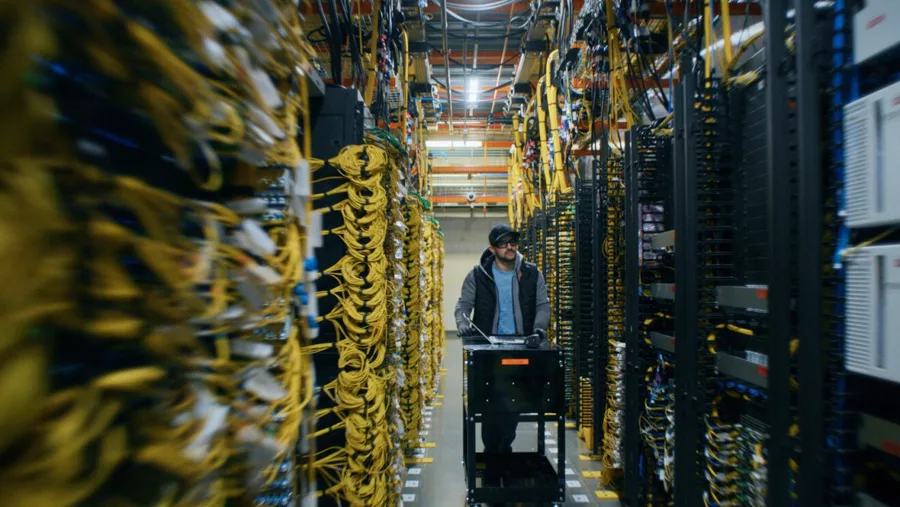
Fidel Contreras began working for Amazon Web Services after high school more than eight years ago. He’s now an electrical field engineer. “One of the most eye-catching things you’ll see as you go further into a data center are the cables that run alongside and above the server racks. These cables are a vital part of the networking equipment, delivering high volumes of data at long distances and allowing the servers to talk to the outside world,” he said in a 2023 AWS news story.
Courtesy AmazonHermiston is featured in a recent study asserting Amazon’s data centers aren’t negatively affecting energy resources in the communities where they’re located and are instead actually lowering costs for residents and bringing other economic benefits.
The study, commissioned by the multinational online retailer and tech giant with Seattle roots, was conducted by consultancy firm Energy and Environmental Economics, or E3. In addition to Hermiston, located south of the Tri-Cities in Oregon, the study looked at communities in California, Virginia and Mississippi that also are home to data centers.
The study’s findings stress utilities and communities need to begin adapting energy rates to match the fast-paced development of data centers but that these facilities otherwise provide a net gain in the communities that host them.
“Across all cases, E3 found that the data centers generate sufficient revenue to cover their costs and, in many instances, generated surplus revenue, providing a potential net benefit to other ratepayers,” according to a release.
Amazon Web Services maintains multiple data center campuses in Boardman, Hermiston and Umatilla. The facilities have brought jobs and increased revenue to those communities.
The Mid-Columbia region also has become a focal point for planned and speculative data center developments, with projects identified in West Richland and Wallula Gap.
The city of Hermiston is betting on a future where such facilities continue to have a strong presence. In early September, the city council took the first step to add 810 acres of the South Hermiston Industrial Park to be within Hermiston’s urban growth boundary with zoning specific to data centers. That same week, city officials provided details about the 20-acre RV park it was developing to provide RV spaces for AWS contractors and employees.
However, data centers require not just land to house servers but also vast amounts of energy to operate as well as water to cool servers. Environmental advocates, skeptics of the artificial intelligence, or A.I., boom and others have criticized the sudden proliferation of the “resource ravenous” infrastructure.
“Even a mid-sized data center consumes as much water as a small town, while larger ones require up to 5 million gallons of water every day – as much as a city of 50,000 people,” according to an October report from the Lincoln Institute of Land Policy.
The E3 study acknowledges that data center energy needs are on a different scale than traditional industrial energy users. However, that has prompted data center developers to invest in electricity grid enhancements and energy sources.
For example, Amazon is the financial backer of another prominent Mid-Columbia project: the Cascade Advanced Energy Facility, which will house an initial four small modular nuclear reactors near Energy Northwest’s Columbia Generating Station north of Richland.
Amazon will have first call on the power from those reactors, but it eases the path for future reactors at the site, increasing much needed power supplies in the region.
And while those power sources and improvements are not yet fully online, Hermiston residents are seeing benefits already: The city recently lowered electricity rates due to the revenue from Amazon’s operations.
“In short, data centers can act as a catalyst for modernizing the grid, improving reliability, and increasing clean energy deployment,” according to the E3 report
Amazon is also seeking to address water resource issues in the region. The company is funding an underground storage project capable of storing up to 1.2 billion gallons of potable water by enhancing existing pumped water storage from the Columbia River.
However, E3’s study acknowledged challenges facing communities courted by data center developers: Data center operators want certainty they can begin operations quickly, flexibility in power sources and assurance of fair energy costs. Utilities worry about the cost of necessary infrastructure and the possibility that projects don’t follow through, leading to sunk costs.
To mitigate those risks, utilities and data center developers will need to innovate, particularly through how power rates are assessed on users.
To continue preventing communities from subsidizing data center power use the E3 report notes that “utilities must keep pace and leverage the full range of tools available to them to mitigate these risks (e.g., updated tariff structures and energy supply contracting), based on key factors such as priorities (e.g., relative risk burden on the utility vs. new customer), market structure (e.g., deregulated vs. regulated), and nature of load growth in their territory.”