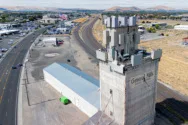
Hermiston adds 810 acres to support future data centers
City also plans RV park with $8M from Amazon Web Services
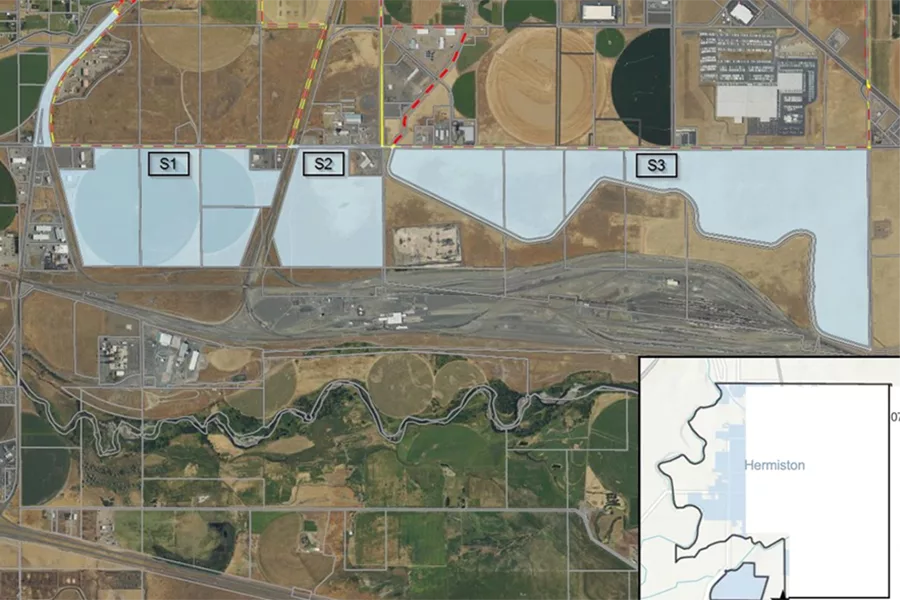
Hermiston recently approved expanding the city’s Urban Growth Boundary by about 810 acres in the South Hermiston Industrial Park to allow for future large-scale data centers.
Courtesy City of HermistonThe city of Hermiston is making more bets that artificial intelligence and big data could transform its economy.
In early September, city council members took the first step to add 810 acres of the South Hermiston Industrial Park to be within Hermiston’s urban growth boundary with zoning specific to data centers, according to a city news release.
That same week, city officials provided details about the 20-acre RV park it was developing to provide RV spaces for contractors and employees of Amazon Web Services (AWS), which has multiple data center campuses in Hermiston, Umatilla and Boardman.
Those moves represent the latest efforts by Mid-Columbia communities to set themselves up to welcome tech companies looking for places to locate the facilities that are powering the use of artificial intelligence, or AI.
“This is a big step for us. It opens our area up to more growth, and it is important that we make those accommodations and circumstances for where jobs can be created,” said Mayor Doug Primmer in a statement about the urban growth boundary.
The urban growth boundary expansion is aligned with Hermiston’s 2024 Economic Opportunities Analysis, which found a shortage of large industrial parcels over 100 acres. The shortage specifically identified a lack of property for the development of hyperscale data centers, which city leaders said could bring significant economic investment.
The boundary expansion also requires the approval of the Umatilla County Planning Commission and Board of Commissioners.
For the RV park project, AWS will provide the city $8 million to construct it with preference for those working for the company to park in one of the 100 RV spaces it will have. The site for the project, acquired via a partnership with Farm-City Pro Rodeo and Umatilla County, is adjacent to the Eastern Oregon Trade & Event Center just south of the Hermiston Municipal Airport.
City Manager Byron Smith told the council the project will allow for additional future uses for the property beyond serving as an RV park. The latest plans for the project show it would also add other amenities such as two additional grass athletic fields.
“I know that many people are concerned about the influx of people to fill new jobs being created in the community, but I’m hopeful that with the job training programs through Blue Mountain Community College that our local constituents will fill those jobs in the long run,” said city councilman Roy Barron in a statement.
Just across the Washington-Oregon border, other communities are taking similar steps to welcome the AI revolution.
A yet-unidentified American company a year ago began discussions with the Port of Walla Walla to potentially buy 500 acres of port land near Wallula to establish a data center campus that could create hundreds of jobs and inject $5 billion into the region’s economy.
In early 2025, the West Richland City Council approved amending the city’s municipal codes to allow data centers to be built in areas zoned as urban transition and light industrial. That change was prompted by a request from Frank Tiegs LLC, which is also developing the Lewis and Clark Ranch mixed-use development in the city.
“Data centers bring daytime jobs, are a significant source of utility and sales tax revenue, and would have the potential of bringing overall taxes down for residents,” Eric Mendenhall, West Richland’s community and economic development director, wrote in a memo to the planning commission.
Such facilities require large amounts of energy and the Mid-Columbia's hydroelectric and other power-generating facilities make the region attractive. However, energy leaders have said much more power generation, transmission and storage capacity is needed to meet projected demand.
There are also questions around the financial investment needed to build the data centers that experts project are needed to fully integrate AI into society.
Vishwanath Tirupattur, Global Head of Quantitative Strategy at Morgan Stanley, said this past summer that the investment bank’s forecast shows tech companies need to spend $3 trillion, or roughly $900 billion per year, by 2028 on hardware, construction and associated costs for AI to reach its estimated potential.
“For reference, the total capital expenditures of all S&P 500 Index companies in 2024 are projected to be around $950 billion,” according to an article published by MooMoo Technologies Inc.