Benton County among sites for newly recorded bee species in Washington survey
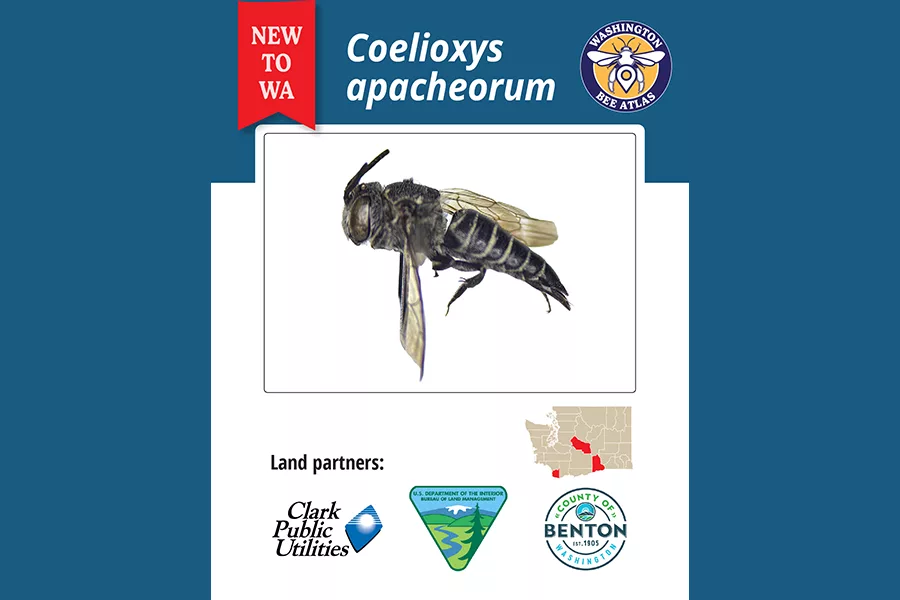
The Coelioxys apacheorum bee has never been recorded in the state before and was found in Benton, Clark and Kittitas counties.
Washington State Department of AgricultureBenton County is among the locations where the Washington State Department of Agriculture’s Washington Bee Atlas identified a bee species never before recorded in the state.
The survey also found new and rare species in other counties, including Grant, Yakima, Kittitas, Chelan, Clark, Stevens, Clallam, Walla Walla, Klickitat, Lincoln, Whitman, Garfield, Spokane and Thurston.
After completing its second full year, the Washington Bee Atlas has collected nearly 30 new or rare bee species statewide. Seventeen of these are considered new state records – meaning they had not previously been documented in Washington. One of those, Coelioxys apacheorum, was found in Benton, Clark and Kittitas counties.
The program also identified 12 species that had not been recorded in the state for at least 50 years, including one last documented in 1882. Volunteers collected specimens from 2023-25 and submitted them to WSDA’s Pollinator Program for identification, a process that can take months or longer depending on the species.
Officials said understanding native bee populations is important for conservation and agriculture. Reliance on honey bees alone presents risks to food production, and native pollinators can improve crop yields for certain plants.
The bee atlas, launched in 2023, is the first coordinated statewide effort to survey native bees since the early 1900s. The program has grown with state funding, partnerships with Oregon State University and Washington State University and more than 150 trained volunteers.
Several of the newly recorded species were found on a mix of public and private lands, including areas managed by Benton County Parks, the Washington Department of Fish and Wildlife, the Washington Department of Natural Resources, Cowiche Canyon Conservancy, U.S. Bureau of Land Management, U.S. Fish and Wildlife Service, Washington State Parks, the U.S. Forest Service, and other public and private landowners.
Program officials said access to land remains critical for documenting bees and are encouraging additional landowners to participate. Volunteers continue to be sought to help survey native bees and their host plants across the state.