Built here, bound for Japan
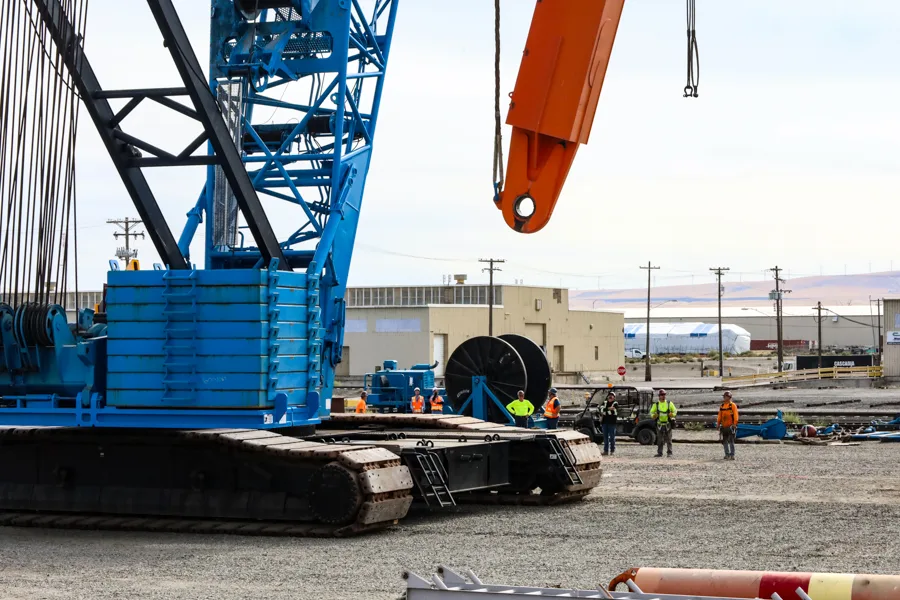
A crew at Lampson International works in late September to lay down part of the company’s largest crane – a process which takes 10 weeks and involves other, smaller cranes.
Photo by Rachel VisickFor nearly a decade, the massive crane has been one of the Tri-Cities’ fixed points.
It rises hundreds of feet above the ground and has become a part of Pasco’s skyline, like the rivers and hills beyond it.
Now it is coming apart.
Piece by piece, the crane is being dismantled, its sections prepared for a journey across the Pacific to Japan.
The towering orange and white crane was manufactured and built here in the Tri-Cities by Kennewick-based Lampson International for a nuclear power plant in Japan. But before it could make that journey, an earthquake and tsunami triggered a disaster at the Fukushima power plant in 2011 and stalled the country’s nuclear program.
It’s been stranded in the Tri-Cities ever since, waiting while the industry it was built to serve waited, too.
Now Japan’s nuclear power plants are being recommissioned so the crane built to move things will finally get to do the job it was designed to do.
Part of the skyline
The Lampson Transi-Lift LTL-3000 crane stands 520 feet at full height, as tall as Seattle’s Space Needle’s observation deck, though its proximity to the Tri-Cities Airport means it stood here at about 300 feet, about the height of the Statue of Liberty.
It is the largest crane Lampson has built, with a capacity of 3,000 tons – or 6 million pounds.
Lampson began manufacturing the crane for Hitachi, now Logisteed, in 2010, a process that took 22 months, with commissioning and testing extending into 2014.
Dismantling the crane will take about 10 weeks, then the boom sections, stinger, mast and crawler transporters will get a fresh coat of paint before being packaged for shipment.
The disassembled crane will travel by barge to a port closer to the mouth of the Columbia River, where it will be loaded onto a ship bound for Muroran, Japan. From there, it will be loaded onto a barge once more to travel to the Ohma nuclear site.
The crane is scheduled to be reassembled in Japan in September 2027, a process that will take 10 weeks, just like the disassembly.
In Pasco in late September, Lampson Crane employees were working on a critical part of disassembly: lowering the triangle.
A crawler crept backward, while winches let out lengths of wire. Smaller cranes stood by to help with the process.
With the crane’s large boom already on the ground, lowering this component was a critical step to bring everything close to the ground, making disassembly much easier, said Bruce Stemp, director of safety for Lampson Crane.
Though Lampson has 300 employees worldwide, it takes only a small crew of 12 to do the work, which consists of slow, small movements accompanied by the beeping and whirring of machinery.
“In the heavy lift industry, if things are happening fast, something’s not right,” Stemp said.
A Japanese contingent from Logisteed is on the ground, too, observing the process. Some are staying only a few days, while others will be on site until November.
They’ll need to reassemble the crane once it reaches its destination. Lampson Crane will dispatch a couple of technicians to help guide and oversee the reassembly process.
Once the crane is on the ground, all of the pieces will come apart, Stemp said. The pin-together boom is a little bit like a tinker toy, he said, and each of the pipes that form it can come apart. If the whole thing was welded together, it wouldn’t be able to be shipped anywhere, he said.
It’s designed so that it can break into pieces small enough to be transported by a conventional truck. It would take about 140 to 150 truckloads, but only needs about four or five barges, which is why water transportation is preferable as the crane ships out, though Stemp said cranes seldom get to their final destination without some travel by road.
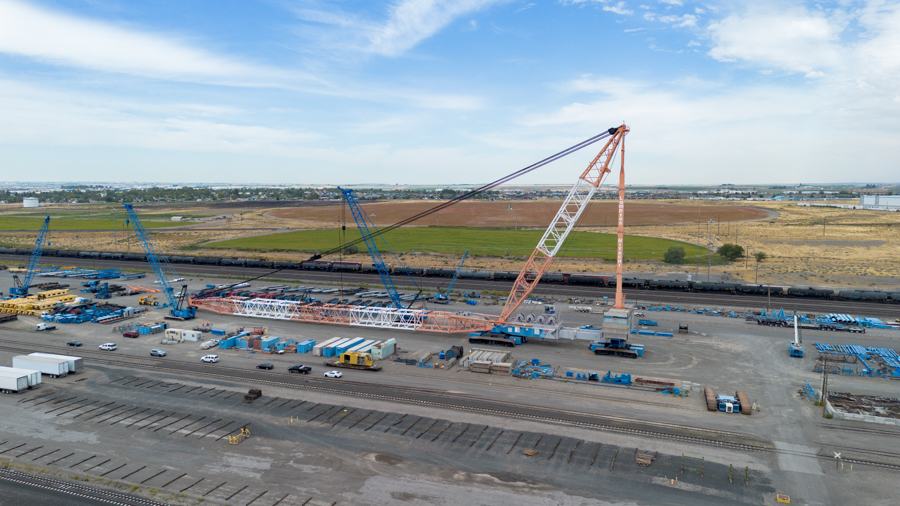
Lampson Crane’s massive Transi-Lift LTL-3000 is being disassembled to be shipped to Japan, where it will finally be put to use.
The crane dominated Pasco’s skyline for more than a decade.
Custom designed
Logisteed already owned a 2,000-ton capacity crane from Lampson, but needed another with even more lifting capacity, so Lampson custom built the LTL-3000 for them.
The LTL-3000 is made of high-strength steel and was built from start to finish at Lampson, Stemp said. It still uses the same Transi-Lift design, he said, “we just make it bigger and better.”
The company does its own manufacturing rather than using premade parts.
Kate Lampson, director of marketing at Lampson International, said that due to the new crane’s larger boom, crews had to design a new front crawler, built in three pieces instead of just one. The size presented a fabrication challenge, but the company was able to overcome it.
Another first that came with the LTL-3000 was the use of winches powered by hydraulic motors. Usually, winches are powered by chains and gears, and the hydraulics make operations safer and easier, Stemp said.
Since the crane was constructed, it has only been lowered for testing or high winds.
The crane is built to work in winds of up to 44 miles per hour, though Lampson said it’s recommended the boom be lowered if winds are stronger than 60 miles per hour for a sustained period. Japanese safety requirements are more stringent than in the U.S. or Europe, she said.
The crane also has had to be “exercised” at times, which included moving the boom up and down, raising and lowering the hoist, and crawling forward and backward, Stemp said. These workouts helped keep the crane in good shape and ready to be taken down and shipped at any time.
“It’s still for all intents and purposes a brand-new machine,” he said.
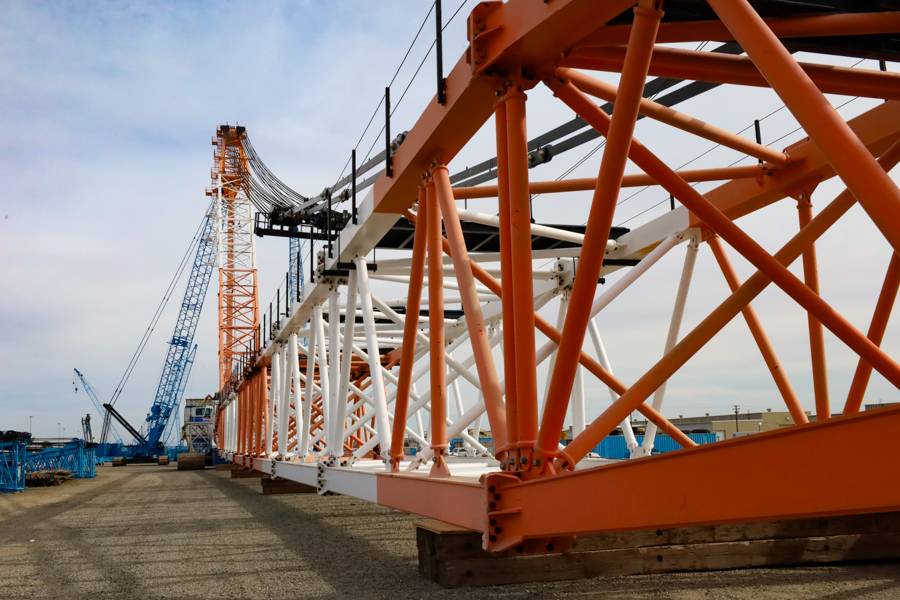
The Lampson Transi-Lift LTL-3000’s massive boom lies on the ground in late September. At full height, the crane is 520 feet tall.
| Photo by Rachel VisickPut to work
Soon, the crane will be gone, and there’s a feeling of bittersweetness about the crane leaving, Stemp said.
“This machine kind of changed the skyline of the Tri-Cities for a while,” he said, and Tri-Citians are likely to notice when it’s gone.
The crane has also been a bit of a showpiece for Lampson, putting the company’s manufacturing capabilities on display right outside their headquarters. It’s a little bit like “part of the family,” Stemp said.
But the employees are excited to see how the crane performs now that it will finally be put to work. They “really want to see it get out there,” he said.