PNNL researchers reinvent the rivet
New PNNL technology could change how metals are joined
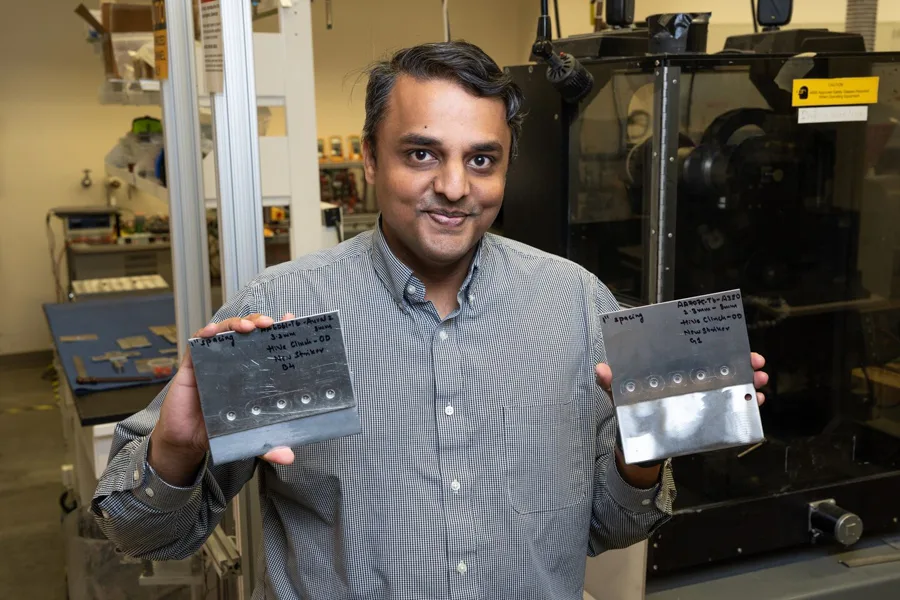
Vineet Joshi, chief materials scientist and team lead, holds up metal joined together by a new High-Velocity Joining method of clinching.
Photo by Andrea Starr | Pacific Northwest National LaboratoryAs metals used in the automotive industry and other areas become more advanced, they also pose more challenges in joining them together.
A team of scientists at the Pacific Northwest National Laboratory is finding new methods of holding these metals together to boost manufacturing efficiency and lower costs, and the technology has already won an award.
Chief materials scientist and team lead Vineet Joshi said that many new materials are being developed for automotive applications. Often, they are low ductile materials, which are very brittle, or very high-strength materials – both of which make it harder for traditional joining methods to perform well.
While thinking about how to address the challenges of marrying these materials, he considered the way a bullet would penetrate a sheet of metal. That led him to High-Velocity Joining, or HiVe, a process that uses a striker propelled at a high velocity to combine the two materials.
The method is special because it mimics traditional joining techniques like self-piercing, riveting, nailing or clinching, but the process creates a metallurgical bond.
That means that there’s an atomic-level connection between the two materials, giving the joint more strength than one that’s merely mechanical.
HiVe accomplishes this with high velocity and high pressure.
It’s not the same as explosive bonding, where two sheets of metal come together at more than 300 meters per second and bond, Joshi said. Instead, HiVe hits a sweet spot at between 40 to 300 meters per second, he said, making for a fast and controlled process.
The speed, combined with high pressure, creates heat the way you can warm up your hands by rubbing them together, Joshi said.
Unlike traditional joining methods like welding, the heat used in HiVe is much more localized, meaning it cools off quickly, said Mayur Pole, a materials scientist who joined PNNL as a postdoctoral researcher.
HiVe’s process takes microseconds compared to a few seconds. And whereas traditional riveting requires preheated and predrilled holes, HiVe doesn’t need that to make joints just as strong.
“The biggest advantage that we are seeing is we can join material stacks that the traditional joining systems couldn’t essentially join,” Joshi said.
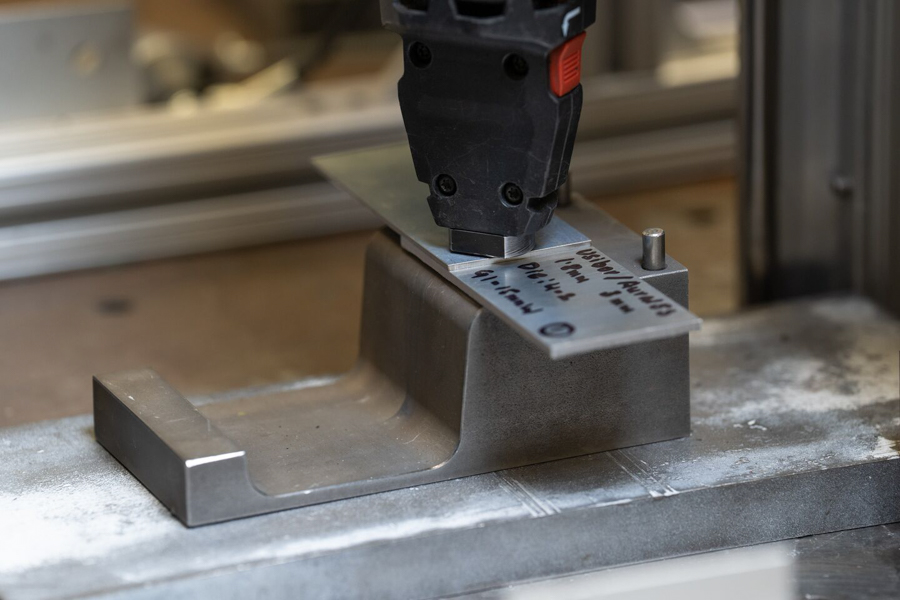
The tip of the HiVe instrument set against metal pieces and the backing die, ready to operate.
| Photo by Andrea Starr | Pacific Northwest National LaboratoryAuto industry savings
The team has a test lab where joined materials are pulled under different conditions to test the strength of a bond. The scientists follow industry standards to know what types of tests to perform based on different applications.
In addition to its metal joining abilities, HiVe has other advantages to offer automotive manufacturers, its primary target.
In the manufacturing industry, “if it is cheap or fast, they may not be good. If it is good or cheap, they may not be fast. If it is good or fast, they may not be cheap,” Pole explained. “But we are in the ballpark of all these three things.”
The energy required for HiVe is low, meaning it can be more energy efficient depending on the materials being joined.
With the equipment that the team is developing right now, one robot would be able to quickly switch velocities and make different types of joints, Joshi said. That means that auto manufacturers might be able to save floor space by using just one robotic arm rather than moving stacks of metal through multiple stations.
There are also potential cost efficiencies. HiVe’s ability to perform clinching – or creating an interlock between two metal sheets – with a metallurgical bond allows strong joints to be made without using rivets. That can save the cost of an extra piece in the process.
Joshi said that even if a rivet only costs 5 cents, each car or truck has more than 2,000 rivets, multiplying savings exponentially as manufacturers churn out hundreds of thousands of vehicles.
“Every cent counts when it comes to automotive production,” Joshi said. “And that’s where HiVe is very attractive.”
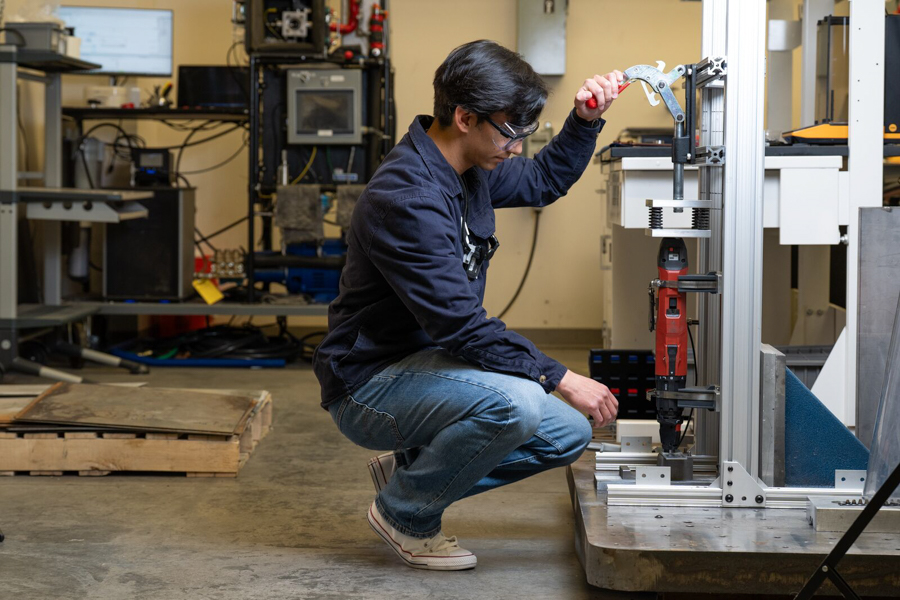
Lab technician Jorge Ortiz sets up the HiVE instrument for a clinching test. HiVe uses high speed and pressure to join dissimilar metals with less energy than current manufacturing techniques.
| Photo by Andrea Starr | Pacific Northwest National LaboratoryFusing science and industry
Although the PNNL team has worked out the HiVe technique, it’s still working with industrial collaborators to develop the machinery to perform it.
The scientists currently have a simple setup that they’ve used for the joinings they’ve made so far, but Joshi said the team is working to build something that could go on a robot or a C-frame so that the technology could be transferred to automotive companies.
Already, HiVe has earned an award. The technique was one of five PNNL innovations to win one of R&D World magazine’s R&D 100 awards in 2026. PNNL has won 135 of the awards since 1969, when the lab began submitting entries.
While HiVe was developed for automotive applications, Joshi said that going forward, the team is planning to look into aerospace applications and other heavy industries.
“We are here to bridge the fundamental science to the applied world,” Pole said. It’s what gets the team excited about its work.
Joshi said he enjoys the aspect of commercializing something that they have worked to develop, taking the concept of how atoms bond at a small scale and using that to make a car.