Backed by local investors, Tri-Cities biotech startup eyes global market
And its CEO wants to keep company local
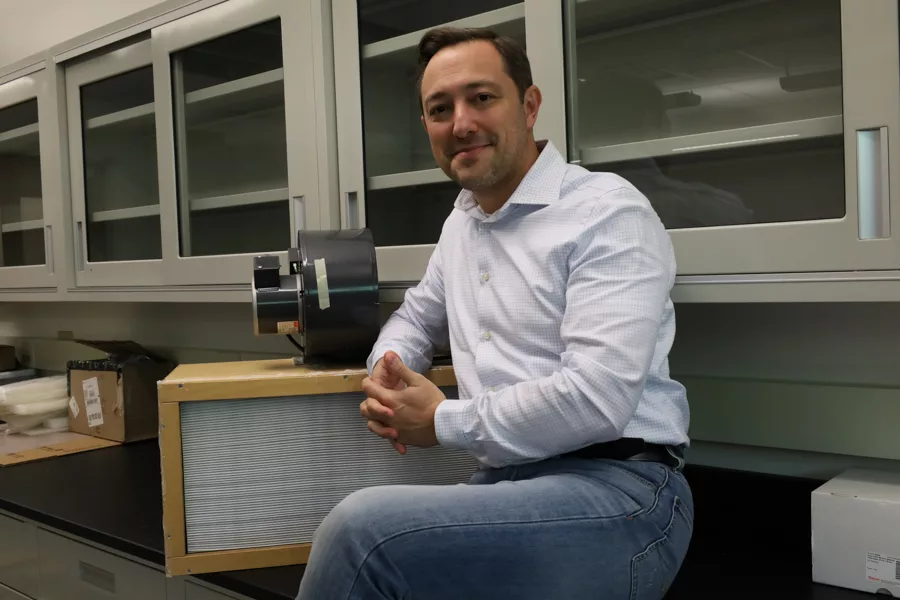
Andrey Pinchuk, CEO of LiveGrow Bio, sits with one of the original pieces of equipment the group cobbled together when first starting out in his father’s garage.
Photo by Rachel VisickAndrey Pinchuk will tell you the early days at his biotech company weren’t glamorous. He was working out of his father’s garage in the Tri-Cities, running experiments on makeshift equipment, trying to prove that microbes – the kind that already exist in nature – could replace the chemicals that farmers spray on their crops.
That was more than a decade ago. Today, LiveGrow Bio has cracked a problem the agriculture industry has struggled with for years – how to make microbes work as practical, affordable alternatives to chemical fertilizers and pesticides.
Backed by local investors, LiveGrow Bio is now fielding inquiries from about 30 companies worldwide, has earned international recognition from a Swiss startup accelerator and is working to raise more than $8 million to scale up.
The Tri-Cities, it turns out, was the right place to grow it.
Local investors, including the Port of Benton, Fuse Fund and the Tri-City Development Council, or TRIDEC, have been key to keeping LiveGrow Bio rooted here – and Pinchuk wants it to stay that way.
“I want to make sure the Tri-Cities remains our innovation hub, our headquarters,” Pinchuk said.
How it started
The premise behind LiveGrow Bio is straightforward: Agriculture relies heavily on chemicals, but microbes already exist in nature and help plants grow. So why weren’t they being used as a safe, natural alternative?
The question drove Andrey Pinchuk’s late father, Grigoriy Pinchuk, a former Pacific Northwest National Laboratory microbiologist, and his colleague, plant physiologist Alan Wicks, to start the company in 2013 after the agricultural product company they were working for shut down local operations.
The challenge was getting microbes to work practically at farm scale. Three problems stood in the way: cost, shelf stability and efficacy. Unlike chemicals, microbes are living organisms – sensitive to storage conditions and prone to losing effectiveness when processed for longer shelf life.
LiveGrow Bio spent six years, from 2013-19, and roughly $300,000 of its own money solving those problems before becoming an official company in 2019, patent in hand. It also eventually rented lab space at Energy Northwest’s Applied Process Engineering Laboratory, or APEL.
Finding footing
Just as LiveGrow Bio was ready to approach investors, Covid-19 hit and froze the funding landscape.
Pinchuk, a self-described “serial entrepreneur” who immigrated to the U.S. from Ukraine at age 12, turned to the Port of Benton for help.
The port connected him with Marty Conger, managing partner for Fuse Advisors LLC, which manages Fuse Fund, a local investment group dedicated to funding Tri-Cities startups.
LiveGrow Bio ultimately received $400,000 through the fund.
“It was a huge boost,” Pinchuk said.
Conger said there are several reasons for investing in Pinchuk’s startup: “It is Andrey’s passion for it, it’s his novel approach that he has patented that I think gives him an edge over competitors, and it is the fact that we like to see a business like that be located in the Tri-Cities.”
The funding helped LiveGrow Bio get back into the APEL lab space and enter MassChallenge Switzerland, a prestigious global startup accelerator. The company emerged as one of the program’s winners, earning capital, and, perhaps more importantly, international visibility.
Pinchuk said that was a big break for the startup.
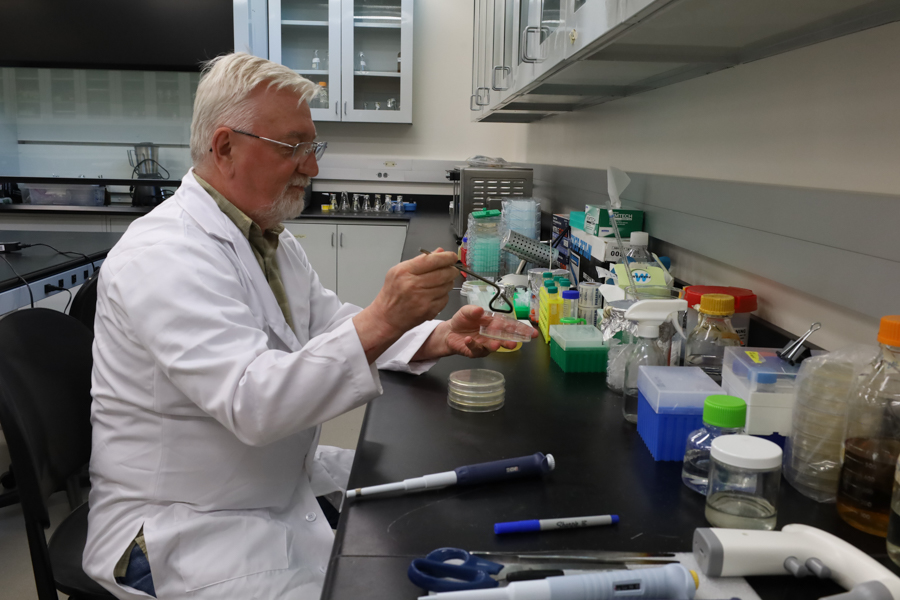
Sergey Stolyar, head of product formulation for LiveGrow Bio, works in the company’s lab space. The company helps develop microbes for use in agriculture.
| Photo by Rachel VisickPicking up speed
The company faced a significant setback when Pinchuk’s dad died in 2024, but LiveGrow Bio’s work has been ramping up since then.
They began getting clients, attending conferences and building key relationships.
This year, TRIDEC invested $250,000 and helped connect Pinchuk with LiveGrow Bio’s new lab space at Washington State University Tri-Cities’ Institute for Northwest Energy Futures building at 2892 Pauling Ave., Richland.
Pinchuk said it tripled their previous lab space, and the setup was better for biological research, too.
The company’s model has also sharpened. Rather than selling a specific product, LiveGrow Bio offers its technology and 14 years of expertise to other companies, helping them develop and manufacture microbes and create custom biological products.
The timing couldn’t be better. Pinchuk has seen a growing interest in biotech in the past few years, and it’s caused a demand for their services, too.
“Now everybody wants biologicals, but they don’t know how to do it,” Pinchuk said. “And so we had this meeting, we said, ‘OK, we know how to do it.’”
A local future
With a four-person team and 30 potential clients, LiveGrow Bio is working to hire and scale. TRIDEC and Fuse Fund are collaborating to provide bridge funding while the company pursues a larger $8 million raise.
When the two-year lease ends, Pinchuk hopes to build his own facility combining research, development and manufacturing – and he wants it in the Tri-Cities, though other companies may court the startup to locate manufacturing elsewhere.
The region’s agricultural diversity makes it ideal for product testing, and the presence of PNNL adds research credibility. Pinchuk sees that combination as attractive not just for LiveGrow Bio, but for other biotech companies as well.
Conger also wants him to stay and grow locally: “Andrey and LiveGrow Bio are going to stimulate a fair amount of visitors to the Tri-Cities to come see what he does.”
For Pinchuck, the goal is bigger than his own company.
“I think it’s going to be a great thing for this area … and ultimately, as part of our operations, I’m hoping to fix the local food production as well, because as we test sustainable solutions for farmers, it will naturally help our local agriculture,” Pinchuk said.