AI could help PNNL pack more nuclear waste into glass
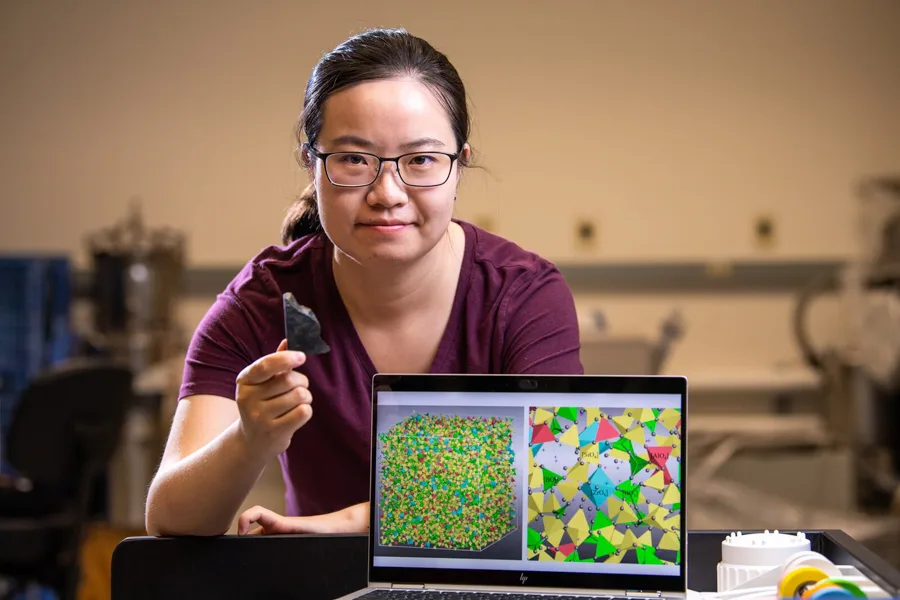
Pacific Northwest National Laboratory Materials Scientist Xiaonan Lu is the lead author of a paper discussing how artificial intelligence can help pack more waste into glass.
Courtesy Andrea Starr/PNNLWith the help of artificial intelligence, research from scientists at the Pacific Northwest National Laboratory in Richland could help optimize the vitrification of nuclear waste at Hanford and other nuclear sites.
While Hanford’s Waste Treatment and Immobilization Plant, also known as WTP or the vit plant, is responsible for turning the site’s nuclear waste into glass, PNNL plays a support role for the facility, developing algorithms, new technologies and troubleshooting.
A recently published paper looks to improve the vitrification process by increasing the “waste loading” of the glass – or getting as much waste into glass as possible. To do that, the team created AI models to recommend the right “recipe” for the glass, depending on waste composition.
Ultimately, implementing the research would make the vitrification process faster and cheaper.
“Even small gains by about 1% to 2% in terms of waste loading can save the taxpayers,” said José Marcial, a material scientist as well as embedded staff at the WTP. “One estimate was over $600 million over the course of the lifetime of the mission.”
PNNL’s work in increasing the “waste loading” of glass could help the Hanford site and other sites around the country to process waste more efficiently, saving money over time.
| Courtesy Andrea Starr/PNNLMaking glass
Since the vit plant started processing waste in October 2025, it has processed 100,000 gallons of tank waste, a milestone the plant hit in May.
But that’s just a small fraction of Hanford’s 56 million gallons of waste stored in 177 underground tanks.
Marcial described Hanford as “very unique in that we have so much volume of waste and it’s so variable.”
Other sites may have smaller amounts of waste and can study each batch before turning it into glass. But Hanford’s waste gets transferred in 1,600-gallon batches, Marcial said, and there’s a limited amount of time to develop additive mixtures so the waste can be processed as glass.
While waste could in theory be melted and turned into glass on its own, “you would make a really bad glass,” he said. So, other materials are added to make the glass more durable in the long run, more efficient to melt and easier to pour.
Difficulties come in when considering that “from batch to batch, there’s a lot of variability,” Marcial said, not only in terms of what the waste is made up of, but also the potential properties of the glass.
That’s what makes optimizing each batch to have the most waste in glass difficult. But it’s exactly this complex environment where AI’s speed and power can prove useful.
Typically, waste makes up about 20% to 30% of the glass, Marcial said. The models PNNL researched allow that percentage to increase, depending on the waste, while maintaining the durability and processability of the glass.
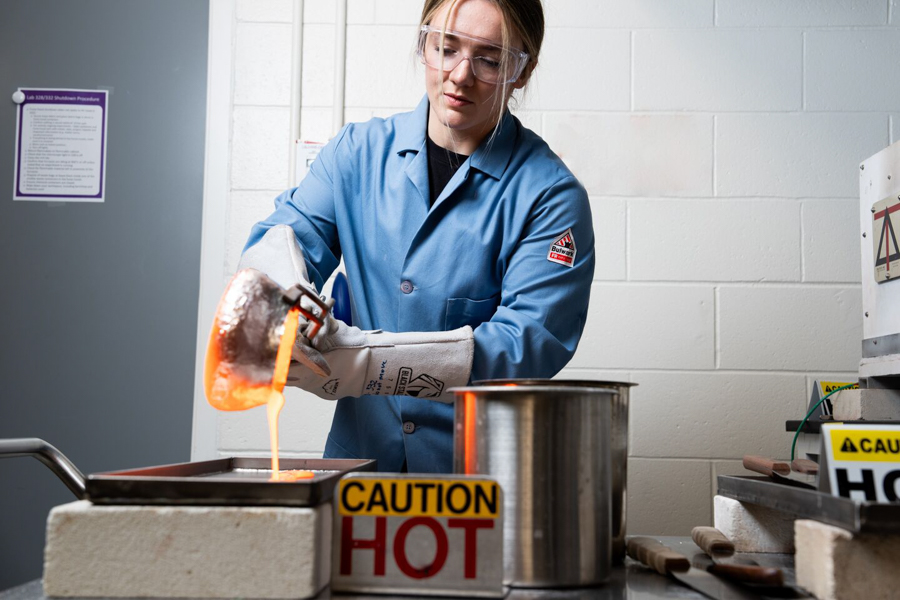
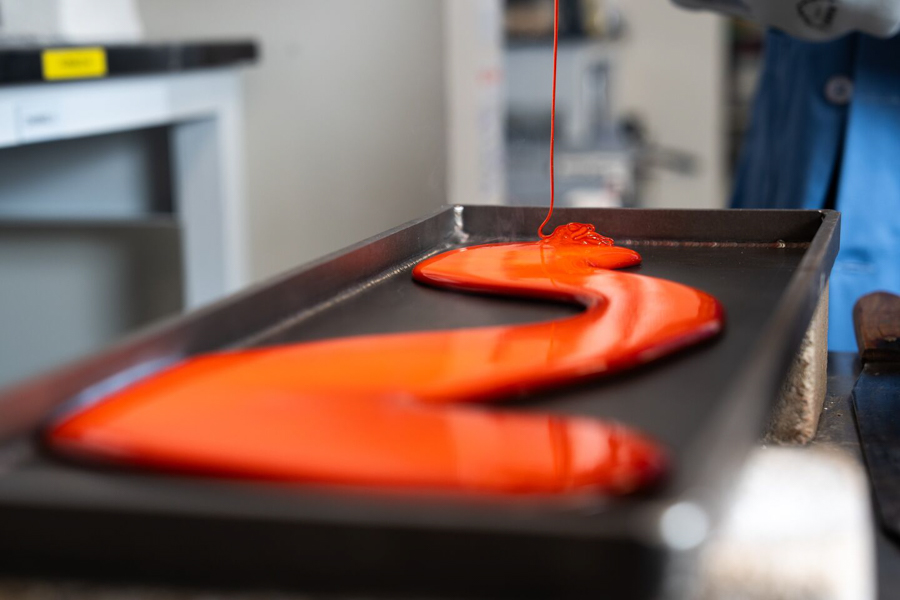
Materials Scientist Jess Rigby pours demo glass. Artificial intelligence can help predict what materials to add to a batch of waste in order to achieve durable glass with a maximum of waste.
AI models
The researchers have collected a database of glass properties and compositions, which they used to train a machine learning model. Then, researchers actually produced the glasses suggested by the model.
The glasses were tested, then the model was retrained based on the results “because some of them actually didn’t perform as well, or some of them performed better than the model suggested,” Marcial said.
Implementing the model into the vitrification process would be similar to the algorithm already used, but more advanced.
Operators running the plant would measure the chemistry of the waste and give that information to the model, which would then come back with the amount of additives to use for a certain amount of waste.
Then, the operators physically do that and double check that the mixture is meeting the right properties depending on how much they measured out.
The way the new research makes use of AI isn’t an isolated event; it’s part of PNNL’s work to leverage the technology in problem-solving as part of the U.S. Department of Energy’s Genesis Mission.
The program intends to bring together the country’s 17 national laboratories to use AI to pursue breakthroughs in energy dominance, discovery science and national security. In February, DOE identified 26 science and technology challenges to advance the Genesis Mission, including “transforming nuclear cleanup and restoration.”
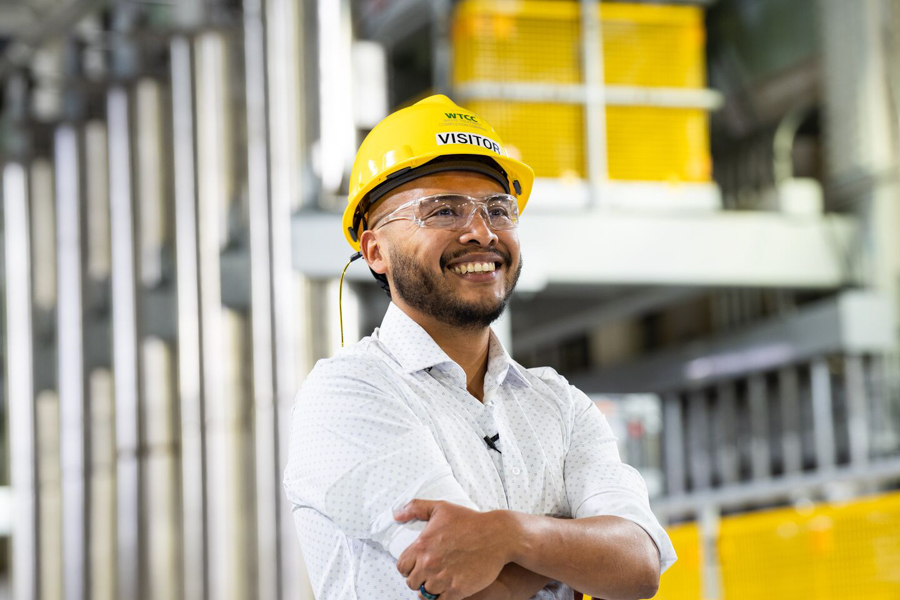
José Marcial, a material scientist at PNNL and embedded staff at the Waste Treatment and Immobilization Plant, said that AI “recipes” could help optimize glass composition.
| Courtesy Andrea Starr/PNNLNext steps
Now that a paper has been published – its main author is Xiaonan Lu, PNNL materials scientist – the technology can be implemented at Hanford and other sites, but it’s up to the contractor to accept the research and then have the models built into the vitrification process.
“As a nuclear facility, you have to be pretty careful with that kind of thing,” Marcial said. “So from a scientific exercise, it’s a pretty mature model now, but in terms of implementation in an actual nuclear facility, it might need further technological development and incorporation” into the day-to-day operations of the facility.
While the paper focuses on low-activity waste, there’s also high-level waste, which can have issues when being melted when parts of the waste crystalize or form a sludge that plugs the melters. Solving the problems involved with high-level waste could be a future implementation of the models created in this study.
“We’re hoping to continue to work with the WTP to continue to develop new models and help them kind of forecast things before they become a challenge,” Marcial said.