Richland schools weigh smaller $103M bond
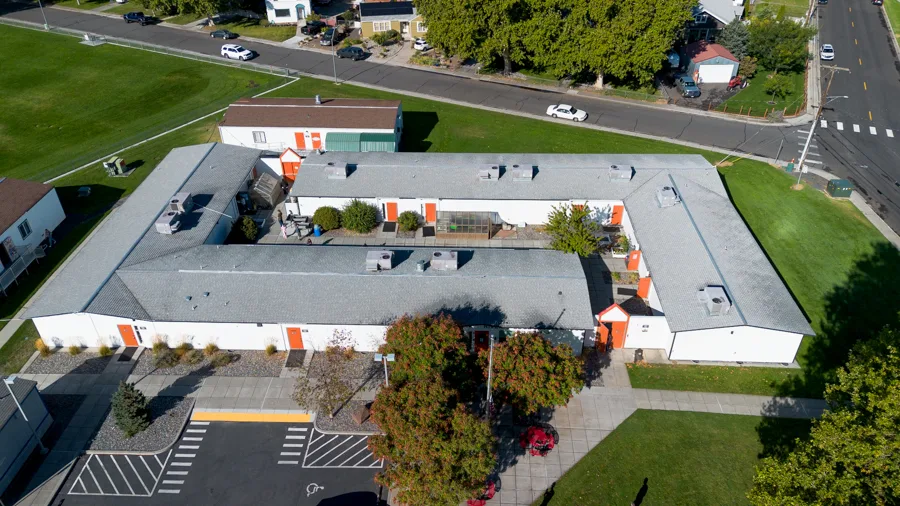
At River’s Edge High School, aging portables would be replaced with a durable modular building, the task force proposed to the Richland School District board.
Photo by Nathan FinkeThe Richland School District may ask voters to approve a $103 million bond in February to modernize aging schools and address urgent maintenance and safety needs.
A community task force recommended to the Richland School Board a scaled-back proposal on Sept. 22 after reviewing district facilities and surveying voters about their priorities and willingness to pay higher property taxes.
The proposed bond would replace the district’s capital levy and increase property taxes by an estimated 13 cents per $1,000 of assessed value, or about $85 annually for a $500,000 home.
The proposal is significantly smaller than the $314 million bond voters rejected in November 2024, which included construction of a third comprehensive high school. With enrollment leveling off, the district no longer sees an immediate need for another high school.
Instead, the new proposal would focus on modernizing Chief Joseph Middle School, replacing aging portables at River’s Edge High School, upgrading roofs and heating and cooling systems at several schools, and improving safety and security district wide.
The school board will consider whether to place the measure on the February ballot at its Oct. 13 meeting. Results from the meeting were not available at press time.
Recommendations
The district formed the Community Facilities Task Force in the spring of 2026 to develop a long-range facilities plan. The roughly 30-member task force included community members, parents, staff and student representatives.
The committee met monthly from April through September, reviewing building condition assessments, a structural engineering evaluation, birth rate and enrollment trends, school-by-school capacity, preventative maintenance spending, and state construction assistance estimates.
A spring stakeholder survey and staff focus groups helped inform the committee.
“From the very first meeting, this committee asked one question over and over: What do our schools truly need, and what is the most responsible way to pay for it?” said Matthew Parkhill, the task force’s chairman, in a statement.
After the group drafted its initial recommendations, the task force “asked the community to check our work,” Parkhill said in a statement.
The group hired Rushlight Research to conduct a phone survey from Aug. 31 to Sept. 2 to gauge community response.
“The survey confirmed our priorities, and when it told us to sharpen the pencil, we did. The result is a plan that takes care of the buildings we already have, preserves what this community values about Chief Joseph, and asks as little of taxpayers as possible,” Parkhill said in the statement.
Facility needs
Chief Joseph, originally built in 1951, hasn’t seen a major renovation in more than 30 years. The committee identified modernizing the school at 504 Wilson St. as the most urgent facility need.
The process will be cheaper than demolition and replacement, preserving the school’s auditorium and other amenities, including recent roof and HVAC investments made in the building.
The project is expected to cost $48.3 million locally, and it would also qualify for about $12 million in state construction assistance.
That state funding would be lost if the renovation is delayed, according to the task force.
At River’s Edge, located at 975 Gillespie St., aging portables would be replaced with a durable modular building, similar to the approach used at Three Rivers Homelink, an alternative school at 1710 Van Giesen St.
The high school’s existing portables are too small and have insufficient bathrooms, according to the task force.
That replacement project would cost $27.56 million.
Roof, boiler, chiller and HVAC replacements at Richland High School, Hanford High School and the district’s Early Learning Center are also included on the list of priorities.
Safety and security upgrades such as districtwide cameras and an emergency notification system will be implemented, as well as traffic safety and access improvements at the Early Learning Center and lighting, fencing and cameras at William Wiley Elementary in West Richland.
Footing the bill
The slate of recommended projects totals about $103 million.
The draft recommendations were initially estimated to cost $114.3 million, but when the August community survey didn’t show support for plans to move the bus barn and improve parking at Richland High, the committee moved that nearly $10 million project to a list of long-term needs.
The task force recommends the district consider a future replacement bond around 2034 to address these needs. This would be timed as existing bonds are paid off so that the tax rate doesn’t increase, according to the district.
Third high school?
Although the Tri-Cities’ population has grown since district voters rejected the 2024 school bond, student enrollment has flattened, meaning there is no near-term need for a third high school.
High school enrollment is about 3,600 to 3,700 students, below the 4,200-student capacity of Richland and Hanford high schools.
“The last big bond issued that we had we were looking at a third high school because the demographics predicted that we’d be bursting at the seams – and we’re not,” said Brian Palmer, a committee member and teacher at Hanford High, during the group’s Sept. 22 presentation to the school board.
The district’s schools are at about 90% capacity on average, so there’s no real need to either add any new schools, committee members said during the presentation.