Cannabis industry tries to roll with uncertain future
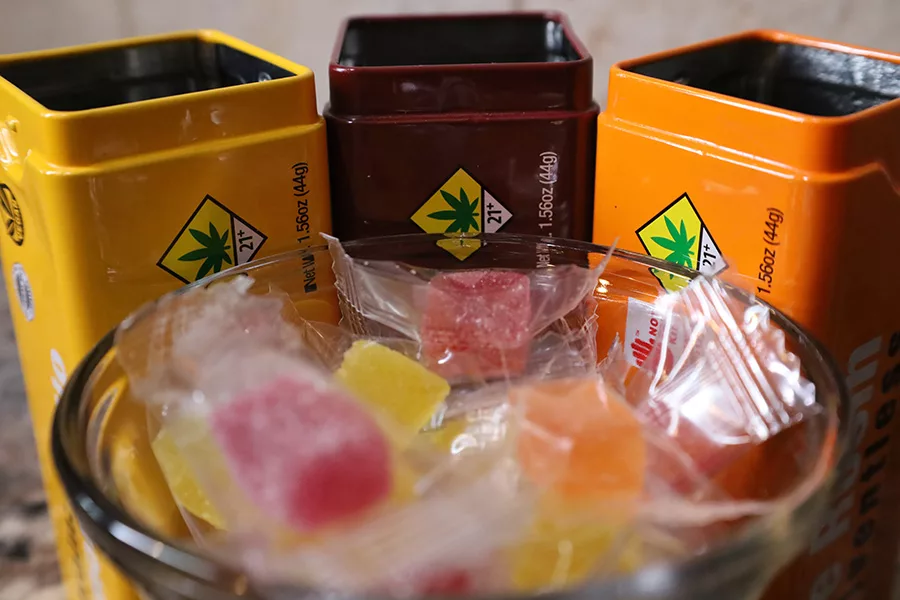
Cannabis-infused gummies are among the plethora of products sold in the state's licensed recreational cannabis dispensaries.
Photo by Nathan FinkeThere was only one other customer in Green2Go’s Finley dispensary one mid-October day, but the lull didn’t bother the staff. There was a flurry of customers all week and this was the first chance they’d had to catch their breath.
That’s the nature of the business, though, one staff member said – some weeks are nothing but slow while others see a steady parade of customers coming in for edibles, flower or other cannabis-infused products.
“It’s volatile, it’s like an ocean,” the staff member said.
But many in the state’s cannabis industry are wishing the seas weren’t so tumultuous. Sales from licensed producers, processors and retailers have dropped every year since 2021. Processors and producers statewide – those who do everything from growing cannabis to turning it into edibles and other infused products – have seen the steepest decline, going from a peak of $2.2 billion in sales in 2021 to less than half that in 2024.
Those growing and processing in Benton County have reported pre-tax sales of just over $3.5 million for the first eight months of 2025, about half what was sold in the same period in 2024, according to Top Shelf Data, a data analytics company that publishes cannabis industry data reported to the state.
“The failure rate among cannabis businesses has been pretty dramatic,” Vicki Christophersen, executive director of the Washington Cannabusiness Association (WACA), told the Tri-Cities Area Journal of Business. “It has been very turbulent.”
The Tri-Cities are something of a safe harbor for retailers. Cumulative retail pre-tax sales for shops located in or immediately outside of Kennewick, Pasco, Richland and West Richland haven’t dropped below $30 million since 2020. The six cannabis retailers currently serving the metropolitan area tallied $33.8 million in sales in 2024, a nearly 10% increase over the year prior.
Despite that bright point, cannabis business owners and their advocates say that a variety of pressures – an oversupply of cannabis, the still present illicit market and competition from now federally-permitted hemp-derived products that sidestep state regulations and safety precautions – threaten to capsize the industry entirely.
“You try to hunker down and weather the storm and hope there’s some right siding of it,” Rodney Boast, co-owner of Stevens County-based Ray’s Lemonade, told the Journal.
Legal for 13 years
Washington state voters legalized cannabis for recreational use by those 21 and older in 2012, making the state the first to allow such use in the country. That vote ushered in licensing for retailers, producers and processors; a possession limit of up to 1 ounce of marijuana for consumers; blood-THC levels for assessing those driving under the influence of an intoxicant; and development of extensive regulations and tax rates.
As of 2025, the industry statewide is valued at $1.1 billion with tens of thousands working in roles ranging from retail sales and business managers to harvesters and processors.
Benton and Franklin counties and most of their incorporated cities have enacted moratoriums on marijuana retailers as well as producers and processors. However, those bans went into place after dozens of businesses were already established and thus allowed to continue operating.
Despite restrictions, cannabis is a big business in the region.
Benton City and Prosser have allowed marijuana businesses to operate since state legalization, with Benton City, population 3,845, becoming a hub of growing and processing operations. Pasco began allowing cannabis retailers in 2023.
In July 2025 – the most recent month Top Shelf shows sales data – Nirvana Cannabis Co., which operates several dispensaries around the state, had the 11th highest monthly retail sales statewide, recording $748,055 at its location outside West Richland.
Spokane-based Lucky Leaf had $571,832 in pre-tax retail sales that month at its west Pasco store, placing it at No. 22.
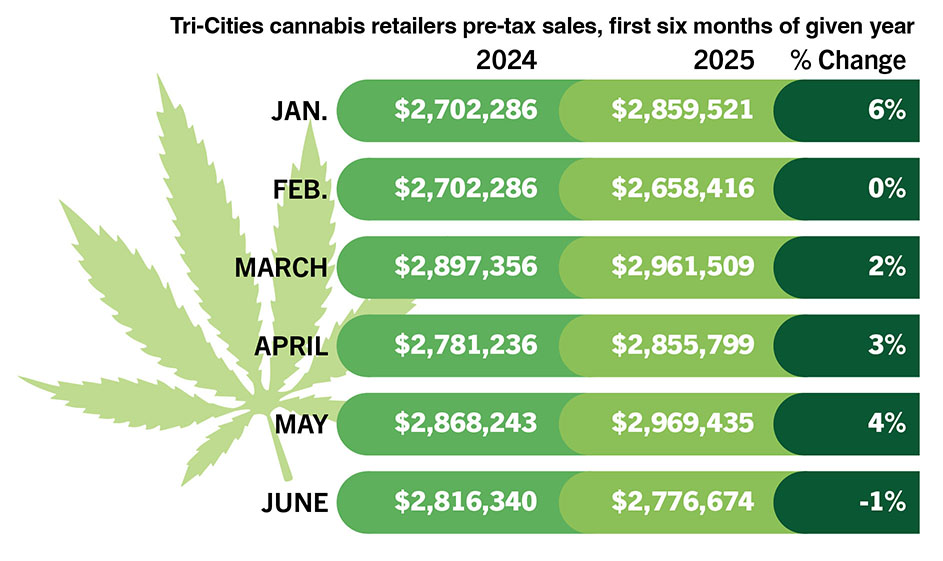
Green2Go, which operates dispensaries on both sides of the river, has collected on average more than $980,000 in monthly receipts through the first half of 2025.
Declining sales
It appears the state may have hit a ceiling when it comes to demand. Retail sales have been largely flat for the past few years, topping out at $1.5 billion in 2021 and floating between that high water mark and $1 billion ever since.
Nearly every category of consumer cannabis product has seen declines year-over-year according to Headset, another cannabis industry market analyst company. Demand for capsules and tinctures has dropped 20% or more over the past year while concentrates and beverages are down 15%. Flower – the dried buds of female cannabis plants – is down nearly 13%.
“A lot of our colleagues are closing,” said Jordan Zager, co-founder of Pullman-based Dewey Scientific, which manufactures pre-rolled joints and cannabis-infused vape fluid sold by Tri-City cannabis retailers. “The volume of product moving from producer to retailer has severely declined, down 60% in just a year.”
Part of the problem is the sheer volume of products on the market. In 2017, licensed growers produced 121,254 pounds of cannabis, a little less than double the amount sold that year. But in 2023, production tripled to more than 363,000 pounds while sales only doubled.
Attrition among producers and processors is high, hitting an annual turnover rate of 20% in 2022 compared to 7% for retailers, according to a July 2025 report from the state’s Joint Legislative Audit & Review Committee (JLARC).
Christophersen, who was one of the original members of WACA, said none of the organization’s original board members remain in the industry. In Benton County, 30 producers and processors had documented sales in 2023. Only 24 have so far recorded moving product in 2025.
The hemp issue
The July 2025 JLARC report cited overproduction as one of the biggest issues facing the state’s cannabis market. And that problem is hard to tackle given the state’s lack of a tracking system that can fully trace every aspect of the market.
The state began using the Central Cannabis Reporting System (CCRS) in 2021, which was meant to be a temporary system after problems with the prior one. However, CCRS “currently lacks the basic information (the state) needs to reliably estimate production and sales.”
And despite state legalization, the report indicated approximately 30% to 40% of the cannabis consumed in the state is from illicit producers and dealers.
Cannabis business owners and advocates agree that better industry tracking and monitoring is needed and the illicit market remains a challenge for the state’s licensed businesses.
However, they said there is another competitor that is doing even more damage: hemp.
Congress removed hemp, which contains less THC by weight than cannabis, from the federal list of controlled substances in 2018. The effort was championed by U.S. Sen. Mitch McConnell, R-Kentucky, ostensibly to support farmers providing hemp for industrial purposes. That change gave hemp producers access to many resources not available to federally-prohibited cannabis, such as the ability to hold water rights, access to financing and banking services and crop insurance coverage.
It also opened the door to hemp-derived products comparable to those manufactured by the cannabis producers and processors that can be delivered by mail or sold surreptitiously in convenience stores, which avoids the state’s 37% excise tax on cannabis. Those products also skirt state regulations, including limits on how much THC they can contain, which has led to overdose incidents.
“We had a kid who got some hemp gummies that had 200 milligrams and ate them all,” Christophersen said recalling one overdose case.
State lawmakers banned hemp products during the 2023-24 legislative session. However, WACA says enforcement has been inconsistent, partly because of how pervasive hemp-derived products have become.
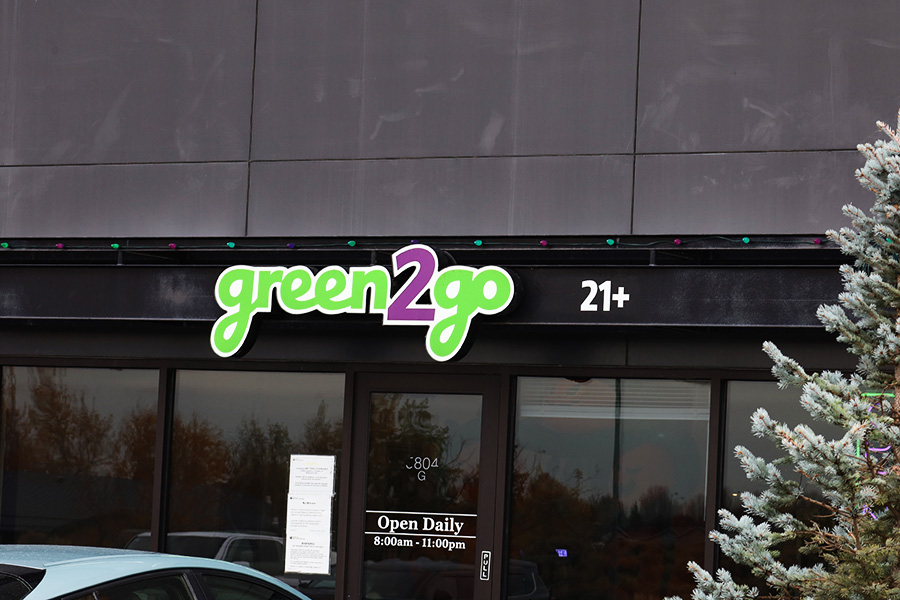
Green2Go’s Pasco recreational cannabis dispensary is one of six serving the Tri-Cities and nine spread across Benton and Franklin counties.
| Photo by Nathan FinkeWhat’s the future hold?
The market has become challenging enough that Dewey Scientific plans to suspend operations for the winter to regroup and determine next steps.
Boast said there’s the option for his business of expanding into other markets, especially as many more states have legalized cannabis “but because of the cost associated with it, we’re forced to hunker down.”
“In all honesty I don’t see a lot of things changing right now,” he added.
Boast said the industry will continue to push for the state to do more to stabilize and support the cannabis market. Some of the changes businesses want to see include tighter enforcement of current state regulations while loosening restrictions on individuals holding retail licenses alongside those for producers and processors.
WACA also wants more of the excise taxes collected on cannabis going back to local governments rather than the state’s general fund. In 2024, $470,000 in excise tax revenue went to Benton County while just under $30,000 went to Benton City and Prosser, accounting for roughly 5% of excise tax collections. Franklin County did not receive any as no retail outlets operate in its unincorporated areas and data was not available from the state regarding Pasco’s share.
The state’s budget crunch will make that request daunting.
“It’s going to be a very challenging year for the Legislature but we’ll still seek to advance our priorities,” Boast said.
And yet, in the Tri-Cities, there are signs of individuals still seeing opportunity in the cannabis market. The Pacific Outpost became Pasco’s fourth retailer in early 2024 and it saw a monthly average of roughly $235,000 in pre-tax sales that year. In 2025, its average monthly sales increased by $100,000.
In the past three months, five producers and processors with operations in Benton County have re-activated their licenses. Market analyst company Headset says the state’s cannabis demand remains robust and that one product category, edibles, is seeing some growth.
“We do still think the industry has a future,” Christophersen said. “We are in the middle of a grand experiment.”