Concrete classic reimagined
New arts building to balance unique design, modern needs
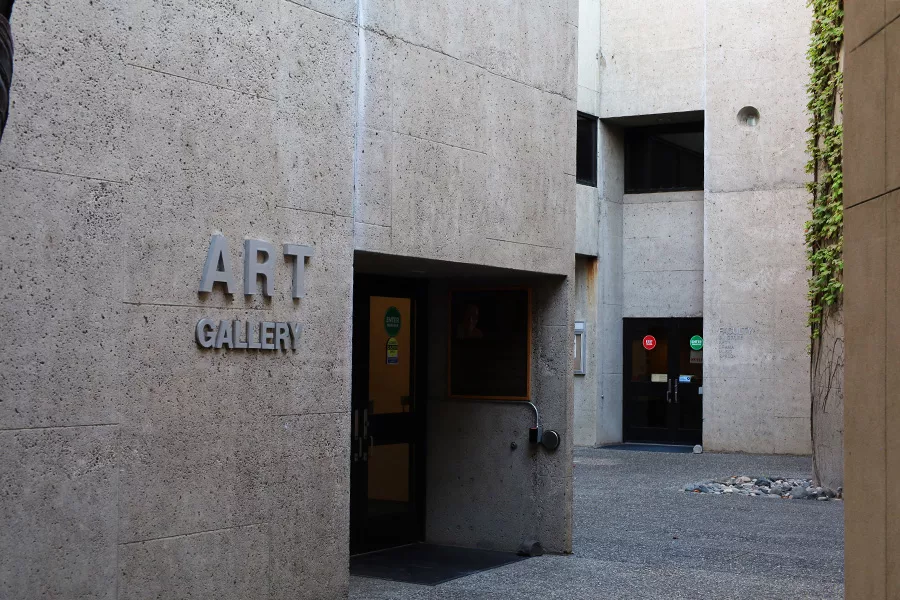
The P Building at Columbia Basin College appears as nearly fitted together pieces of an unadorned concrete block. Designed by Spokane architect Ken Brooks, it took 4,000 cubic yards of concrete to build for $1.8 million in 1971.
Photo by Nathan FinkeVisitors to Columbia Basin College’s Pasco campus can quickly pick up on shared design characteristics among the many academic buildings.
Several have pitched roofs with blue metal sheeting, such as the Center for Technical Education and the A & B buildings, which house the business education department and the college’s administrative offices, respectively.
A few have rounded structural elements, such as the library and the Richard Cummins Social Science and World Languages Center, also called the D or SWL building. And nearly all are clad in a beige stucco or brick.
However, the P Building, a brutalist-inspired block structure with exposed pebble concrete shrouded in ivy, stands alone.
“It’s a beautiful building from an architectural standpoint,” Brian Dexter, assistant vice president for campus operations, told the Tri-Cities Area Journal of Business. “It’s a very unique building.”
The college is working toward replacing the 55-year-old structure after receiving $54.5 million from state lawmakers during the 2025 legislative session. And while it’s too early to say what that new home for the college’s arts and humanities departments will look like, college leaders stress that their intent is ensuring it is just as unique as it is functional.
“We’ve grown since the P Building was built, so making sure we can accommodate our instructional areas is important,” said Michael Lee, the college’s vice president for instruction.
The P Building appears as nearly fitted together pieces of an unadorned concrete block. Designed by Spokane architect Ken Brooks, it took 4,000 cubic yards of concrete to build for $1.8 million in 1971.
The 31,000-square-foot facility houses the college’s School of Arts, Humanities & Communication. Its features include Esvelt Gallery, which hosts regular art shows and installations, a 292-seat indoor theater, a black box theater and an outdoor amphitheater that was added to the building’s west side about a decade ago.
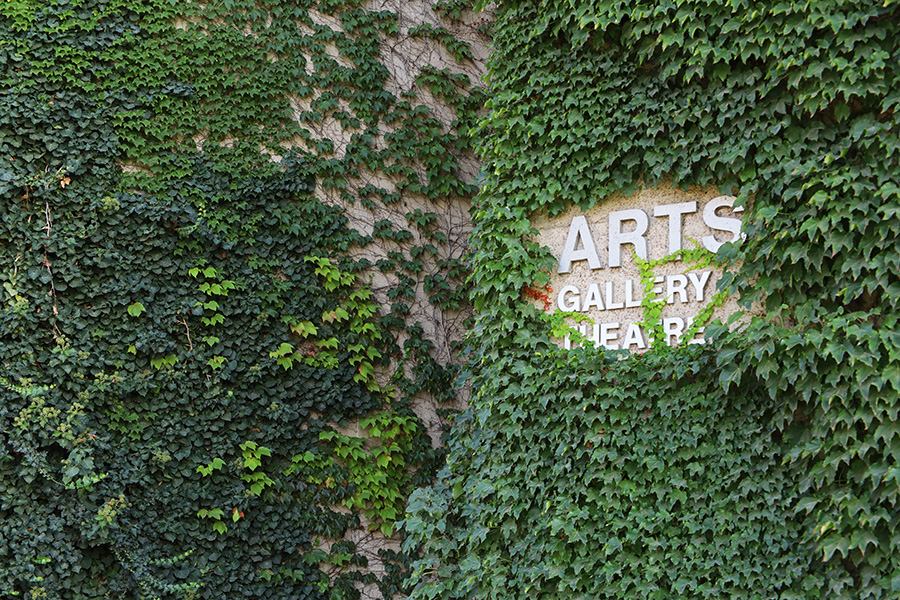 Photo by Nathan Finke
Its design has made it not only one of the more unique buildings at CBC but also in the Tri-Cities. However, the design has not aged well from utility and technological standpoints. Whole portions of the building, including offices and classrooms, are not accessible to those with wheelchairs or limited mobility. Its dense concrete structure is not Wi-Fi friendly, a must-have in modern teaching.
“While your existing facility was thoughtfully designed and remains a distinctive presence on campus, it no longer meets the evolving needs of today’s students, performers and audiences,” said Spokane-based architecture firm Integrus in its prospectus for the new building’s pre-design work. “It limits the potential of your performing and visual arts programs to thrive.”
Integrus was named the pre-design architect for the project, chosen from a pool of applicants that included national firms. Its past work on arts-focused buildings include Wenatchee Valley College’s Music & Arts Center, the Cowles Music Center at Whitworth University and The Hive, a collection of maker spaces, studios and galleries serving Spokane Public Library and Spokane Public Schools.
“We welcome the opportunity to make this facility a high-performing demonstration of what the arts can achieve in a campus environment – a student-centered space that encourages collaboration and creative thinking, empowers students to develop expertise and a sense of their own trajectory, engages the broader community in the value of the College (and) enables students to showcase both the process and final product of their work,” Integrus wrote in its proposal.
When it began pursuing funding, the college did submit a rendering of a building to the state that showed the different areas it would require, from performance and studio spaces to classrooms and offices. CBC officials, however, stress that rendering was only a placeholder.
“No renderings. It’s just spreadsheets of numbers right now,” said Susan Shelangoskie, dean for arts, humanities and communication, referring to data on estimated square footage for specific parts of a future building.
CBC officials are tentatively planning to build the new arts building just to the north of the P Building, a space currently used as a parking lot. Actual design of the structure won’t begin until later this year and the earliest it could be finished is 2028.
“We don’t want just another classroom building, we want this to continue to be a unique structure on campus,” Dexter said. “We’re not building a box. We’re not building a Costco.”
As for the P Building, it will eventually be demolished once the new arts building is complete. However, CBC officials said they are looking at ways to preserve its legacy, whether as a garden made up of chunks of its concrete structure or a mural inside its successor.
“Artistic representations would be a natural way of doing that,” Lee said.