
Census data shows slowing population growth
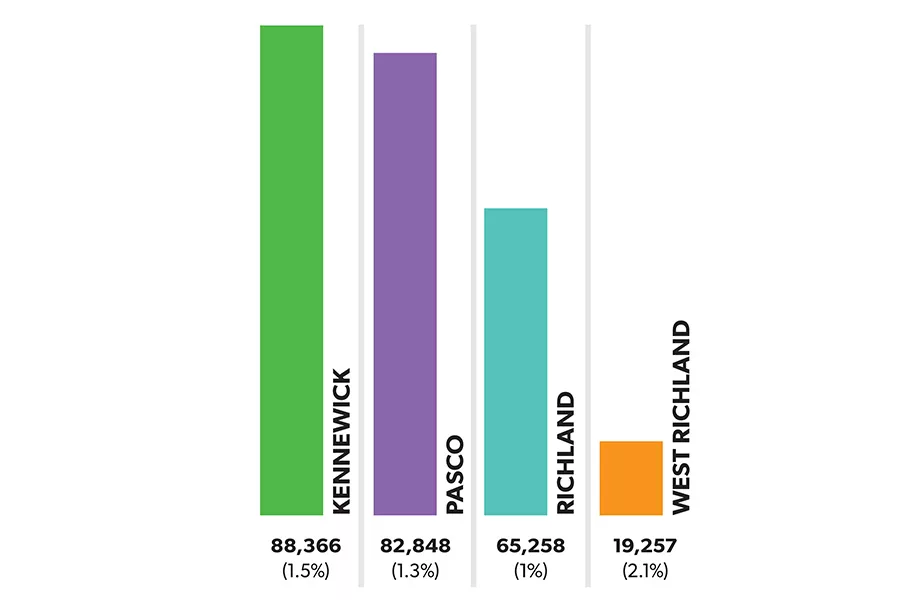
The Tri-Cities are continuing to grow but at a lower rate than in previous years.
The combined population of Tri-Cities metropolitan statistical area was 324,334, according to 2025 estimates recently released by the U.S. Census Bureau. That’s 4,117 more people than the 2024 estimate, representing 1.3% growth.
Kennewick remains the largest of the four cities with 88,366 residents, adding 1,271 residents since 2024, or 1.5% growth. Pasco recorded 82,848 residents, with 1,036 moving to the community in the past year, or 1.3% growth.
Richland posted the lowest growth, both in percentage and raw numbers. The city has a population of 65,258, growing 1% by adding 668 residents in the past year. West Richland, on the other hand, while adding the fewest people at 404, grew the most at a rate of 2.1% to hit 19,257.
The Tri-Cities remains the state’s fourth-largest metropolitan area. The Spokane-Spokane Valley metro added 3,349 residents over the past year but remained the third largest metro with 608,012 residents. The multistate Portland-Vancouver metro area is home to 2.54 million residents, more than 11,000 more compared to a year ago. The Seattle-Tacoma metro grew to 4.16 million.
Nationally, the Tri-Cities and Washington state are bucking the trend of cities in Southern states seeing the biggest gains. The largest numeric increases for the year were in Charlotte, North Carolina (up by 20,731 people); Fort Worth, Texas (up 19,512) and the Dallas suburb of Celina, Texas (up 12,710), as reported by Stateline.
However, while major cities such as New York City, Los Angeles, St. Louis and Albuquerque saw population declines, Seattle saw growth in the past year, adding nearly 12,000 residents.
Much of that growth is from people moving to Washington cities rather than growing families already living there. Natural population growth – births less deaths – has accounted for about 30% of the state’s growth between 2010-25, according to the state Office of Financial Management, which also releases population numbers. By comparison, natural population growth provided about 45% of the state’s growth from 2000-10.
And the growth is slowing. While the Tri-Cities overall has seen a percentage growth lower than the 1.3% growth for 2025, it’s a far cry from the five-year growth rate of 7%. State officials have indicated that the declining birth rate is the primary cause of the state’s slowing population growth.
Here are how other cities in Adams, Benton, Franklin, Walla Walla and Yakima counties stack up in 2025:
- Benton City – 4,019 (3.6%)
- College Place – 9,923 (0.7%)
- Connell – 5,080 (-0.1%)
- Kahlotus – 141 (-0.7%)
- Mesa – 391 (1%)
- Moses Lake – 27,469 (5.7%)
- Othello – 8,540 (1.3%)
- Prosser – 6,654 (1.6%)
- Sunnyside – 16,430 (0.5%)
- Walla Walla – 34,058 (0.4%)
- Yakima – 97,458 (-0.04%)