Sticker shock
Small businesses feel the pain at the pump
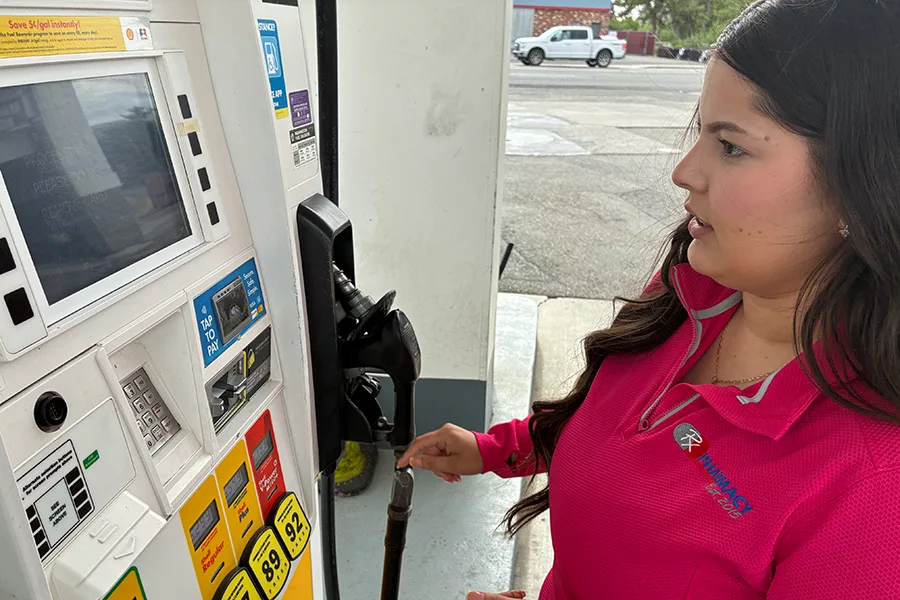
Belinda Larios, a delivery driver for RX Pharmacy in Richland, fuels up the company’s delivery vehicle at the start of her day.
Photo by Ty BeaverBelinda Larios couldn’t help but gasp as the numbers on the pump climbed.
“Forty-eight dollars and it was at half a tank,” she said as she pulled the nozzle from the sedan she uses for deliveries from RX Pharmacy on the Kadlec Regional Medical Center campus in Richland. “That’s diabolical.” The price? $5.29 a gallon.
She’s not alone in getting sticker shock at the pump. Many Mid-Columbia businesses have been affected by the sharp climb in gas prices this spring following the U.S. military’s operations against Iran and the resulting closure of the Strait of Hormuz.
While not all are facing severely strained budgets, it is prompting them to find new efficiencies and change how they serve customers.
“While it’s frustrating and we hope prices will taper off and go down, business needs to move on,” said Lindsay Best, owner and vice president of Abadan, a printer and IT services provider in Richland.
Washington state has the second-highest gas prices in the nation after California, according to AAA.
A gallon of regular unleaded gas was selling for an average of $5.24 as of June 9 in the Tri-Cities. That’s a steep increase from the $4.08 a gallon gas was going for a year ago.
The cost difference in diesel is even more severe, with a gallon costing almost $2 more per gallon than at this time in 2025.
Pharmacist Randy Johnson, who owns and operates RX Pharmacy and another pharmacy service focused on long-term care, has reconsidered whether to continue providing free delivery from his two pharmacies before. But since gas prices shot up, he’s about as close to giving it up as he can ever recall.
“Compared to six months ago, I’m paying an extra $2,000 a month for gasoline alone,” Johnson told the Tri-Cities Area Journal of Business. “It’s such a tight margin to operate and work off of anyway.”
He has seven delivery vehicles and drivers serving customers between Yakima and Walla Walla. He’s offered prescription delivery free of charge since opening the retail pharmacy 11 years ago.
“Any kind of bump in costs, whether it be wages or materials, is certainly felt, but this whole thing gas thing has become something else,” Johnson said.
Much of Ben Franklin Transit’s fleet of buses run on diesel so Kevin Sliger, the agency’s chief planning & development officer, keeps his eye on how the price of fuel is fluctuating.
Fuel is not the transit agency’s greatest expense, typically accounting for only 6% of its operating budget. And BFT is able to buy it via a state contract and only pay state taxes, which can be reimbursed.
“We’re not as impacted as the direct consumer,” he said.
Abadan has felt the pinch in fueling up its 14 technicians and their vehicles. They drive an average of 950 miles per month to provide support to much of Washington east of the Cascades and even some businesses in northeastern Oregon.
Best said the family-owned company has found some cost-cutting success by triaging which support calls need a technician to visit in-person.
“They might be able to have them tell us what the error code is over the phone” and give directions, Best said, which has the added benefit of addressing a problem before a scheduled tech could be available to visit in-person.
However, tech support isn’t the only part of Abadan’s business being impacted. The company also operates a print shop and the freight costs for its materials have gone up hundreds of dollars per month, which Best said is forcing the company to reconsider longtime vendor relationships that aren’t within the region.
Businesses are also looking at more than the present moment.
Best said Abadan is working to outfit its technicians with hybrid vehicles to cut back on fuel costs in the future.
Sliger said BFT has two electric buses and may add some in the future.
“As fuel prices rise, it then becomes a little bit more economical, a little bit more of a cost savings,” he said.
But for Johnson, there are limited options to absorb or mitigate the increased costs of fuel.
“I’d hate to eliminate the service or implement a fee, but eventually there comes a breaking point,” he said.