
More Tri-City students are considering trades over four-year degrees
Tri-Tech, CBC report growing demand as skilled trades training fills up faster than ever
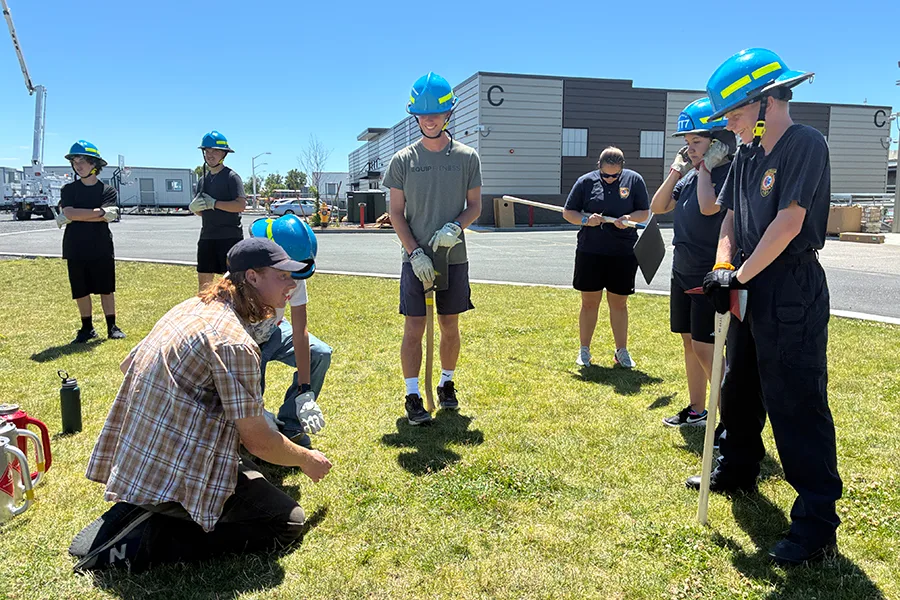
Students participating in the firefighting program of Tri-Tech Skills Center’s Summer Academy practice using various pieces of equipment. More young people are considering trades for their future careers as they weigh the cost of college and the stability of jobs that could be impacted by artificial intelligence.
Photo by Ty BeaverDemand for skilled trades training in the Tri-Cities has outpaced capacity so sharply that Columbia Basin College’s technical programs filled three months earlier than usual this year, while Tri-Tech Skills Center continues to turn away hundreds of qualified applicants annually.
Both schools are striving to meet demand.
Tri-Tech, a vocational school for area high schoolers in Kennewick, is wrapping up a $45 million state-funded modernization aimed at upgrading its now 45-year-old original structure – which also had expansions in 2007 and 2020 – and reconfiguring space for programs ranging from welding to dental assisting, with room for potential future programs such as pharmacy technician training and HVAC and plumbing.
For the students signing up for these programs, the appeal isn’t just hands-on work – it’s a bet on where the economy is headed.
“I think these are jobs that can never really be taken over by artificial intelligence,” said Sadie Wysock, who recently graduated from Richland High School after two years in Tri-Tech’s firefighting and emergency medical services program.
Enrollment in CBC’s career and technical education programs opened for currently enrolled students on May 26. By the time open enrollment began at the Pasco college on June 1, only slots in its manufacturing program were still available.
“This is three to three-and-a-half months sooner for these to fill than in the past,” said Jesus Mota, CBC’s dean for career and technical education.
Demand is high at Tri-Tech, too.
"Our electrical class went from one to two (sessions) in three years and I still have 150 applicants I can’t take," Lisa McKinney, Tri-Tech’s assistant director, told the Journal.
Labor pool
The shortage of skilled workers has been a challenge for industries ranging from construction and manufacturing to public safety and healthcare for years.
According to Draup, a firm that focuses on assessing talent and workforce pools, nearly 600,000 jobs were posted last year for major skilled trades in the U.S., while only about 150,000 new workers entered the labor pool through apprenticeship programs. The U.S. Department of Education estimates that for every five workers retiring, only two new workers join the workforce.
“As four-year colleges became the culturally reinforced path of choice over several decades, enrollment in vocational schools and apprenticeship programs has historically stagnated, creating a generational chasm of skilled trades talent,” according to a report from JLL, a commercial real estate services and investment management firm.
But JLL notes that trend is reversing, citing a recent survey of more than 3,000 students that indicates teens considering apprenticeships, vocational schools and technical bootcamp programs more than tripled from 12% in 2018, to 38% in 2024. Community college enrollment has risen 12% over the past five years, compared to 3% at four-year institutions.
Last fall, CBC accepted 152 students – a 76% increase over 2022 enrollment – into its career and technical education programs, which include automotive, welding, nuclear technology and manufacturing. It’s also grown its continuing education programs and partnership with six apprenticeship programs, where apprentices can earn college credit as part of their training.
“I’ve been here four years, and I think when I started in total, there were maybe 700 apprentices,” said Clarissa Pruenda, CBC’s director for workforce development. “Now we’re over 900.”
Hands-on appeal
Recent graduates and incoming seniors helping out and participating in Tri-Tech Skills Center’s Summer Academy say the hands-on jobs and careers are appealing to the students.
“Being in an office job sounds like the worst,” said Emilio Mendoza, a Chiawana High senior who will be in his second year of Tri-Tech’s pre-electrical program this fall.
He quickly added “no offense” upon considering the job of his interviewer.
But doing something they enjoy each day wasn’t their only consideration.
Like many other young people from across the country, the Tri-Tech students see the writing on the wall. Tech companies are shedding jobs, and the return-on-investment for a four-year degree doesn’t always pencil out.
“I think a lot of people are afraid of debt,” said Ramsey Livingston, a Chiawana High School graduate, referring to the cost of pursuing a college degree. “That terrifies me.”
They’ve seen friends and family who trained for a trade having no trouble finding work.
“Electrical is going to get bigger, construction is going to get bigger, everything is going to get bigger,” Mendoza said.
Training still required
Tradespeople still require some form of post-secondary training and education. Programs at Tri-Tech as well as CBC have grown their offerings and capacity in recent years to support employers as well as apprenticeship programs vying for future workers. But after a generation of the nation pushing academic over applied learning, they are playing catch-up.
Tri-Tech routinely receives hundreds more student applications than it can accept each year.
Local career and technical education officials said they are seeking to be strategic and grow programs responsibly, so students aren't just fully trained but have jobs or opportunities waiting when they graduate or complete them.
For the Tri-Tech students, they are appreciative of what their time at the vocational magnet school provided them, from the opportunity to learn and connect with local professionals in their chosen industry to just showing them their options.
“I never knew what I wanted to do but a friend told me about the (firefighting) program,” said Abbigail Ramirez, who recently graduated from Pasco High after two years at Tri-Tech. “My first day I literally fell in love.”