
He asked for a seat – and now he runs the school
Trade school offers fast track to Hanford jobs
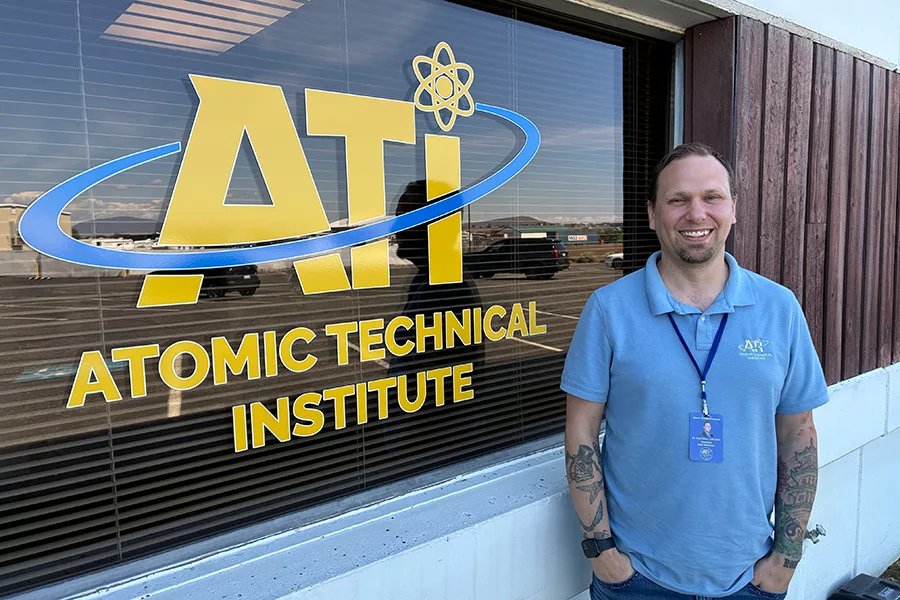
Paul Nims has launched Atomic Technical Institute, or ATI, which aims to fill workforce gaps in environmental and nuclear health and safety training for Hanford-area contractors.
Photo by Ty BeaverIn his early 20s and after earning his GED, Paul Nims showed up at EnergX LLC ready to enroll in a trade school designed to train workers for Hanford contractors – only to be told the class was full.
But even after scraping together the $6,000 tuition for the school, Nims was placed on a waitlist. He was bummed because he knew the school churned out graduates that Hanford site contractors routinely hired.
“I told (the instructor) I had to be in that class,” Nims recalled. “He said, ‘What do you want me to do, kid?’ So I told him he could sit a chair just outside the classroom with the door open and I’d watch and listen from there.”
Nims said the instructor smiled, said to follow him and found a spot for him to squeeze into the class.
Now, more than a decade after EnergX closed, Nims has opened his own trade school, aiming to give others the same kind of opportunity he once had to push for.
He has launched the Atomic Technical Institute, or ATI, which aims to fill workforce gaps in environmental and nuclear health and safety training for Hanford-area contractors.
He said he’s already seeing high demand for enrollment and that Hanford contractors and adjacent industry are also boosting the trade school, which has received U.S. Department of Energy, or DOE, National Training Center reciprocity certification, certification, helping boost its credibility.
Nims is striving to provide determined individuals the same opportunity he was shown, regardless of where they are in their career journey.
“One of my main concerns was coming in at 48 and being out of school for so long I wouldn’t be able to learn,” said student Kristina Mitchell. “It’s not easy, it’s not a breeze but everything you need to pass the test is provided to you.”
First Hanford job
Nims got his first job on the Hanford site in 2009 after training to be a radiological control and health physics technician, or RCT/HPT, at EnergX.
As he moved to new positions at different contractors and became a manager, he used tuition reimbursement through his employers to build up his credentials. He eventually earned a doctorate in occupational health and industrial hygiene via Capitol Technology University in Maryland.
It was while working full time in occupational health and safety that he also began working to train and educate the next generation of workers for Hanford and similar projects.
For nearly a decade he worked on the side as a consultant, offering staff trainings and other support in health, safety and hygiene for employers across the Pacific Northwest. He also became adjunct faculty for Columbia Southern University, or CSU, an accredited online university known for its occupational health and safety education program.
A layoff and a pivot
Nims said he hadn’t planned on establishing ATI until after he was among the casualties of federal job reductions made in the first year of President Donald Trump’s second term. But with the encouragement of family and friends – and seeing the gap in workforce development created by EnergX’s closure years ago – he got to work.
“I printed up a bunch of tri-fold brochures and just started handing them out,” Nims said.
Based in offices at 1835 Terminal Drive at the Richland Airport, not far from where EnergX previously operated, ATI offers eight certification programs that take three months to complete. They range from the RCT/HPT role he started his career with to roles such as hazardous materials technician, safety specialist and chemical operator. Teaching and learning are a combination of online and in-person instruction, such as simulated health and safety scenarios.
ATI also offers more than 70 workforce trainings that take between a couple of hours to a week to finish.
Nims’ trade school isn’t the region’s only option for training Hanford workers. The Volpentest Hazardous Materials Management and Emergency Response, or HAMMER, Federal Training Center has operated on the site since 1997, and it’s a resource Nims said he values. However, HAMMER primarily serves those who already have a job lined up on the site or have been actively working for a contractor and need additional or updated training, whereas ATI aims to primarily serve those pursuing roles on the site.
And while Columbia Basin College and Washington State University Tri-Cities provide pathways that can lead to roles at Hanford, Nims said the time and resources to pursue them aren’t feasible for many workers, nor is spending years in a classroom before getting on the site.
“Everyone thinks you have to have a white coat or an engineering degree and you don’t,” he said.
But that’s not to say Nims doesn’t see value in a higher education degree – those who complete one of the three-month certification programs also can earn up to 48 college credits through ATI’s association with CSU. That opens the door for ATI’s graduates to pursue further education and seek reimbursement from their future or current employers.
“When I saw the CSU credit, I didn’t hesitate, I knew it was perfect,” said Danielle Davis, an ATI student currently employed by Hanford Tank Waste & Closure, or H2C. “How else are you going to get 48 credits for $5,000?”
And securing reciprocity certification as a DOE National Training Center means ATI’s graduates are qualified to work at any DOE site around the country.
Affordable tuition
ATI tuition starts at $5,000 per three-month program, less than what Nims paid for his term at EnergX. Nims said that was intentional, as he wanted to make sure anyone committed to doing the work could get in. The trade school also offers no-cost financing with monthly payment plans and accepts reimbursement via the GI Bill and scholarships.
There’s even a way for unemployed students to enroll and not have to pay and still collect unemployment benefits. Nims said he has worked with WorkSource Columbia Basin to set up the option for case managers to reimburse the tuition fee for their clients, maintaining their benefits while taking courses.
“I want everybody to have the chance I did and for it to be affordable,” Nims said. “What’s the point of charging something that someone with a job can’t afford?”
That’s how Daisy Herrera is paying for her ATI tuition. While she has a bachelor’s in environmental science, she said she “wanted something that was a pivot but still gave me some similarities to my science background.”
“Going into this class, I didn’t know what to expect,” Herrera said. “But it’s so interesting. Sometimes I go home afterward and just start Googling things so I can get a bigger picture.”
A whirlwind
ATI is preparing for its next three-month term in June. Nims said open houses for prospective RCT/HPT students have been packed, with one more to come at 6 p.m. May 21.
Getting to this point has been a whirlwind, Nims said, and there have been challenges such as ensuring he had the necessary state licensing to operate. But he’s excited to see so much interest in what ATI is offering, especially as nuclear energy experiences a renaissance in the Tri-Cities and across the U.S.
“You pay $5,000 to get a six-figure job in three months,” Nims said.