
New partnership sets stage for university district in Kennewick
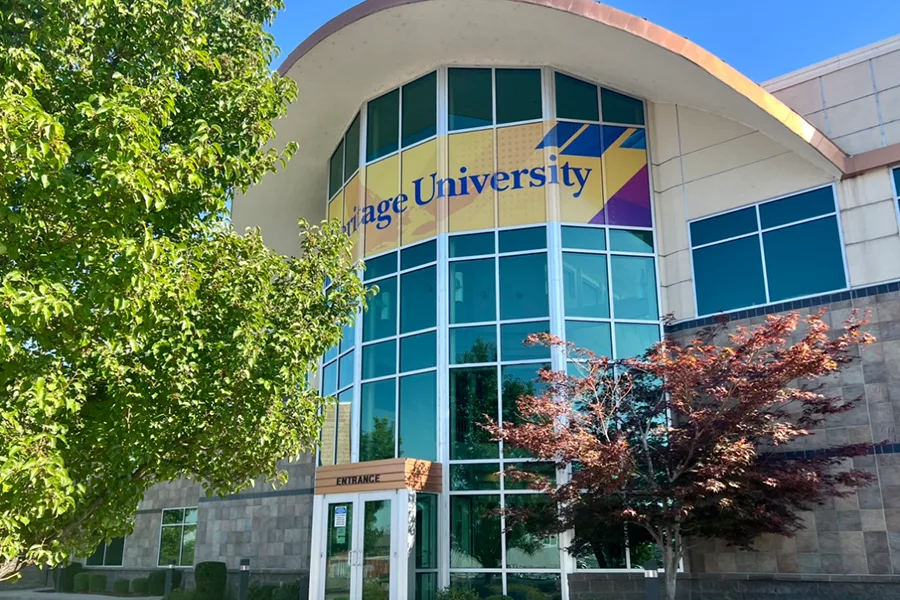
Heritage University, 333 W. Canal Drive, downtown Kennewick.
Photo by Sara SchillingOnly months after Heritage University’s president said he wanted his institution to play a bigger role in the Tri-Cities, a new deal between the university and the city of Kennewick appears to be the first step toward that goal.
Heritage and city officials formally signed a memorandum of understanding on May 1 to establish a university district in downtown Kennewick, where Heritage currently operates its Tri-Cities campus in the former Tri-City Herald building on Canal Drive.
University and city officials said the new partnership paves the way for a number of initiatives aimed at serving students and downtown businesses. Those range from working together to secure grants and supporting coworking spaces to mentoring students and developing a business incubator on Heritage’s campus.
“We hope the partnership shows our ongoing commitment,” Heritage President Chris Gilmer told the Tri-Cities Area Journal of Business. “We hope this is a tangible demonstration of Heritage’s dedication to the area.”
Meanwhile, the downtown’s leading booster organization is pleased to see what could be a new chapter for the city’s oldest commercial area.
“We are excited about the potential to partner and help translate this vision into real outcomes that strengthen businesses, activate spaces and bring more people into the downtown core of Kennewick,” said Stephanie Button, executive director for the Historic Downtown Kennewick Partnership, in a statement.
Most of Heritage’s overall enrollment of 1,000 students are based on its Toppenish campus. About 125 students are served out of Heritage’s downtown Kennewick campus, which offers four-year degrees in six fields – accounting, business administration, criminal justice, elementary education, psychology and social work – that can be completed without visiting the main campus.
Combining efforts
The agreement doesn’t bind the city nor the university to any financial commitments or incentives, nor does it lay out any planned infrastructure or construction projects. Rather, it focuses on how the two entities can combine their efforts when it comes to workforce and business development alongside innovation and community building.
The city has welcomed Gilmer’s intent to grow Heritage, seeing it as an opportunity to revitalize downtown.
“Campus expansion means a growing student population living, spending and engaging in our city center – and that directly supports the businesses, entrepreneurs and community members who call downtown Kennewick home,” City Manager Erin Erdman said in a statement. “By aligning academic programming with local workforce needs and fostering innovation and business development, this partnership creates opportunity on both sides: Heritage University grows with the full support of the city, and Kennewick gains a university that’s a genuine engine for downtown revitalization.”
Button said she’s encouraged by the shared vision the city’s and university’s partnership offers on entrepreneurship, workforce needs and downtown’s redevelopment.
“(The downtown partnership) is already deeply engaged in the day-to-day work of revitalization, supporting small businesses, and cultivating an entrepreneurial ecosystem in downtown Kennewick,” she said. “This agreement builds on that momentum and reinforces downtown as a center for opportunity, innovation, and long-term economic vitality.”
Growing Kennewick enrollment
Gilmer said the college has put more resources than ever before into the Kennewick campus, as its board “wants students to feel they’re getting the same hands-on learning experience that Heritage is known for on the Toppenish campus.”
The timing of the university and city’s new partnership was intentional; with the high school class of 2026 nearing graduation, Gilmer said there’s still time for its members to find their way to Heritage, particularly at the Kennewick campus.
“If enrollment is strong for fall, and we anticipate it will be, there is the opportunity to expand our footprint in (our current) building,” he said.
And while Gilmer is eager to see Heritage’s enrollment grow in downtown Kennewick, he stressed that the university is not seeking to supplant the Tri-Cities’ two other long-standing higher education institutions.
He said he has met with Sandra Haynes, executive vice president for statewide campuses for Washington State University, and Rebekah Woods, president of Columbia Basin College, to develop a collaborative rather than competitive relationship.
“There’s a large unmet need for higher education,” Gilmer said. “We’re not seeking to compete with them, just provide another alternative.”


Stay Informed. It’s Free.
Subscribe to our newsletters and get the latest news and insights delivered to your inbox.
We respect your privacy.
Unsubscribe anytime.
Thank you!
You’re subscribed. Keep an eye on your inbox for the latest updates.