Cannabis industry veterans plan west Pasco dispensary
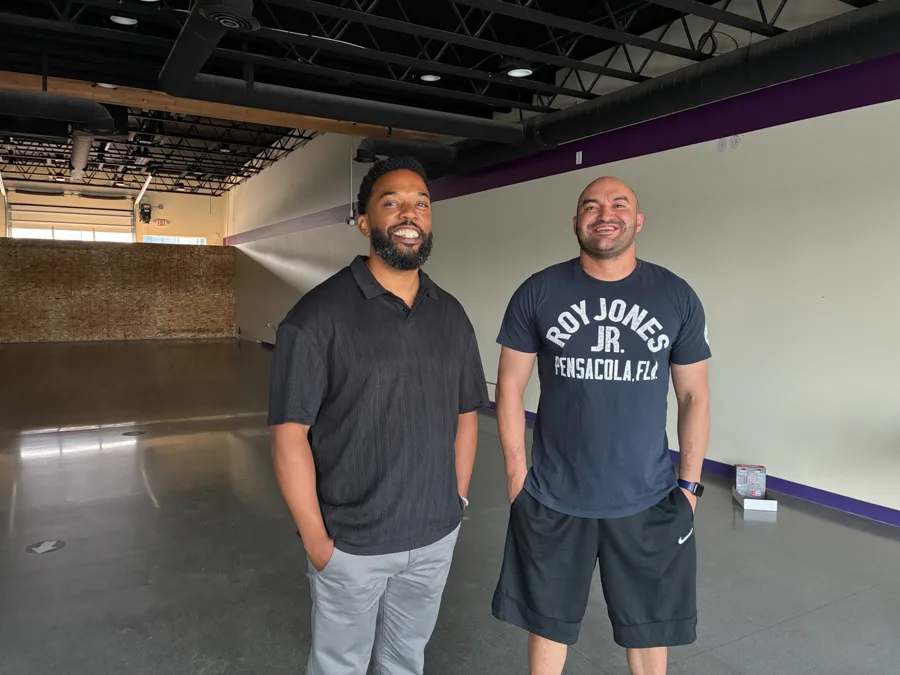
Zach Fairley, left, and Steve Garrido are preparing to open Pasco’s fifth cannabis retail store after the city council narrowly approved updating its ordinance to allow another store to open.
Photo by Ty BeaverZach Fairley thought he was going to become a car salesman.
He had a job interview lined up with a dealership but then he was invited to another interview where he’d have to wait to learn more about the position.
“I had no idea what the job was about, just that it was for a general manager role,” Fairley said.
That job ended up launching the first cannabis dispensary in 2014 in Benton County. Ever since, Fairley and his business partner Steve Garrido have worked their way through the industry, from running retail and grow operations around the country to developing training for hundreds working in retail stores as budtenders.
Now the pair are aiming to launch their own shop in west Pasco, in the location that formerly served as Green2Go’s west Pasco store. With the Pasco City Council recently narrowly voting to allow one more cannabis retail store within city limits, both say this is an opportunity to bring their years of experience and professionalism to the local cannabis market while also giving back to the community.
“To actually own and run our own. I’m pretty excited,” Garrido said.
Unique backgrounds
Neither Fairley nor Garrido are originally from Pasco, but both have spent extensive portions of their lives in the Tri-Cities. Fairley, an Army veteran, moved to the region more than 20 years ago, after being stationed at the now-decommissioned Umatilla Chemical Weapons Depot in Oregon. Garrido was born in Inglewood, California, but moved to Pasco when he was 6.
The pair met in 2005 when both were working jobs at Columbia Center mall and struck up a friendship.
Fairley joined the Pasco Police Department in 2007 and served with the agency for seven years before being fired in 2014. An internal investigation concluded he had lied to supervisors about text messages discovered during an unrelated police investigation. He was later convicted of obstructing a law enforcement officer and making false or misleading statements, while a jury acquitted him of another charge stemming from the messages.
He later challenged the legality of the search that produced the evidence used against him. In 2020, the Washington State Court of Appeals ruled that the search was unconstitutional and reversed his conviction. Fairley additionally sued the involved parties.
The experience eventually led him to interview for the general manager position at what would become cannabis retail shop Altitude in Prosser. He was hired and charged with getting the shop up and running in two weeks, as well as everything from securing stock to hiring employees. It was work that he said suited him.
“I found something that was within my niche,” he said.
Entrepreneurs in making
The role at Altitude led to another in Oregon and then Fairley ended up in Florida and California. Garrido joined him, having gone through stints working for cellphone maker Blackberry and then running his own restaurant. Most recently they served as CEO and chief operating officer of a dispensary in Santa Rosa, California.
“I really got bit by the entrepreneurial bug,” Garrido said.
But the pair wanted to return to the Tri-Cities and so began seeking one of the cannabis licenses through the state’s social equity program. That program makes retail and processor licenses available to those who meet some conditions, such as being a socially and economically disadvantaged individual as defined by the state Office of Minority and Women’s Business Enterprises or having a household income that was less than the median household income within the state of Washington.
The pair weren’t among the recipients of the first social equity licenses issued in 2023 but recently made it in on the second round. As a condition of receiving that license from the state, the men had to commit to contribute financially to the city’s Martin Luther King Jr. Community Center to satisfy a state requirement that they provide financial support to a charitable or philanthropic effort. Garrido said he spent a lot of his youth there playing basketball and spending time with friends.
They’ve spent the subsequent months working to open their shop through their company, Compas LLC. Along with notifying state and city officials of their plans, they’ve been designing the store’s layout, lining up suppliers and looking at ways to enhance the store’s already existing security systems.
They’ve also secured the option to sublet some of the space they’ve leased. That’s led to conversations about potentially welcoming a cannabis-adjacent eatery or a nail salon, Fairley said.
Neither was concerned about the recent statewide trend in cannabis production and sales disrupting their plans. Falling marijuana prices, oversupply and high operating costs have squeezed Washington’s legal cannabis industry for years, with producers and processors in Benton County seeing their revenues drop 22% in 2025 compared to the prior year.
Fairley and Garrido argue that there is still room for more in the cannabis business in the region.
“Just because there’s state data showing things, that’s not always the case in the Tri-Cities or even Pasco,” Fairley said.
A divided council
While Pasco has allowed cannabis retail stores since 2023, a city ordinance enforced a hard cap on the number that could operate at four. Those slots are currently taken by Green2Go, Pacific Outpost and Lucky Leaf Co., which operates two stores in the city.
A deeply split city council in August approved Compas’ application to operate in the city. However, the council also had to vote to amend the ordinance to allow another store, a process triggered by Compas’ application, which generated significant debate among the council and the community.
Opponents were critical of allowing another business that sells products they say only have negative health effects. They also criticized how Compas obtained its license and sought the ordinance amendment, as well as Fairley’s now-overturned conviction.
“I would ask my esteemed colleagues to reconsider those who have either pushed or want to go along with this data previously cited that we already have an oversaturation of licenses compared with the state average,” said Mayor Charles Grimm during the council’s Sept. 21 meeting. “Considering the potential casino in East Pasco, talks and presentations of one in West Pasco, and continuing to add marijuana stores throughout the city, I worry about our legacy, our culture, our city, and just really our future.”
However, the majority of the council, as well as supportive community members, praised Fairley’s and Garrido’s ambition, entrepreneurial spirit and interest in serving the community. Supporters also said changing the ordinance will allow for future measured growth while also encouraging competition.
“One of the biggest drives for me as a council member is to make sure that we are partnering with everybody with every given opportunity,” said Councilman Abel Campos. “That means partnering with people that we agree with and also partnering with people that maybe we're not. And I believe that with this industry, even though we have four, possibly five, we have an opportunity here to make sure that even though it is regulated tightly in the state, that we also do our due diligence within the city.”
Awaiting approval
Getting the city ordinance amended was a critical step to moving Fairley’s and Garrido’s store forward. However, they do still have some hurdles to get through, including a final inspection and getting a standard business license. Fairley said they plan to be open by the end of the year or in October at the earliest.
He and Garrido said they are striving to be good ambassadors for their industry. They said they knocked on doors in the neighborhood to let people know of their plans and get feedback on how they could be good neighbors. Those conversations led to their efforts to enhance security and make plans to keep the area outside the store clean.
Either way, they said they are excited to move forward.
“Good fortune comes to those who are prepared,” Fairley said.
Public meeting transcripts transcribed by Hamlet API were used to report this story.