Historic milestone
DOE: Hanford vit plant is operational
Workers commemorate historic event with a “We made the glass” banner
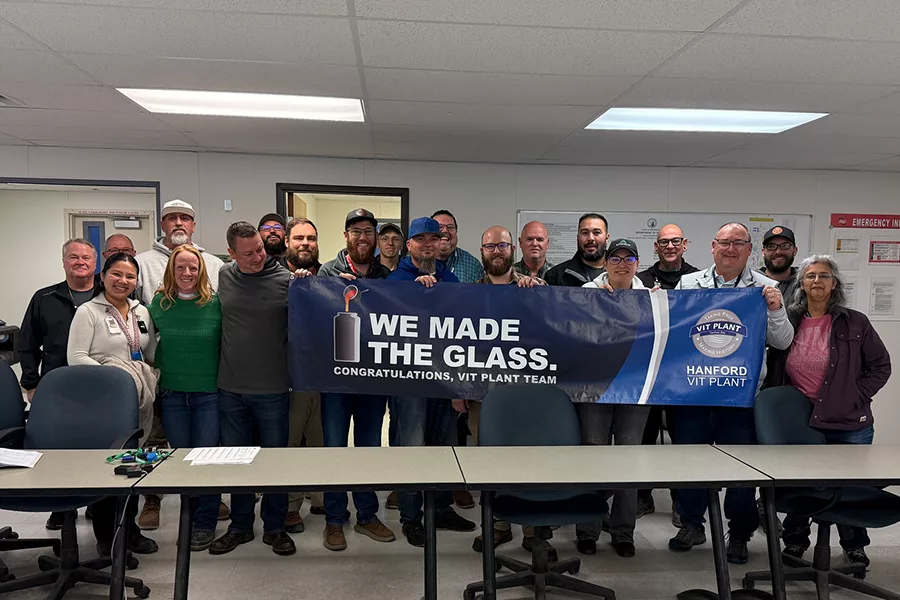
Waste Treatment Plant crews celebrate on Oct. 15 the beginning of full operations of the facility after it began vitrifying, or transforming into glass, waste stored in underground tanks for the first time.
Courtesy Bechtel NationalA facility under construction for decades and costing tens of billions of dollars is at last transforming toxic waste stored in underground tanks at the Hanford site into a glass form for storage.
The U.S. Department of Energy announced Oct. 15 that the Waste Treatment Plant has officially started turning tank waste into glass for the first time, meeting the court-ordered deadline to begin operations.
“I appreciate the hard work and determination of the entire Hanford team to deliver on this legal commitment,” said Hanford Site Manager Ray Geimer in a statement. “This achievement enables us to shift focus to safely operating the plant and to progressing solutions for the Hanford tank waste mission in its entirety.”
The milestone now opens the door for full operation of the facility, commonly known as the vitrification or vit plant, to process the 56 million gallons of waste stored in 177 underground tanks, a legacy of nuclear weapons manufacturing at the site dating back to World War II and the Cold War.
“This milestone represents the realization of a vision shared by many. It reflects decades of teamwork, innovation, and partnership with our customer to solve one of the nation’s most complex environmental challenges – safely and permanently,” said Dena Volovar, president of Bechtel’s Nuclear, Security & Environmental business, in a statement.
“Together with the Department of Energy, the state of Washington, our labor partners, local suppliers, subcontractors, and world-class scientific experts, we’ve turned vitrification into a reality at Hanford. It’s an important step forward in protecting the Columbia River, surrounding communities, and future generations.”
The vit plant, designed and built by Bechtel, is the largest and most technically sophisticated radioactive waste treatment plant in the world. The Direct-Feed Low-Activity Waste facility of the Waste Treatment Plant is fed the tank waste and, using a process called vitrification, will mix the waste with a tailored blend of chemicals to turn it into a glass form for stable and safe long-term storage.
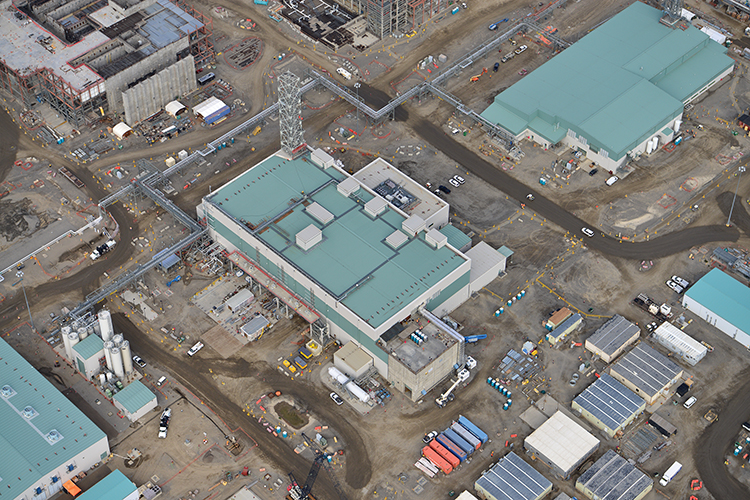 Aerial of the Low-Activity Waste Facility at the Waste Treatment and Immobilization Plant, known as the vit plant. | Courtesy Bechtel National Inc.
The initial processing is part of the hot commissioning phase, where actual tank waste is fed into the facility to test its systems. Once that is successfully completed, the facility will ramp up to run 24 hours a day, with Hanford site contractor Hanford Tank Waste Operations and Closure, or H2C, taking over operations.
The announcement that vitrification had begun earned accolades from numerous stakeholders.
“For the first time ever, a campaign is now underway to significantly reduce the total amount of waste in Hanford’s tanks – a historic achievement decades in the making,” said David Reeploeg, vice president for federal programs at Tri-City Development Council, in an email to the Tri-Cities Area Journal of Business.
“I congratulate the DOE Environmental Management Program and the leaders that have moved forward with the program. This program now works based on strong management and oversight and partnerships with the world class contractors and workers that designed and built the facility,” said Seth Kirshenberg, executive director of Energy Communities Alliance, an advocacy organization representing communities with DOE sites, in a statement. “This proves we can build difficult projects with annual appropriations that are engineering models for other programs.”
“This is really a historic breakthrough. After decades of effort, we are officially turning nuclear waste into glass at Hanford,” said U.S. Sen. Patty Murray, D-Washington, said in a statement. “This is a monumental achievement that belongs to quite literally generations of Hanford workers. When it comes to Hanford, you can’t cut corners – and that’s part of why I’ve always fought to secure the federal resources needed to move this cleanup forward. I’ll always fight to support the Hanford cleanup and the workers who power this mission. The federal government has a moral and legal obligation to follow through on the Hanford cleanup – and I’ll never let any president forget it. This is just the start and we’ve still got a ways to go before we’re anywhere near done, but today’s success is worth celebrating – let’s make glass!”
“Congratulations to everyone at Hanford who has worked to bring the DFLAW project online and for your unwavering commitment to the cleanup mission,” U.S. Rep. Dan Newhouse, R-Washington, said in a statement. “I have been a proud ally to Hanford through my role on the House Appropriations Committee, and I will continue working to make sure the federal government plays its part in supporting the cleanup effort.”
On Nov. 5, Ecology officials confirmed that the first containers of vitrified low-activity waste were transported to the Integrated Disposal Facility, an engineered landfill, at the Hanford site.
The start of the vit plant came after a month fraught with concern from federal and state lawmakers, government watchdogs and other stakeholders following reports that DOE Secretary Chris Wright wanted to take cleanup at the Hanford site “in a different direction.”
Wright, in multiple statements, denied that there was any intention to halt vit plant startup. But that did not prevent Gov. Bob Ferguson and other state leaders from saying that the state would pursue legal action to make sure the facility was processing waste by Oct. 15 as required by the Tri-Party Agreement, which DOE, the state Department of Ecology and the U.S. Environmental Protection Agency are signatories to.
And the ongoing federal government shutdown could complicate the facility’s ongoing operations.
On Oct. 8, H2C notified the Hanford Atomic Metal Trades Council that due to Congress’ inability to pass a federal budget or continuing resolution, the contractor was “directed by DOE to reduce operations to a ‘minimum safe’ staffing level, effective Oct. 20, 2025,” according to the notice from Mike O’Conner, H2C’s labor relations manager.
H2C reportedly later rescinded the letter.
10/15/2025 9:45 a.m.: Story updated to include background and comments from officials with Bechtel National, Tri-City Development Council (TRIDEC) and Energy Communities Alliance.
10/15/2025 10:45 a.m.: Story updated to include comments from U.S. Sen. Patty Murray, D-Washington.
10/15/25 1 p.m.: Story updated to include comments from U.S. Rep. Dan Newhouse, R-Washington.