

Higher education
Private colleges bolster their Tri-City presence
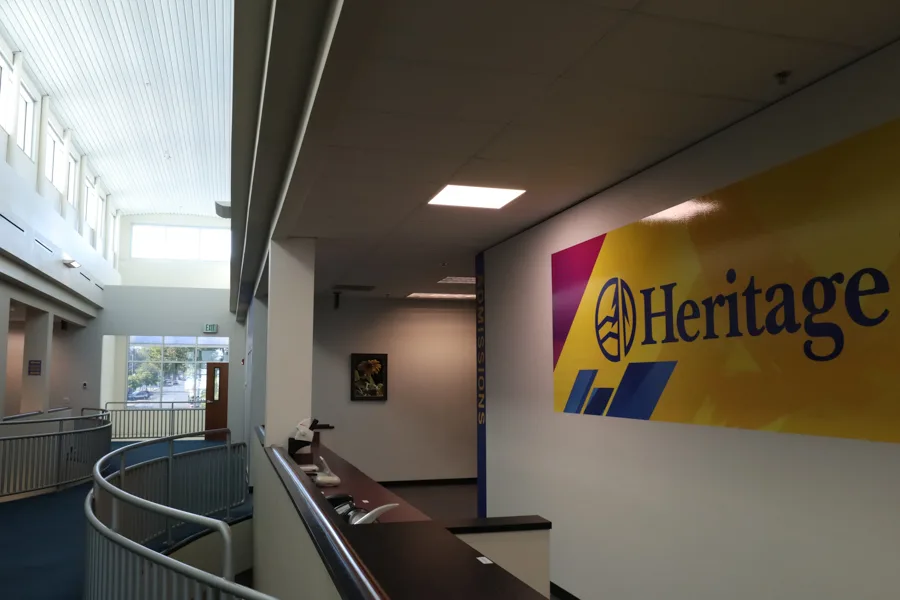
Heritage University’s downtown Kennewick campus was renovated to accommodate classrooms, a tutoring center and other university amenities, as well as upgraded signs and branding.
Photo by Nathan FinkeTwo private Kennewick colleges welcomed students back to their new and improved campuses this fall. Heritage University and Pacific Northwest Christian College completed extensive renovations to the buildings they lease on opposite ends of town.
Meanwhile, Columbia Basin College continues to pursue its new performing arts center and Washington State University Tri-Cities welcomed students back to campus with refreshed signs.
Heritage University
Toppenish-based Heritage University has had a 20-year connection to Tri-Cities.
Through its partnership with Columbia Basin College in Pasco, CBC students have a clear pathway to bachelor’s programs at Heritage.
Heritage solidified its presence in the community four years ago when it began leasing the former Tri-City Herald building in downtown Kennewick to launch its second campus.
This fall saw all 140 of the university’s Tri-City area students in attendance at the new campus.
Heritage worked with the owner of the building at 333 W. Canal Drive to complete the building’s transition to an urban university facility.
The building was renovated to accommodate classrooms, a tutoring center and other university amenities as well as upgraded signs and branding.
“We put high tech in all of our classrooms and replaced computers. It was a significant financial investment,” said Chris Gilmer, Heritage University president.
Heritage, which manages a $30 million total budget, employs 15 full-time faculty at the Kennewick campus, as well as several adjunct faculty who split their time between Heritage’s two campuses.
Heritage has a diverse student body:
- 85% of Heritage students are the first in their families to attend college. It is also the only private university in the nation that is both federally designated as a Native American-serving non-tribal institution as well as being federally designated as Hispanic-serving.
- 70% of the student population is Latino and 15% are Native American.
“What Heritage is locally famous for in the state of Washington is we are an open access university. Anyone with a high school diploma or GED credential is welcome. We meet students where they are,” Gilmer said.
The university is known for a retention rate above the national average and wraparound services such as financial aid, transportation, advising and tutoring services.
Gilmer said that rather than compete against other higher education institutions in Tri-Cities, Heritage wants to collaborate.
“We are trying to help students who maybe didn’t think of college as an option to see college as an option, such as those facing economic challenges,” he said.
Heritage offers more than 30 undergraduate majors, as well as several master’s programs.
“Six of our most compelling undergrad programs are offered at our Kennewick campus: accounting, business administration, criminal justice, education, psychology and social work,” Gilmer said.
Students wanting to pursue other programs can complete them at the Toppenish campus. More will be added to the Kennewick campus over time based on local demand.
Though Heritage leases its Kennewick building, Gilmer said the university doesn’t see it as a short-term investment.
“The location of the building is right on the edge of the downtown Kennewick business district and we have a memorandum of understanding making downtown a university district. Kennewick is doing some exciting things to reinvigorate downtown, and we want to be one of the anchors to help them do that while also serving Pasco and Richland as well,” Gilmer said.
Pacific Northwest Christian College
Fall 2026 saw Pacific Northwest Christian College students enter the renovated halls of the former 3.48-acre Golf Universe property at 6311 W. Clearwater Ave. in Kennewick.
The faith-based college put $2.5 million into improving the 7,000-square-foot existing space and adding 5,200 more square feet at the back of the building facing the former driving range.
The reimagined space includes four classrooms, a library, study rooms, indoor and outdoor common space, lavatories, administrative offices, conference room and lobby for the mini golf operation, which is due to reopen in February 2027 following some sprucing up.
The college, which manages a $2.6 million budget, has just under 200 students enrolled this year and offers two-year associate degrees in general studies and biblical studies, as well as two one-year certificate programs.
The college employs seven administrative staff, three full-time professors and 14 adjunct faculty holding advanced degrees.
In addition to the remodel, the college has adapted the lawn directly behind the building for soccer and football fields for its growing athletic program, which includes men’s football, women’s soccer, and men’s and women’s basketball teams.
The college is leasing-to-own the property and once it is paid off, the adjoining eight acres of the former driving range will be gifted to the school by the former owner, Adams Enterprises.
Though the college left its secondary building across the street from its 3021 W. Clearwater Ave. location, it still conducts some of its classes and operations out of the latter for the time being.
The college is in the midst of its latest capital funding campaign to tackle the next $19.2 million phase of campus development for a 48,000-square-foot second building.
This will house the college’s chapel, auditorium, full-size library, cafeteria, additional classrooms and more administrative and faculty spaces.
“We’re excited about what the Lord is doing,” said Bob Nash, college president. “It’s hard work, no question, but it’s a very exciting time right now.”
He added that though the college is grateful for the generous support of the community to date, “if we had someone step up and anchor us financially, that would really catapult us forward.”
“Lives are being transformed. Our core values and what we represent is huge. Kids need hope and they’re getting that here. That’s really what stands out more than anything,” Nash said.
Columbia Basin College
Columbia Basin College in Pasco manages an operating budget of over $80 million and employs 1,037 faculty, adjuncts, hourly and student employees.
Elizabeth Burtner, vice president for marketing and external engagement at CBC, said enrollment is trending slightly upward. The college reported 8,806 students on the first day of fall 2026 term, a 6.1% increase over the year prior.
“It is not projected to be as strong of an upward trend as last year,” she said.
The college recently completed construction on a $28 million student housing project, its second such facility, at 20th Avenue and Argent Road, adding 47 units to house up to 160 students enrolled in at least 12 credits at CBC.
Predesign work has wrapped up on the $49 million P Building replacement project which will see the demolition of CBC’s iconic concrete brutalist performing arts building. The college is actively advertising for design-build teams for the 58,668-square-foot facility.
The new arts center will feature a multipurpose theater, visual arts gallery, recital hall and instructional studio and lab spaces tailored for various disciplines according to its highergov.com project listing.
Also moving up on the state’s major capital budget request priorities list for the 2025-27 funding biennium is a building to house the Center for Applied Science and Agriculture. The project has advanced from No. 30 in priority to No. 14, Burtner said.
In the meantime, CBC is gearing up for more improvements to its Saraceno Way campus entrance with construction scheduled to commence in spring 2027 and be completed the following fall.
Phases of replacing aging water infrastructure on campus is also ongoing.
On the academic side, CBC launched a new Bachelor of Applied Science (BAS) program in respiratory therapy this fall and is proposing changes to its existing BAS in teacher education program.
Burtner said that it would upgrade from a pre-kindergarten endorsement to a kindergarten-through-eighth grade endorsement with the option of adding a multilingual learner endorsement.
“This will give CBC graduates broader opportunities for work and meet community needs. We are also in the process of proposing a (BAS) in behavioral health to support the growth in community need for mental health services,” Burtner said.
WSU Tri-Cities
New and returning students to WSU Tri-Cities’ campus were greeted by updated signs at the entrance to the school in Richland.
The university ushered in no major capital projects this past year and has none on the horizon.





