Port of Walla Walla
Big industrial projects underway just outside Tri-Cities
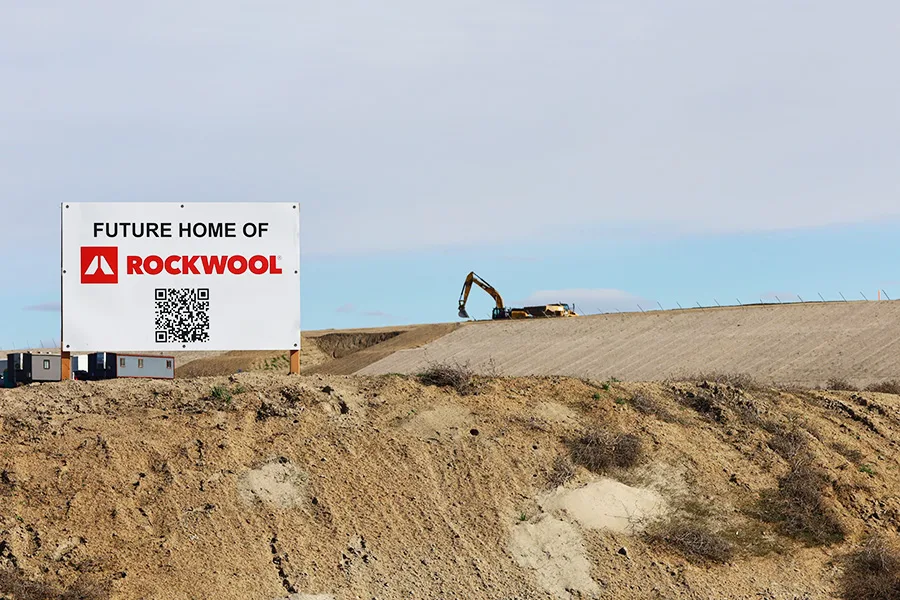
Rockwool North America officially broke ground on its new $175 million facility at Wallula Gap Business Park in April. It is expected to open in 2028 and employ upward of 125 people.
Photo by Nathan FinkeThe Tri-Cities has its eye on big developments beyond the Snake River bridge along Highway 12 in western Walla Walla County, an area already home to several large industries with more on the way.
One of three major projects is currently under construction at the Port of Walla Walla’s Wallula Gap Business Park. Two others are waiting for regulatory hurdles and potentially winning broader public support before moving forward.
The port is also preparing to welcome its first river cruise patrons at its Burbank high dock next spring after striking a deal with a cruise line, potentially driving tourism dollars.
Rockwool
The North American division of a Danish stone wool insulation manufacturer has officially begun construction of its newest facility at 220 Petersen Road.
Rockwool North America officially broke ground on its new $175 million facility in April, though grading and other site preparation began months before. It was nearly two years ago that the company signed a deal with the port for 250 acres at the business park for $8.75 million.
The plant will use a proprietary electric melting process to make an environmentally-friendly material for residential, commercial and industrial uses. Once operational, the plant will employ 125 people, many of whom the company intends to hire locally.
The facility isn’t expected to be online until 2028, but even after that, there’s still expansion potential. At full build-out, the facility could be more than 2.7 million square feet, using 185 of the 250 acres, according to documents filed under Washington’s environmental review process.
Patrick Reay, the port’s executive director, said the project is making good progress and that its construction has generated some interest from other companies looking for land.
“Once Rockwool started coming out of the ground, people saw the potential,” he said.
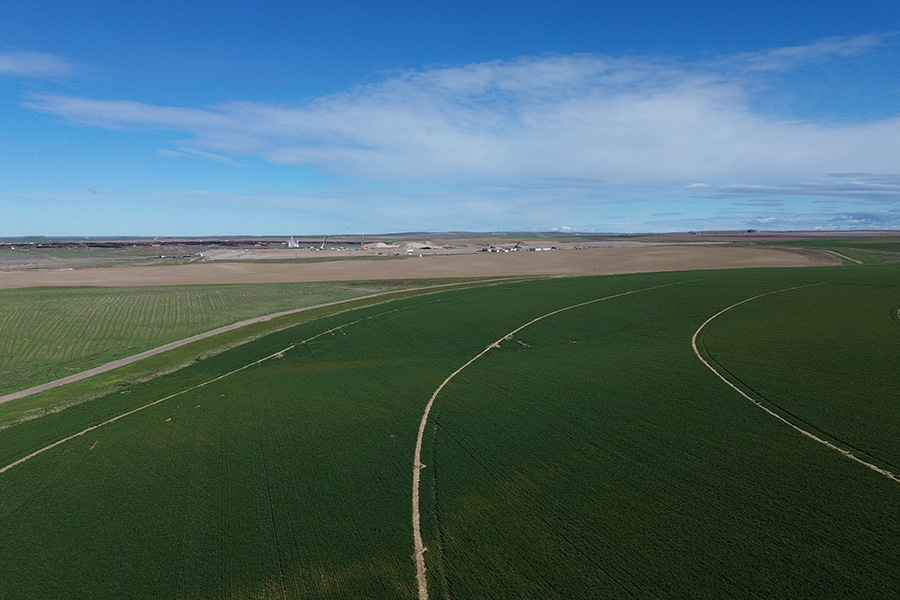
A $5 billion proposal by Amazon to build a data center at the Port of Walla Walla’s Wallula Gap Business Park is currently under review but has also received pushback from some residents over concerns about energy, water and other potential impacts from the project.
| Photo by Nathan FinkeAmazon data center
Amazon has formally filed its application with the county of Walla Walla to construct a reported $5 billion data center and the county was accepting public comment on the document at the end of September.
Amazon was revealed as the developer of the project earlier this year when the company bought an additional 50 acres to go with the 500 acres it acquired in November 2024 under a pseudonym.
The tech giant already operates smaller data centers in and around Hermiston and Boardman in Oregon. But building a larger one close to the Tri-Cities makes sense as Amazon has partnered with Energy Northwest and nuclear power company X-energy to develop and build four small modular nuclear reactors, or SMRs, near the nuclear-powered Columbia Generating Station north of Richland.
The deal for that project gives Amazon first call on the energy the SMRs produce, and data centers require substantial energy to operate.
At the time of the original land purchase, port officials said the project would grow Walla Walla County’s tax base by 50% as it is built out over four phases. Each phase will reportedly involve constructing four buildings, each about 215,000 square feet.
But the project has generated pushback from Mid-Columbia residents and others from outside the region over fears it would diminish local water supplies, drive up energy prices and have other detrimental effects on the environment.
Amazon held an open house about the project in Burbank in August 2026 to answer questions and provide information to the public.
“Any major industrial project should have questions, and we know there’s a lot out there,” said Roger Wehner, vice president of economic development for Amazon Web Services, during the open house.
Other developments
The port has plenty of other developments at Wallula Gap, the nearby Dodd Road Industrial Park and surrounding area:
- Century Pipe LLC recently completed construction of its new 53,000-square-foot manufacturing facility at 1181 Railex Road in Burbank. The facility is used to manufacture high-density polyethylene pressure pipe. It currently has three new production lines using German technology and can produce pipe ranging from 2 inches to 36 inches in diameter. The building was designed to accommodate up to five production lines.
- SkyNRG, a Dutch company with plans for a sustainable aviation fuel production facility at Wallula Gap, cleared an important regulatory hurdle for the project late last year. State Department of Ecology officials determined that SkyNRG’s manufacturing facility, being pursued by its North American unit SkyNRG Americas, would not create significant environmental impacts. The company has not yet closed on the land it’s proposing to build on but Reay said the project is proceeding. The company has not released details about construction costs for the facility. SkyNRG officials have said construction will create up to 600 jobs and the facility itself about 100 jobs once production begins in 2029.
- Packaging Corporation of America, or PCA, which operates a long-standing pulp mill at Dodd Road, permanently shuttered part of its facility in December, with company officials blaming a challenging cost environment. The shutdown resulted in the loss of 200 jobs. In September, PCA reupped its lease with the port for property adjacent to the plant it uses for processing byproducts. However, it cut the land it will lease from 28 acres to 18 acres.
- In August, national meat processor Tyson Foods announced it would put its facility at Wallula Gap on the market as part of downsizing efforts. Between 1,400 to 1,600 employees work at the 273,438-square foot facility, which serves as both a slaughterhouse and processing plant. It originally opened as a family-owned operation in 1966 but has been operated by Tyson since 2001. The company completed a $36 million renovation at the facility less than 10 years ago.
State transportation and Walla Walla County officials late last year discussed breaking up a project that would reroute Highway 12 across the hills and agricultural fields north of the Walla Walla River before creating a new three-way interchange near PCA and Wallula Gap.
Reay said local officials are still negotiating with federal transportation officials about breaking up the project in phases.
Under the state’s proposal, elements of the western and eastern terminuses of the project could be completed first before connecting them later when more funding is available.
Currently, $160 million is set aside for the project across state and federal funding.
Even with those secured funds, more is needed to cover the overall estimated project cost of $236.7 million.
State transportation officials last reported they were still aiming for construction to start in 2027 or 2028, with work continuing for two years.
Burbank cruise stop
Port commissioners earlier this year signed off on a lease agreement with American Cruise Lines Inc. for the port’s high dock and about two acres of surrounding land in Burbank. The deal was the culmination of years of work with the river cruise operator and the first cruise is scheduled to stop there in May 2027.
“It’s an important area for us and also a very popular area for people around the country for a variety of reasons,” Mark Freeman, the cruise line’s government affairs manager, told commissioners when the lease was approved. “For many, this is a scouting expedition for visitors for future trips.”
American Cruise Lines operates 28 small cruise ships on more than 50 itineraries on rivers across the U.S. It currently offers three itineraries in the region, two of them calling at Richland’s Howard Amon Park dock.
In 2025, the port began working with engineers to make improvements at the Burbank facility, both to the dock and road access from Second Street, specifically a drop-off loop near the dock. Port officials told commissioners that work is currently estimated to cost about $1 million to complete.