Slow recovery
Export-dependent wheat market faces growing competition

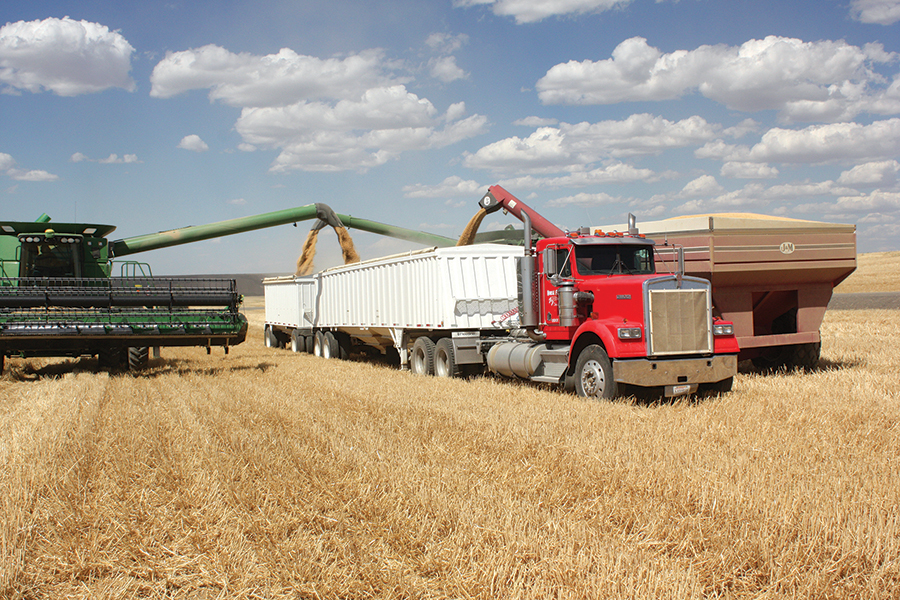
Drought and low precipitation put a damper on wheat harvest nationwide in 2023 — and it was no different in Washington state.
Growing conditions began favorably with good wintertime moisture for spring planting, but then the weather took a turn.
“Mid-May (2023) we stopped getting precipitation and high temperatures dry out the crop fast. We did not meet our 2022 production; we’re down 21% year-over-year,” said Casey Chumrau, CEO of the Washington Grain Commission, which helps facilitate trade and marketing efforts of wheat and barley in the state.
Washington produced 113 million bushels of wheat in 2023, compared to a 2022 return-to-average 144 million bushels, a 22% decrease. A record low crop of 87.1 million bushels was harvested in 2021.
Still, Washington ranked fourth in the nation for wheat production in 2023.
“We’re still recovering from that major drought we had. It takes a while to recover from something like that; it doesn’t just take one year. It takes a while for that moisture to build back up beneath the surface,” said Michelle Hennings, executive director for the Washington Association of Wheat Growers, or WAWG, the industry’s advocacy organization.
The Midwest grain basket is likewise still recovering from drought conditions that have undermined its wheat production. It’s too early to tell if this year will be better.
“We didn’t have a lot of snow this last year, so coming into winter we were already in a moisture deficit, and then to not get that snow has led to drier than ideal conditions. The state (of Washington) has declared a drought disaster already,” Chumrau said.
Fickle winter weather conditions killed wheat crops in some areas, which led to reseeding exposed hilltops and in some cases whole fields, an additional cost which significantly impacts farmers’ bottom line.
“We still need to get more rain for it to be a good crop this season,” Hennings said. “I’m not sure if we’re to that disaster level yet, but if it gets hot really fast, we’re going to see a detriment to the crop.”
Trade challenges
Washington is one of the two most export-dependent states in terms of wheat production, with some 90% exported, Chumrau said.
Exports have been down in recent years because of record worldwide production leading to excess supply.
Compounding the situation, a strong U.S. dollar has deterred international customers who have to pay more due to the exchange rate.
“The U.S. is usually one of the more expensive suppliers so when you add on a really strong dollar, it does really depress the demand for U.S. wheat,” Chumrau said.
Chumrau said that Russia and Ukraine have been able to produce and sell more wheat than many predicted amid the ongoing war between their two countries. Russia keeps prices artificially low to fund its war on Ukraine, she said.
“The majority of wheat exported out of Washington is soft white wheat, which is down 15% year-over-year,” Chumrau said. “Our No. 1 market is still the Philippines, which imported more than last year, but most of our top 10 markets are down compared to last year.”
Japan and South Korea are Washington’s second and third biggest export customers, and Chumrau said competition from Australia’s wheat growers has added to the challenge of returning exports to previous numbers.
 Ben Adams | Courtesy Wheat Life
Dam breaching
WAWG and wheat growers continue to advocate for maintaining the four lower Snake River dams which have been under threat of being breached for years.
WAWG said the dams play a pivotal role in bringing grain to market in the most efficient and cost-effective way possible while also irrigating crops and providing low-cost energy, among other benefits.
Hennings said renewed support for their continued operation came after a commitment was recently announced by the Biden-Harris administration to partner with local tribes and states to “restore wild salmon, expand clean energy production, increase resilience, and provide energy stability in the Columbia River Basin,” according to a White House press release.
“We are working with the state of Washington on studies – one is a transport study; one is on irrigation ... to provide sound reliable data so that they can understand the impacts on the various users of the rivers,” Hennings said.
She added that WAWG is collaborating with Midwest grower organizations to defend U.S. river systems and communicate the impacts of dam breaching.
“The Pacific Northwest is very rarely the least expensive supplier … Barg(ing) also keeps our transport costs down, so if we lose that transport, the cost comes back to the farmer. The cost of production is very close to the break-even point – if not below – so any added costs would be really detrimental,” Hennings said.
Heightened costs
Washington wheat growers are still feeling the heat from recent legislation that increased the cost of doing business.
Farmers are still waiting on the state to establish a reimbursement mechanism for the extra 60 cents to 70 cents per gallon they’ve been paying at the pump as a part of Washington’s Climate Commitment Act. Farmers were supposed to be exempt, but a way to allow this was never established, leaving farmers holding the bill for the past three years.
Growers are likewise still navigating new overtime rules that changed how workers have to be compensated.
“It was a short legislative session so they didn’t address it, but we’re hoping next session to see more of this addressed,” Hennings said.
At the federal level, farmers continue to anxiously await a new Farm Bill. The current bill is in extension and though the cost of some inputs – the resources farmers need to produce their crops – has stabilized, as Hennings explained, the reference price for wheat – at $5.50 per bushel – continues to trail behind the break-even point of around $7 per bushel.
“A new Farm Bill is going to be challenging in an election year,” she said. “There are other items on the table for Congress to prioritize so they would have to move quickly. There is strong support on the House side. If they can get it to the various committees will determine if it will move or not.”
In the meantime, the grain commission continues to market, WAWG continues to advocate, and farmers continue to innovate and find ways to decrease inputs and cut costs, including by increasingly making use of precision technology for the application of pesticides, herbicides and more.
Succession planning for the next generation of wheat farmers also is a growing concern.
“It’s a struggle to get younger farmers to take on farming,” Hennings said, noting that nearly all of the wheat grown in the U.S. is produced in the U.S. “I want people to protect their food and support their farmers and to do that we need to keep our farmers. … We’re losing hundreds of farms a month. … We have safe reliable food in this country, and we need to protect that.”