
Grace Clinic braces for surge as ACA, Medicaid changes loom
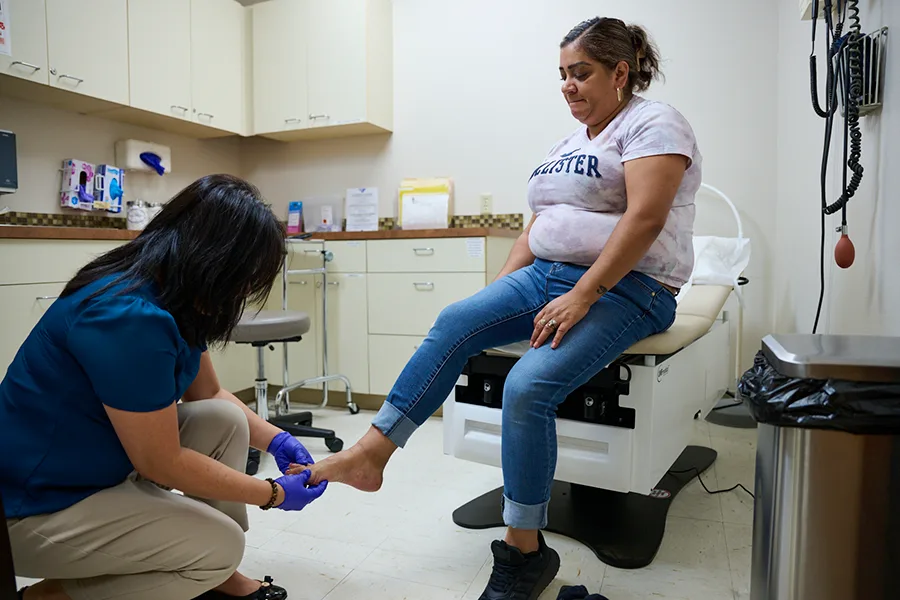
Vi-Thao Le, an Advanced Registered Nurse Practitioner from Kadlec Gastroenterology, checks the foot of Maria, a diabetic patient at Grace Clinic. People living with diabetes have a higher risk of nerve damage leading to foot ulcers. Last year, 250 volunteers like Thao made it possible for Grace Clinic to provide 7,815 total patient visits at no cost to the patients, equivalent to $818,560 at professional rates.
Courtesy Auston JamesKennewick’s Grace Clinic is bracing for a surge in patients.
The free medical and dental clinic – the only one serving both Benton and Franklin counties – expects demand to spike as Affordable Care Act insurance subsidies expire and Medicaid eligibility rules tighten under H.R. 1, the federal budget law also known as the One Big Beautiful Bill Act.
Clinics offering free care, as well as emergency rooms that can’t refuse service based on a patient’s ability to pay, are anticipating a sharp increase in the number of people seeking care.
“All of the free clinics are looking at the oncoming demand of people who need free care and see it like a tsunami,” said Christine Lindquist, executive director of the Washington Healthcare Access Alliance, or WHAA.
Grace Clinic saw 7,800 patient visits last year, provided 7,737 lab tests and 775 medications and supplies – all free of charge – at 800 W. Canal Drive.
“Our job is to address the needs of each person who walks through the door,” said Avonte Jackson, CEO of Grace Clinic, which will celebrate 25 years of operation next year.
The clinic is one of 77 free medical and dental clinics statewide that rely on volunteer healthcare professionals; the next nearest are in Yakima and Walla Walla.
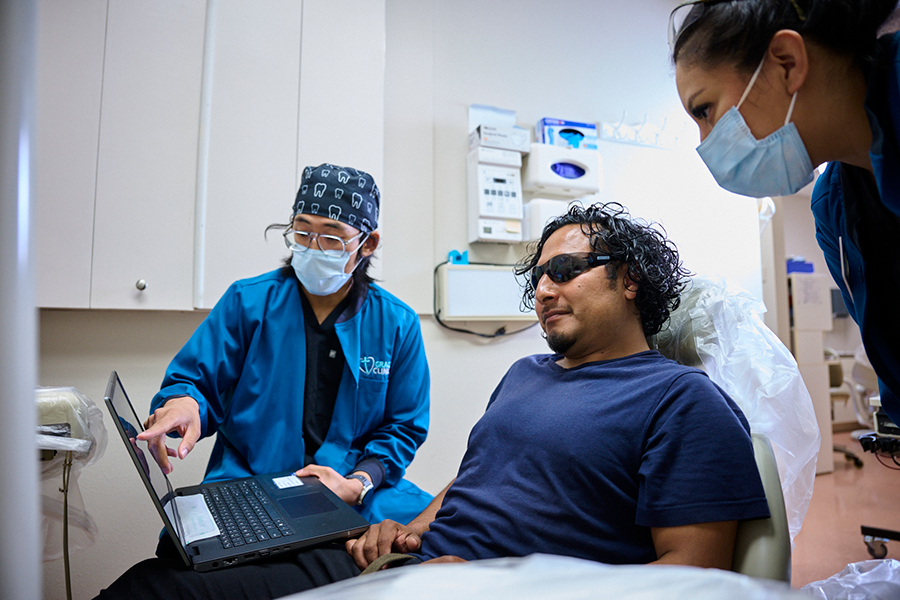
Grace Clinic volunteer dentist Dr. Max Cai shows Alejandro the images from his X-rays, while dental coordinator Geide Hernandez looks on. Last year, 84 volunteer dental professionals served 675 dental patients at Grace Clinic.
| Courtesy Auston JamesLoss of critical care access
Federal Covid-19-era subsidies that previously helped low-income people afford insurance coverage under the Affordable Care Act expired going into 2025, Lindquist said.
Then, starting Oct. 1, 2026, as a part of H.R.-1, some immigrants will no longer be eligible to receive Apple Health benefits, Washington’s Medicaid program.
According to the Washington State Health Care Authority, or HCA, those affected include asylees, conditional entrants, refugees, those for whom deportation or removal has been withheld, victims of trafficking, Violence Against Women Act self-petitioners and parolees.
Beginning Jan. 1, 2027, new eligibility requirements also will kick in requiring adult recipients aged 19-64 to work, train or complete community service for 80 hours per month with some exceptions.
Enrollees also will have to renew their coverage every six months instead of every 12 months.
HCA projects that between 200,000 and 300,000 people will lose Medicaid coverage across Washington.
Statewide healthcare exchange enrollments dropped as premiums doubled or tripled (without the subsidies). Franklin County faced a 116% policy cost increase; Benton County saw a 91% increase, forcing thousands of families to drop coverage entirely.
Many of those choosing to keep their plans are downgrading to lower-tier plans with 37% higher average deductibles to maintain some level of medical insurance.
Lindquist said that in Benton and Franklin counties, there are 102,335 people who receive Medicaid and 8,100 people between the two counties get their medical insurance on the healthcare exchange.
“Though not all are on Medicaid, we estimate – and this is very conservative – that probably 30% of those people will drop or lose their healthcare coverage,” she said.
In addition, in 2024, there were 38,000 uninsured people in Benton and Franklin counties according to Benton-Franklin Health District data.
“This is a way to create barriers to get people disenrolled,” Lindquist said, citing the administrative challenges facing some Medicaid recipients, including homeless individuals without stable housing.
“There is a lot of concern that people will lose coverage who should have coverage because the process is complicated,” said Mark Brault, president of the Grace Clinic board of directors.
Many of these community members, faced with forgoing medical coverage altogether, will turn to Grace Clinic for their medical, dental and mental healthcare.
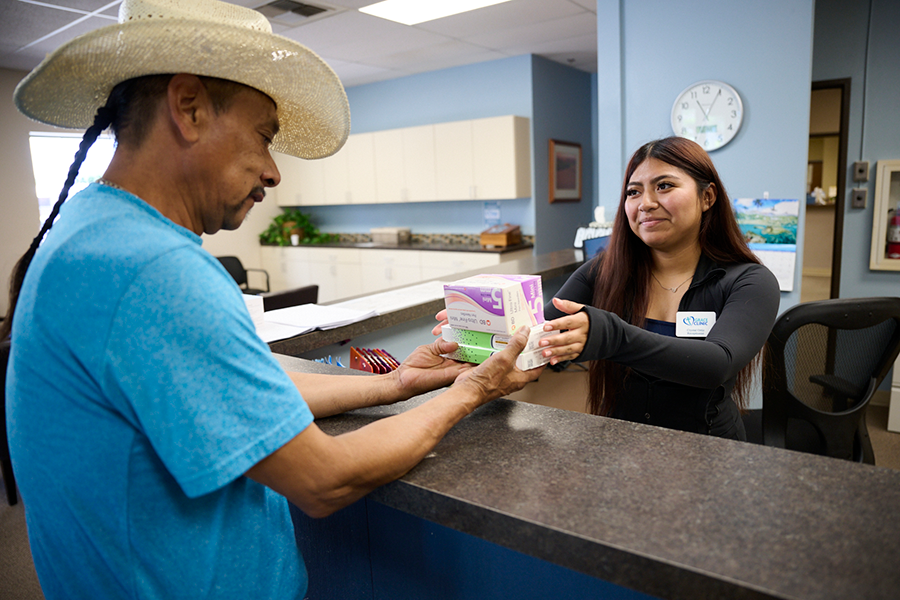
Oscar gets meds from Grace Clinic. Last year, clinic patients picked up free medications 775 times. Staff coordinate the extensive approvals and tracking with pharmaceutical companies so patients get the medications they need.
| Courtesy Auston JamesThe evolution of Grace
Grace Clinic started in the basement of First United Methodist Church in Pasco, thanks to Drs. Carol Endo and Cheryl Snyder who felt called to serve those in need.
It has grown dramatically over the years to meet community needs.
The clinic serves patients whose income is at 200% of the poverty level or lower.
Its typical patient receives no healthcare benefits from their employer, can’t afford to pay out of pocket and has a job that is hard on the body, such as those found in food service, construction, caregiving and the agricultural or janitorial sectors, Jackson said.
Grace Clinic patients often have chronic health conditions such as diabetes, high blood pressure or asthma requiring prescription drugs to manage.
They also typically have kids at home and may struggle to feed their family.
“A lot of our patients are working multiple jobs, but not enough hours in any one spot to receive medical benefits,” Jackson said.
Others, including some military veterans, can’t afford all parts of Medicare so rely on Grace Clinic for dental care.
The clinic provides free medical exams and treatment for chronic and acute conditions, dental services, mental health counseling, a prescription assistance program, food assistance and community referrals, as well as other periodically offered health services and screenings through community partners.
Grace Clinic also hosted 100 medical students, interns and trainees in 2025.
One patient, April, a 53-year-old restaurant server who loves her job and aspires to own her own restaurant one day, came to Grace Clinic after attempting to extract her own tooth with needle-nose pliers because she could not afford to go to a dentist.
“When I originally came in, I came in for the tooth but the doctor also said I had a goiter, so he diagnosed me with diabetes and a thyroid issue … Without having insurance I couldn’t get my (diabetes and thyroid) medication. And without Grace Clinic, I don’t think I’d know where I’d be,” April said.
Grace Clinic patients are identified on a first-name basis only to protect their privacy.
There are many similar patient stories of making do and doing without, which ultimately puts their health and life at risk.
“Meeting this need is keeping our community healthier,” Jackson said.
Grace Clinic is able to bring free healthcare to those in need through a network of 250 volunteer medical professionals largely from the Tri-Cities area and with the generous funding of businesses, organizations, families and individuals throughout Benton and Franklin counties.
WHAA manages the volunteer and retired providers who staff the clinics, contracting with the state to cover their malpractice insurance and license renewal costs.
“It’s so gratifying for people who go into healthcare careers because they want to help people. When they volunteer, they don’t have to worry about billing and insurance and can just focus on patient care,” Lindquist said.
Jackson said patient numbers have already been on the rise as changes tied to the ACA and H.R. 1 begin to take hold.
Though she said Grace Clinic is preparing to rise to the occasion and keep serving, it’s important now more than ever that the organization continues to garner the support of the community.
More volunteers – medically licensed or not – community partnerships, and medical equipment and financial donations are needed. Go to: gracecliniconline.org.
The clinic’s annual Zumbathon fundraiser is Sept. 26 at the Richland Community Center. To register, go to: tinyURL.com/Zumbathon2026.