Grant to help equip students for high-demand nuclear jobs
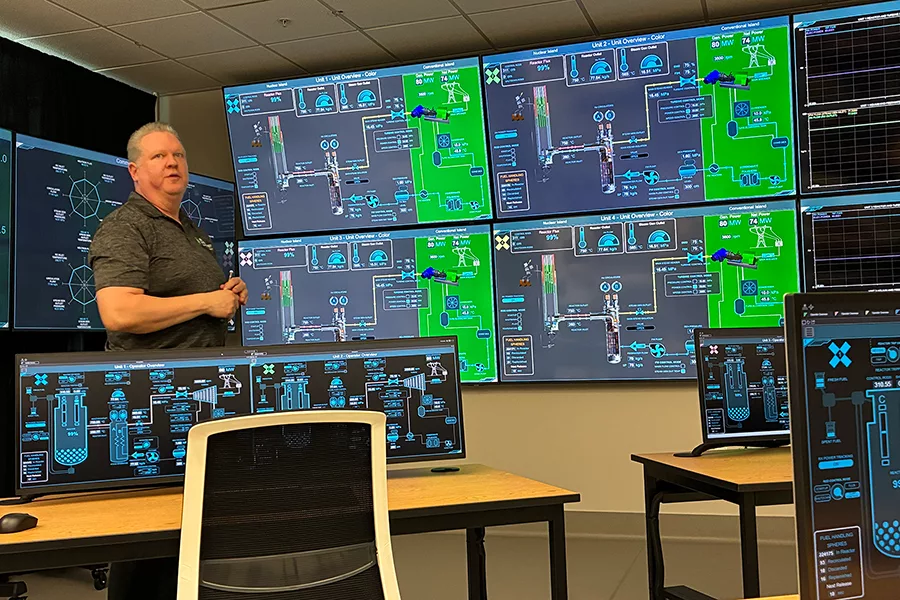
Chris Maxwell, Energy Northwest’s operations readiness manager for nuclear development, explains elements of the Xe-100 small modular reactor simulator at Washington State University Tri-Cities’ Institute for Northwest Energy Futures.
Photo by Ty BeaverThere were roughly 68,000 working in the nuclear energy industry nationwide in 2024.
And that isn’t enough, according to the director of the Nuclear Science Center at Washington State University’s campus in Pullman.
“There’s a shortage of nuclear workers now,” Corey Hines told the Tri-Cities Area Journal of Business. “You need nuclear engineers, yes, but so many supporting personnel.”
Federal officials project needing 375,000 skilled workers by 2050 to sustain ongoing nuclear power operations and continue next-generation reactor deployment. And now they’re turning to academic institutions, including WSU, to fill the gap.
The U.S. Department of Energy’s Office of Nuclear Energy recently awarded a $1.4 million grant to WSU to develop a Reactor Ready Training Program to address workforce gaps in the nuclear industry.
Over the next two years, the university will partner with Columbia Basin College and others in the industry to develop the curriculum necessary to prepare a new nuclear workforce.
WSU educators and officials said the grant will further burnish the university’s – and the Tri-Cities’ – future as a hub for nuclear workforce development. And the region’s already extensive nuclear infrastructure, experts and other resources will help set that workforce apart.
“We can do tours of Framatome, the Columbia Generating Station, Atkins Realis’ facility,” said Noel Schulz, director of the Institute for Northwest Energy Futures at WSU Tri-Cities. “We want to be industry-focused, not just theoretical study.”
Exponentially growing demands for energy in the U.S., partly driven by the deployment of energy-hungry data centers to power artificial intelligence, or AI, have motivated renewed interest and developments in nuclear energy.
The Tri-Cities is already seeing the nuclear power industry’s growth.
- Energy Northwest has partnered with Amazon and X-energy to build and launch small modular nuclear reactors, or SMRs, near the Columbia Generating Station north of Richland.
- Another nuclear tech company, General Matter, plans to potentially invest hundreds of millions in the region to develop new nuclear technologies, including at a dormant Hanford facility.
- Framatome, a long-established fuel manufacturer, continues to take steps and make progress toward expanding its capabilities and capacity to meet the industry’s growing and evolving fuel demands.
WSU is no stranger to training nuclear workers. The Pullman campus has trained nuclear power plant operators for 65 years using its Teaching Research Isotopes General Atomics, or TRIGA, nuclear reactor, initially to serve the Hanford site’s workforce needs.
CBC’s nuclear technology program has also contributed to the region’s nuclear workforce. Both institutions will make use of a new reactor simulator based at WSU Tri-Cities to train future SMR operators.
But the grant provides the opportunity to meet industry demand while also taking the region’s reputation for nuclear education to the next level.
“We’re very excited about this. It’s something we’ve wanted for a long time,” said Kate McAteer, senior associate vice president and vice provost for WSU Tri-Cities and WSU Everett. “All our partners in the nuclear industry have been approaching us for years about providing more workforce training and more grads.”
Hines and Schulz said they want to focus on developing a truly hands-on learning experience for future nuclear workers, whether they are enrolled in Pullman or the Tri-Cities. The reactor in Pullman and simulator in Richland will be part of that effort, but they also plan to lean on nuclear industry partners already in the region.
“We’re both experiential educators,” Hines said of himself and Schulz. “We want to get people in the lab space, in the nuclear facilities we maintain.”
“The opportunity in the Tri-Cities is so rich because of the history and the different folks we have in the community and the companies that are here,” Schulz added.
First steps will be talking to industry leaders to determine specifically what the workforce gaps are so the curriculum and courses can be designed to address them.
But there’s already new offerings on the horizon for those eager to be trained for the nuclear renaissance. Beginning this fall, WSU will offer a hybrid reactor training course available in Pullman and the Tri-Cities.