Cleanup budgets
Federal funding hits record for Hanford, but billions more needed
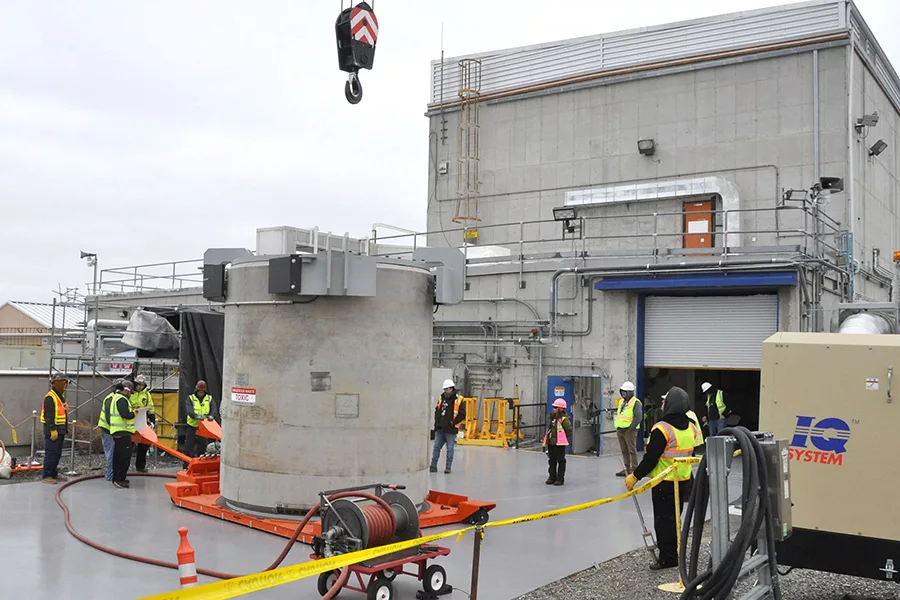
The first engineered concrete cask filled with radioactive capsules – weighing about 160,000 pounds – is moved out of the Hanford site’s Waste Encapsulation and Storage Facility and on to the truck port pad, where it is loaded on a transporter for the quarter-mile journey to the Capsule Storage Area.
Courtesy U.S. Department of EnergyFunding for Hanford site cleanup received its largest allocation ever in the federal budget for fiscal year 2026.
At $3.35 billion, it’s nearly 12% more than the budgets of each of the prior two years, which were also record amounts.
The funding includes roughly $1 billion in spending for the Direct-Feed Low-Activity Waste, or DFLAW, facility – currently in hot commissioning – and the High Level Waste, or HLW, facility still being constructed at the site’s Waste Treatment Plant, or WTP, also known as the vitrification plant.
Another portion of the allocation will pay to prepare the site to ship its transuranic waste off-site for long-term storage.
U.S. Sen. Patty Murray, D-Washington, said in a statement after Congress approved the funding in January that the funding bill delivers record funding to accelerate the cleanup effort sitewide. “This bill is a major step in the right direction,” she said.
But record funding does not mean a smooth path forward as each year the budget becomes a political battleground as it’s already shaping up to be for fiscal year 2027.
Hanford remains the nation’s most expensive and technically complex cleanup project, and delays, legal obligations and debates over how to treat tank waste – including whether to vitrify or grout certain wastes – mean the site could still take decades and tens of billions more to fully clean up.
Regulators, tribes and watchdog groups continue to push for oversight as the U.S. Department of Energy, or DOE, moves forward, making the work as politically and technically challenging as it is critical.
And this year’s funding milestone came only after a series of setbacks and challenges that threatened to slow the cleanup effort:
- The longest federal government shutdown in U.S. history that threatened to leave many of the thousands working on the site without jobs.
- Concerns that the Trump administration was seeking to save money by forgoing vitrification of waste at the WTP for a cheaper and faster treatment solution.
- Murray posing pointed questions to DOE Secretary Chris Wright about his agency’s delay in releasing appropriated funds for a subcontractor faced with laying off its workforce.
- An original White House budget proposal that slashed Hanford funding by tens of millions compared to then current levels.
Those series of events have left many observers – from local and state officials to federal auditors – skeptical that the cleanup will proceed without major setbacks.
Billions more needed
As of May 2025, DOE estimates it will cost $363.7 billion to $578.5 billion and another 60 to 75 years to clean up Hanford, according to the U.S. Government Accountability Office. More than $58 billion has already been spent on cleanup at the site.
Gov. Bob Ferguson called the recent budget for Hanford “a positive step” in the federal government’s obligation to clean up the site after it was approved in January.
But it isn’t a big enough one for DOE to satisfy timelines laid out in court orders, state officials say.
The Tri-Party Agreement, a binding consent decree between DOE, the U.S. Environmental Protection Agency and Washington Department of Ecology, sets specific requirements and benchmarks for the cleanup work. Along with timelines, it requires DOE to require a “compliant” budget request for cleanup operations so that the agency can meet the timelines.
Ecology officials said the federal government needed to appropriate $6.15 billion for the current fiscal year to meet those deadlines, and $6.76 billion will be needed in 2027. Those figures are calculated from DOE’s Lifecycle, Scope, Cost and Schedule reports issued every few years.
“When funding or other factors impact Energy’s ability to meet cleanup milestones, we and EPA are informed and the agencies try to work together on prioritizing work and/or negotiating impacted milestones,” Ecology spokesman Ryan Miller said in a statement. “We also retain our right to enforce if a milestone is not met and we can’t reach agreement.”
Growing expenses
Federal auditors, on the other hand, recently decried the growing expense and uncertainty of the Hanford cleanup effort and other contaminated sites managed by DOE.
In a March 2026 report, GAO officials said DOE’s Office of Environmental Management “struggles to maintain complete documentation and reconcile data discrepancies,” such as the federal headquarters having different cost and schedule information from a given site compared to its on-location office.
“Even if (Environmental Management) improves the completeness and consistency of information on its projects and activities, its cost and schedule estimates may still reflect significant uncertainty,” according to the report. “…officials from several sites told GAO that final cleanup remedies at their sites still need to be determined, which may increase costs and schedules.”
The report also identified hundreds of billions of dollars in potential savings, much of them at Hanford. They included:
- Grouting closed tanks in place, rather than removing them, saving $18 billion.
- Grouting a portion of low-activity waste, rather than vitrifying, saving up to $210 billion.
- Optimizing high-level waste treatment, savings tens of billions of dollars.
A fourth recommendation – optimizing transuranic waste shipments – would save $700 million across multiple sites, including Hanford.
DOE is seeking to put some of those recommended savings into action; GAO’s report notes that DOE officials along with the EPA and the state reached an agreement in January that includes a plan to grout some of Hanford’s low-activity tank waste and dispose of it off-site.
“The agreement contemplates that (Environmental Management) will grout low-activity waste from 22 tanks assuming (it) has a regulatory pathway to grout the waste and dispose of it off-site,” according to the report.
Some Hanford stakeholders in the past have opposed more extensive use of grouting to treat tank waste.
“We do not buy into the popular narrative that grout is the faster, better and cheaper solution,” said watchdog group Hanford Challenge in 2023. “Grout proponents sing the praises of cost savings and expediency, while underselling technical and cost-saving uncertainties and failing to adequately address the health and safety risks of a less protective waste form.”
DOE recently applied for an amendment to its permit for the Hanford site to allow it to grout, rather than vitrify, the byproducts of the vitrification process. The agency is currently accepting public comment on the permit change, and Ecology is expected to make a determination in May.
However, DOE pushed back on GAO’s recommendation to halt work on the vit plant’s high-level waste facility.
“DOE stated that pausing activity on the facility would be in conflict with existing cleanup milestones and proposed changes to those,” a note in the report read.
And despite Congress increasing the budget for cleanup at Hanford in current budget, the White House is again pushing to reduce it. President Donald Trump’s proposed fiscal year 2027 budget cuts funding for the Office of Environmental Management, which oversees Hanford, by 5%, or about $386 million, with the bulk of those cuts being made at operations at Hanford.
Unsustainable budgets
Also in March, the Hanford Advisory Board, in its latest guidance to DOE, urged the federal agency to find ways to accelerate cleanup and reduce expenses.
“Based on recent funding levels, the HAB has concerns that such funding will not be available,” the group wrote in its latest advice. “Without increased funding to meet milestones, cleanup of the Hanford site will cost more and take longer.”
The group’s specific recommendations focus on DOE increasing collaboration with HAB and the public as a means to find efficiencies and move through timelines quicker.
“Anyone who’s been involved recognizes these budgets are unsustainable,” said Chuck Torelli, Kennewick mayor pro tem and a designated HAB member who did not provide input on the guidance because he has not yet been confirmed.
As for individual cleanup activities, HAB advocated for DOE applying lessons from construction of the DFLAW facility to the ongoing construction of the HLW facility so tanks can be cleared as quickly as possible. It also stressed completing the movement of cesium and strontium capsules to dry storage before the 2029 deadline, optimizing groundwater treatment and prioritizing transport and off-site disposal of transuranic waste.
Forward progress
Despite ongoing delays, funding uncertainties and regulatory hurdles, those working at Hanford are pressing forward and making progress.
Ray Geimer, director of DOE’s Hanford Field Office, said as much in his comments at the Waste Management Symposium in Phoenix, Arizona, in March. “What you’re seeing now is the result of decades of engineering, planning and workforce commitment,” he said. “We are building on those successes to move the mission forward, continue reducing risk and deliver meaningful progress for the region, the community and the nation.”
Among the past year’s milestones are beginning to vitrify, or stabilize in glass, waste from the site’s leaking underground tanks as well as transferring the first cesium capsules to dry storage to further reduce risk.
Torelli and other HAB members told the Journal that they see promise with grouting having a greater role in treating waste at the site.
“I think in the long term we need to look at ways to reduce costs,” said David Reeploeg, vice president of federal programs at Tri-City Development Council, or TRIDEC, and a designated HAB member. “Grouting is one of those prime opportunities.”
Even Hanford Challenge sees the potential for something great to come from the work at Hanford, with the messy work of cleanup emphasizing the importance of collaboration.
“Hanford cleanup could be the model we need: A reminder that even in an era of deep division, we can work together, argue in good faith, and keep moving toward solutions none of us could reach alone,” wrote executive director Nikolas Peterson, in a column for the Journal.