Northwest late summer days marred by historic drought, exacerbating wildfires
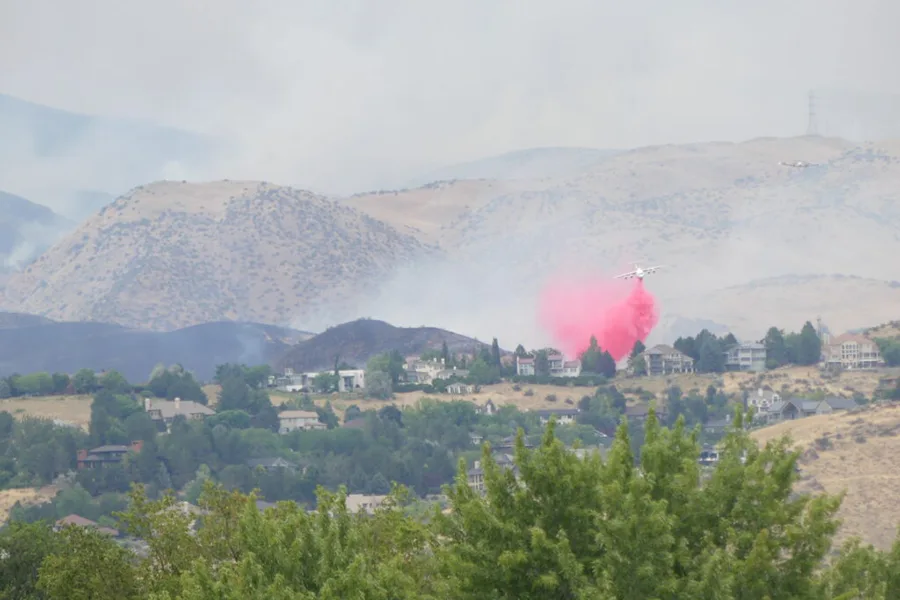
Firefighters on the Claremont Fire in Boise, Idaho on July 6, 2026. Drought across the Northwest has exacerbated wildfire conditions in the region.
Photo by Brenen Helgerson / National Interagency Fire CenterThe last weeks of summer find Oregon and much of the Northwest experiencing historic drought, exacerbating what has become one of the most active wildfire seasons in the state and region, according to state and federal climatologists and hydrologists.
Beyond fish and ecological impacts, drought across Oregon, Idaho and Washington is causing water supply shortages for public water and electric utilities, costing farmers tens of millions of dollars in lost crops and leaving vegetation and soils dry and susceptible to fires.
Wildfire and drought maps overlaid by Oregon’s State Climatologist Larry O’Neill on Monday during an online drought and climate outlook meeting hosted by the National Oceanic and Atmospheric Administration show the summer’s wildfires popping up over historically dry areas of the state and region.
About 4% of Oregon’s total land area — 2.4 million acres of mostly rangeland — has burned in the current fire season, most of which occurred within a one-month period. Overall, about 3.5 million acres have burned across the Northwest, including fires in and around Spokane that became some of the most destructive in Washington history.
“Drought didn’t cause these ignitions, but they created the conditions with exceptionally dry vegetation and fuels that favor rapid fire growth and extreme impacts once those fires started,” O’Neill said.
He and Catherine Fitzpatrick, a hydrologist at NOAA’s Northwest River Forecast Center, detailed water levels and conditions in the Northwest’s rivers, reservoirs and snowpack for a 90-day period, as well as the impacts of temperature anomalies.
Even with a potential deluge of precipitation this winter in what O’Neill expects to be a “very strong” or “super” El Niño weather pattern, water reservoirs in the region are so depleted that there’s unlikely to be much carryover in water supplies into next year, the two warned.
“Across the Pacific Northwest we’re substantially depleting our reservoir storage, and now we’re getting into kind of the later part of August and September, and reservoirs are being emptied out,” O’Neill said. “There’s little hope for carryover into the next water year, and then as I mentioned earlier, we’re seeing record low stream flows occurring in all three states.”
Anomalous heat
Most of eastern Oregon and southern Idaho have experienced summer temperatures 2 to 4 degrees Fahrenheit above normal, following what was the warmest fall and winter on record for the entire region, where temperatures in Oregon and Idaho were 3 to 5 degrees Fahrenheit above normal.
Most of Oregon east of the Cascades has in the last 90 days experienced “extreme drought,” a NOAA designation indicating major crop and pasture losses, and widespread water shortages or restrictions. About 4% of Oregon in and around Grant, Baker and Wheeler counties in the eastern part of the state are in what NOAA classifies as “exceptional drought,” meaning it reached historic levels, among other indicators.
It’s the second time since 2000 that Grant County has received the designation. Despite being surrounded by the Blue Mountains, the area saw the lowest snowpack on record this winter.
About 8% of Idaho is experiencing exceptional drought, particularly in Owyhee, Twin Falls and Cassia counties in southern Idaho. Cuts to irrigation water supply for Idaho farmers have cost them $20 million so far according to crop insurance indemnities that are being paid out, O’Neill said, but the total cost is likely to be far higher as many claims won’t be processed until after the growing season ends.
In the Yakima Basin in Washington, water users are receiving about 58% of their allotment. That includes the Roza Irrigation district, which supports more than $1.5 billion in annual agricultural revenue for the state. In Clallam County on the Olympic Peninsula, some water system operators have floated trucking in water for users after stream flows declined, and many are requiring users to undertake mandatory water saving measures and to curb use.
In Oregon, the Water Resources Department cut senior water right holders’ allotments for the first time, O’Neill said, and some irrigators in the Umpqua Basin in Southwest Oregon are forgoing irrigation. He added that any water carryover in larger reservoirs in 2027 is likely to be non-existent to very low across all of Central and Eastern Oregon.
Some impacts “still have yet to rear their ugly head,” he added.
Drought-exacerbated wildfires
Due to a dry winter and hot spring and summer, many parts of the region experienced record levels of “evapotranspiration” from the landscape, a process whereby water evaporates from soils and vegetation and is lost to the atmosphere.
Soil moisture levels have plummeted in areas where Oregon is experiencing record acreage losses to wildfire. Most of that has been burned grasses in rangeland areas, including areas that have been burned multiple times over the last decade, according to Jessica Neujahr, a spokesperson for the Oregon Department of Forestry.
“We have been seeing fires burning in old burn scars for over a decade now. It is happening with more frequency especially in the rangeland areas, as it only takes a year or two for those areas to be ready to burn again,” Neujahr said in an email.
This story was originally produced by Oregon Capital Chronicle, which is part of States Newsroom, a nonprofit news network which includes Washington State Standard, and is supported by grants and a coalition of donors as a 501c(3) public charity.