Spokane fires could be latest disaster to unsettle property insurance market
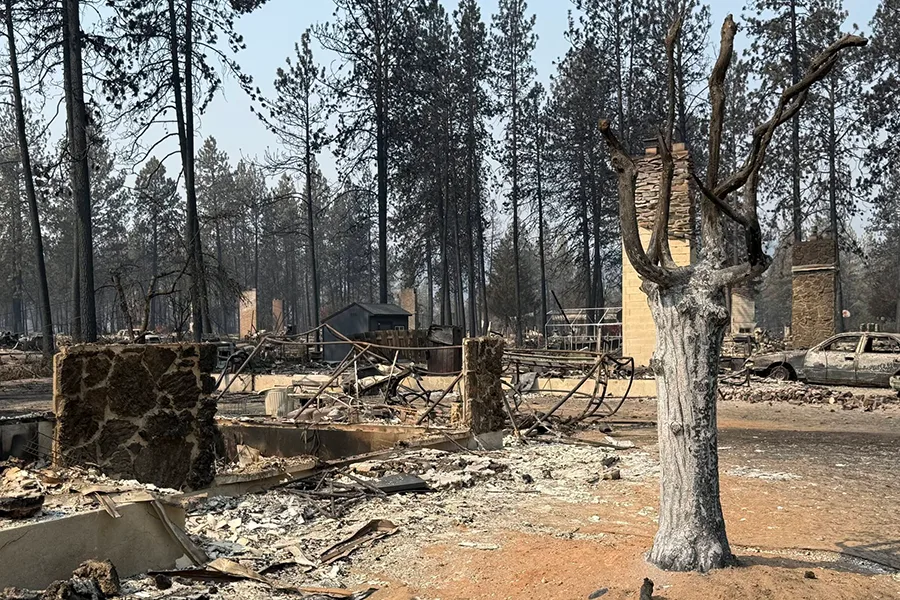
Damage from the fires in the Spokane area that began on Aug. 1, 2026.
As Washington state reels from a devastating wildfire that destroyed hundreds of homes in Spokane last weekend, experts say the disaster has cast newfound uncertainty over a property insurance market that had just begun to stabilize.
Across the country, insurance companies have withdrawn coverage or raised premiums in areas threatened by climate-fueled disasters. In some places, such as California, those trends have triggered a full-blown crisis, with private companies abandoning disaster-prone areas and leaving state-backed “last resort” insurance plans to assume more and more risky policies.
Now, officials and consumer advocates worry that Washington ratepayers could be the latest to face financial repercussions in the wake of disaster.
So far, the state had avoided such drastic impacts. While some residents have had their policies canceled or seen their premiums rise in recent years, Washingtonians have largely been able to find coverage on the private market. In recent months, the state has seen a decline in companies canceling property insurance policies, and rates have stabilized. Over the past three quarters, Washington’s “last resort” FAIR Plan has plateaued at roughly 400 policies. That’s a far cry from the hundreds of thousands of Californians who rely on FAIR Plan coverage.
“The market was heading totally in the right direction,” said David Forte, senior property and casualty policy adviser with the Washington State Office of the Insurance Commissioner. “We had stabilized, and we were heading into a price-competitive market.”
That stability has been thrown into question. A wildfire jumped the Spokane River Aug. 1, driven by high winds, and swept through the northwest portion of the city. Roughly 700 homes were destroyed, 60,000 residents were evacuated, and officials say it will take some time to get a full picture of the damage. While fire crews continue to battle the blaze, leaders say it is already one of the most destructive fires in the state’s history.
Forte said state insurance regulators have put out a call for data from insurance companies, seeking to get a clearer sense in the coming weeks of the scope of damage and policy claims. He said Washington also faced a destructive fire season in 2023, with insurance companies paying out $240 million in claims related to wildfires.
“If (the 2026 wildfire season) is comparable to 2023, I think the market can probably absorb it,” he said. “But if it’s triple that, there may be an impact.”
The bigger concern than the specific dollar figure of the Spokane disaster, Forte said, is that insurance companies might get spooked. More than 2 million acres have burned this year across Oregon and Washington, exceeding all other regions of the country.
“More important is the perception of the risk,” he said. “Now we have what’s happening in Oregon, the largest acreage (burned) in state history, combined with (the Federal Emergency Management Agency) declining their emergency applications, at the same time that we have this catastrophic event in a major city in Washington state.”
Neighboring Oregon has suffered devastating wildfire seasons in recent years. Residents there have been hit with rate hikes and a rise in policy cancellations, and a growing number have turned to the state’s FAIR Plan for coverage. Still, the trends there have been nowhere near as extreme as those in California.
Insurance industry officials said it’s too early to tell just what effect the Spokane disaster will have on the market, but it could prompt insurers to push for changes.
“Our continued priority is to make sure that there’s a fair and flexible regulatory environment that affords companies the ability to be there in the market,” said Adam Shores, senior vice president of state government relations with the American Property Casualty Insurance Association, an industry group.
“That looks like making sure that the rate reflects the risk and to make sure that carriers can price the risk based on what we’re seeing with real time experience. Certainly events like this factor into what that risk looks like.”
Some consumer advocates said Washington residents should brace for insurers to seek rate hikes and policy cancellations in the wake of the fire.
“Insurance companies tend to be opportunistic when calamity happens,” said Doug Heller, director of insurance with the Consumer Federation of America, a research and advocacy nonprofit. “I fully expect the insurance companies to try to leverage the severity of this disaster to get rate increases, to argue for the ability to put new limits on coverage.”
Carmen Balber, executive director of the nonprofit advocacy group Consumer Watchdog, said insurers have used wildfire in California to push for favorable regulations.
“They threatened higher rates, and they threatened to leave the state unless the Department of Insurance endorsed big rollbacks,” Balber said. “There’s a real danger that the industry looks at that same playbook to extract concessions from (Washington) lawmakers and regulators.”
Other insurance industry officials say those concerns are overblown.
“This catastrophe that we’re experiencing right now (in Spokane) is not going to upend the market,” said Janet Ruiz, strategic communication director with the Insurance Information Institute, an industry-backed research group. “An event like this is not a surprise. It’s unfortunate, and we hate to see it happen, but they’re not surprises and we’re preparing for them. One event doesn’t drastically change the market.”
State officials, consumer advocates and insurance industry leaders all urged homeowners and communities to invest in wildfire mitigation efforts, such as removing vegetation and using fire-resistant construction materials.
For Forte, with the state insurance commissioner’s office, the biggest indicator of the Spokane fire’s effect on the market will be whether enrollment increases in the state’s FAIR Plan. Many states have established similar “last resort” plans for residents who can’t find coverage on the private market. A surge in enrollment would indicate that companies are refusing to cover certain areas.
“What broke the (California) insurance market is the urban fires,” Forte said. “…In northwest Spokane, it is in neighborhoods. It looks like a California event. It is too early to tell, but I don’t know how (insurance companies) are going to react.”
In California, the state FAIR Plan now has nearly 700,000 active policies. After the FAIR Plan took on many policies in the Los Angeles area, its reserves were wiped out following the 2025 wildfires that destroyed thousands of homes. That triggered an unprecedented $1 billion assessment on insurance companies and ratepayers in California.
“A FAIR Plan that has more policyholders than it has reserves to cover is a dangerous situation,” said Balber, the consumer advocate. “Washington is clearly far from that situation. This is an opportunity to think about ways to prevent that from happening.”
While Washington’s situation is not nearly as extreme as California’s, Ruiz, with the industry research group, said wildfires are still changing the market. Homeowners may have to do more shopping to find an insurer or secure a policy before closing a home sale with a realtor.
“I do think the market in Washington is still fairly stable, especially if you’re going to compare it to California,” she said.
On Aug. 3, Washington Insurance Commissioner Patty Kuderer issued an emergency order giving residents a grace period for premium payments, preventing insurers from canceling a policy for nonpayment and extending the notice period for expiring policies. The order applies to all ZIP codes where fires have burned homes or other structures. She also announced that a previously planned town hall in Spokane this week would be focused on providing resources for survivors.
Forte, with the insurance commissioner’s office, said it will take some time to determine the disaster’s effect on the state’s insurance market.
“There’s just uncertainty. It’s too early to tell,” he said. “We’ve got to figure out the scope of loss, the severity of the damage. Our focus right now is to help the survivors get their claims going in the right direction.”
This story was originally produced by Stateline, which is part of States Newsroom, a nonprofit news network which includes Washington State Standard, and is supported by grants and a coalition of donors as a 501c(3) public charity.