Solar sludge
Kennewick gives sewage a second life
Kennewick to fire up $43M solar biosolid fertilizer plant by end of May
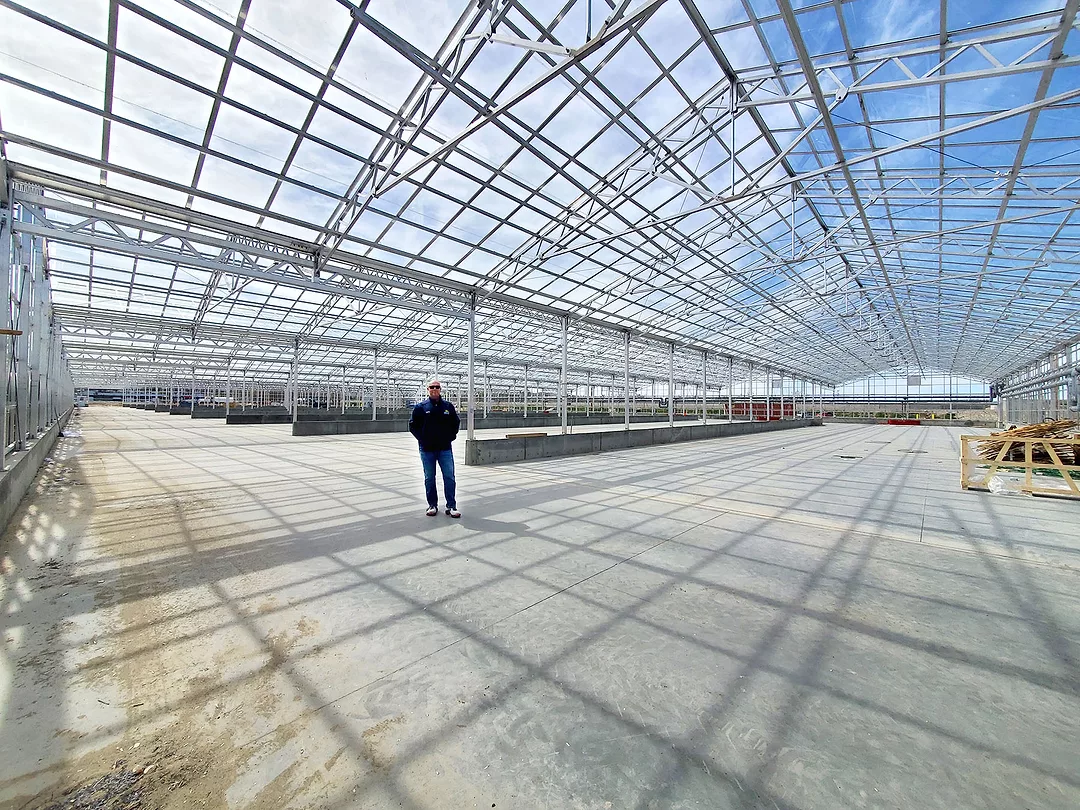
Dustin Gerlach, lead wastewater treatment plant operator for the city of Kennewick, stands in the 150,000-square-foot greenhouse where biosolids will be spread to dry.
Photo by Laura KostadIn Kennewick, a long row of greenhouses won’t be growing plants.
Instead, they’re part of a nearly complete $43 million expansion tucked into the back corner of the city’s wastewater treatment plant off South Nutmeg Street, which handles everything flushed down toilets and drains. The project, expected to wrap up by the end of May, includes 10 greenhouses and a tractor.
But instead of cultivating crops, the city will use a greenhouse to harness solar energy to upcycle waste byproducts it was formerly paying to dispose of into a new revenue stream: nutrient-rich Class A fertilizer.
The source? Biosolids produced from sewage sludge.
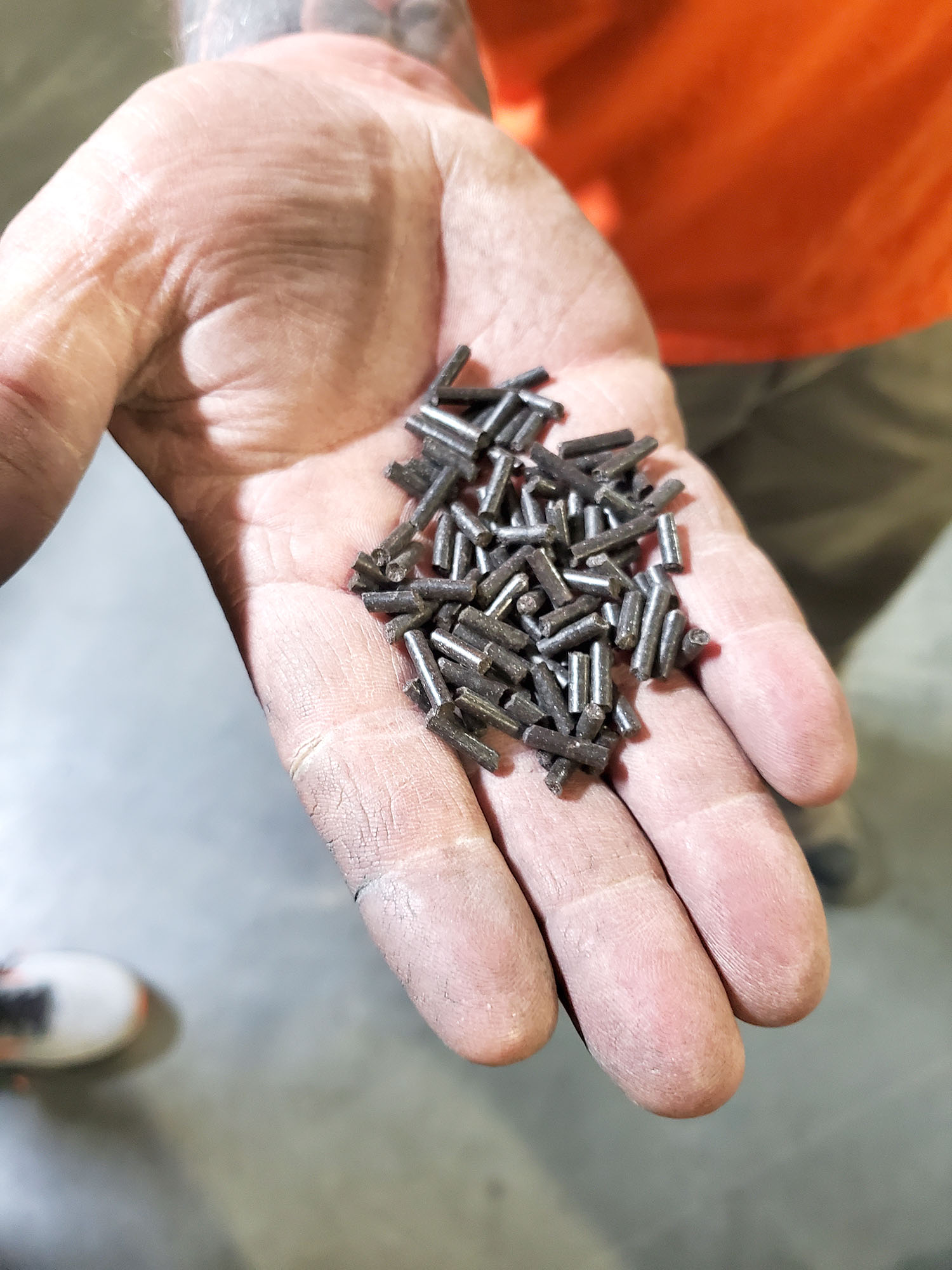
The fertilizer plant’s pelletizer is capable of producing pellets this size that could be sold to residential users in the future.
| Photo by Laura KostadFrom raw sewage to fertilizer
Sewage sludge doesn’t sound glamorous, but it’s a nutrient-rich, semi-solid material created when sewage is treated to separate liquids from solids.
The city plans to use and publicly sell the fertilizer.
Kennewick faced rising costs and limitations with its existing lagoon system, prompting the city to explore new options for handling wastewater solids. After considering approaches used by neighboring cities, officials chose a path that would modernize the facility and improve the final product.
Another bonus? It will be less smelly.
Kennewick’s existing sludge wastewater treatment plant processes about 2 billion gallons of sewage each year using microorganisms to break down the waste before it is treated and returned to the river cleaner than when it was pulled out, said Dustin Gerlach, Kennewick’s lead wastewater treatment plant operator.
Though the final product that makes it to the river is water, the solid material settles out in two open sewage lagoons just off Chemical Drive, also known as Highway 397.
“Every three to five years we dredge those lagoons and alternate back and forth,” said Jeremy Lustig, city of Kennewick’s deputy public works director.
The dredged solids are then run through a contractor’s belt presses and transformed into Class B (non-pasteurized) fertilizer and sold to Sunnyside-based Natural Selection Farms to be used on non-food crops.
“It used to be five to seven years (between dredgings) but with (city) growth that time frame is getting less and less,” Lustig said.
At a cost of $3 million to $5 million for each dredging, it was also becoming increasingly expensive to maintain, according to Indiana-based Merrell Brothers, the contractor which has performed the last two dredgings.
“The lagoons are also the source of a lot of air quality complaints over the years so the primary goal was to get away from the lagoons and that older treatment process,” Lustig said.
The city initially considered adopting a model used by neighboring Richland and Pasco and other municipalities to process solids using anaerobic digesters and drying beds. But that method would have still churned out a Class B fertilizer.
However, in 2017, Merrell Brothers pioneered an innovative new method and debuted it at a municipal facility in Pasco County, Florida.
Kennewick officials visited the new plant and were intrigued.
Sewage sludge enters the Merrell facility at about 5% solid material by volume and is processed through belt presses to increase that to roughly 20%.
The biosolids are then transferred to greenhouses where the natural heat coupled with the assistance of fans and a tractor to periodically turn them over aids in drying them to roughly 60% solid material by volume.
The biosolids are then loaded into a thermal pasteurization oven to kill pathogens and then are pelletized into Class A fertilizer, resulting in about 80% solid material.
This higher grade can be sold more broadly and used on food crops, golf courses, home gardens and more at a variable price, depending on whether it’s left as is, pelletized or powdered.
Bringing it to Kennewick
Merrell Brothers sized a small pilot greenhouse facility on-site in Kennewick to test the concept under local climatic conditions, which was then used to plan the full-scale plant.
The Kennewick wastewater plant at 1010 E. Chemical Drive features 150,000 square feet of greenhouse space – bigger than two-and-a-half football fields – with heated floors for the winter months, a 25,000-square-foot dewatering and processing facility, and 1.2-million-gallon biosolids holding tank that can accommodate roughly four days’ worth of sludge buildup.
Meanwhile, Lagoon 1, which is rock lined, will be decommissioned while Lagoon 2, which is fully lined, will serve as a holding pond for fluids produced from the dewatering process to take pressure off the treatment plant.
The lack of solids in the lagoon will eliminate the current odor issues.
The city was able to secure a Washington State Department of Ecology loan for $33.5 million to put toward the project, of which $6.1 million is forgivable once the plant is complete.
Three new wastewater treatment plant operator positions are being added to the crew to staff the plant and two existing employees also will move to the new facility.
“Kennewick is positioning itself as a progressive leader in municipal biosolids management, embracing cutting-edge solutions that set a benchmark for other cities,” Lustig said.
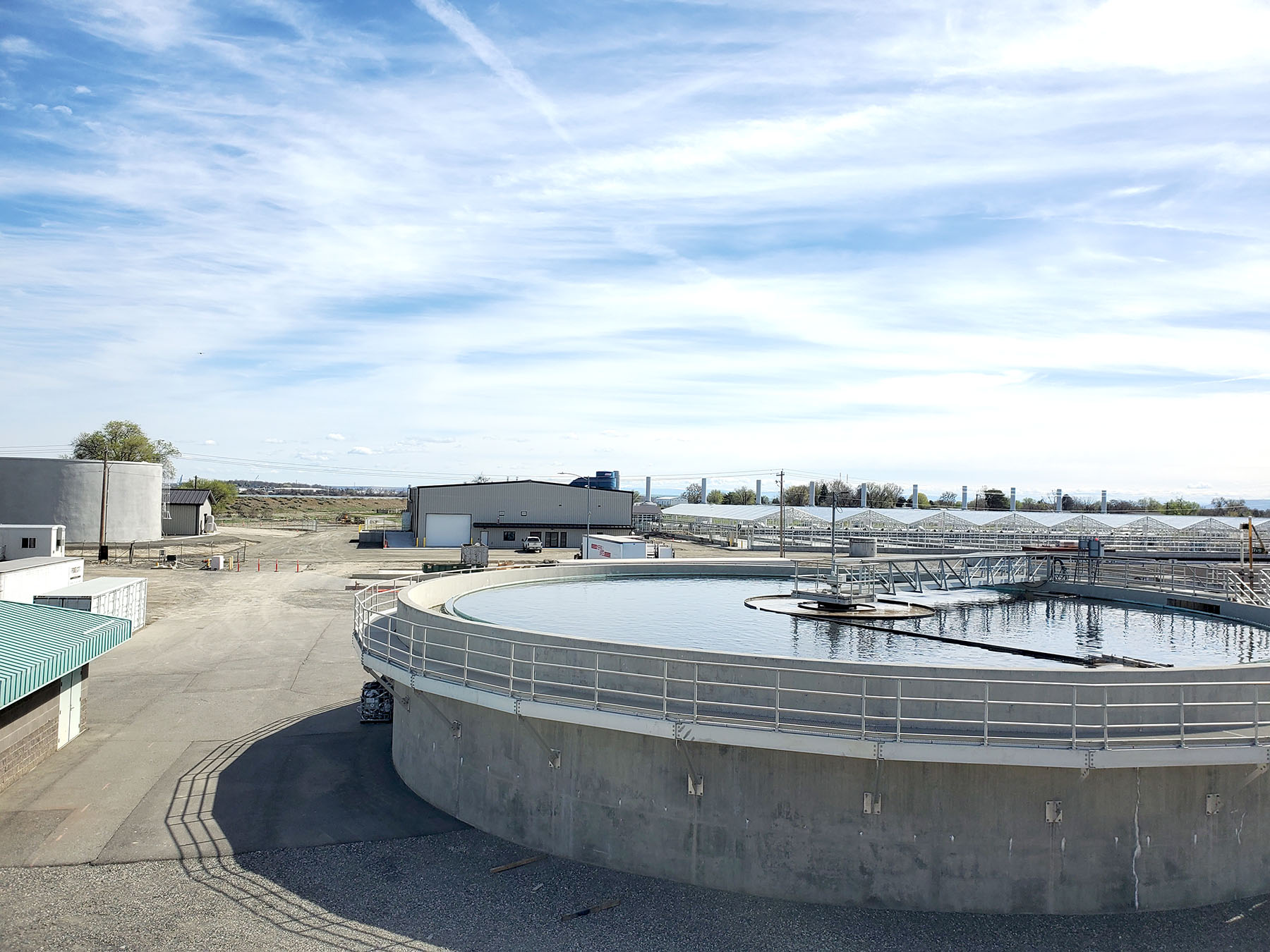
The city of Kennewick’s new biosolid fertilizer production greenhouses, shown in background, are on track to be completed by the end of May. Biosolids from the city’s wastewater treatment plant will be converted into Grade A fertilizer.
| Photo by Laura KostadKenneGro
Kennewick’s fertilizer blends will be called KenneGro.
Lustig said that there has already been interest from other Tri-City municipalities who want to drop off their biosolids for processing as it will be cheaper to bring it to Kennewick than hauled elsewhere.
In addition to potentially using the local fertilizer on city-owned landscaping, it also will be sold to the public. Initially, it will be available only in bulk quantities. A weigh station in front of the dewatering and processing facility will allow customers to weigh in and weigh out, much like the process at a bulk landscape supply store.
A future expansion could include bagged KenneGro products. Depending on demand and cost, bagging machinery and a building to house it may be part of a future plant expansion.
There is room on site for future growth, including another 1.2-million-gallon holding tank and other equipment as well as additional greenhouses.
An official ribbon cutting ceremony for the plant is planned for May 27.


Stay Informed. It’s Free.
Subscribe to our newsletters and get the latest news and insights delivered to your inbox.
We respect your privacy.
Unsubscribe anytime.
Thank you!
You’re subscribed. Keep an eye on your inbox for the latest updates.