Kennewick plans $33M PFAS treatment plant after repeat detections
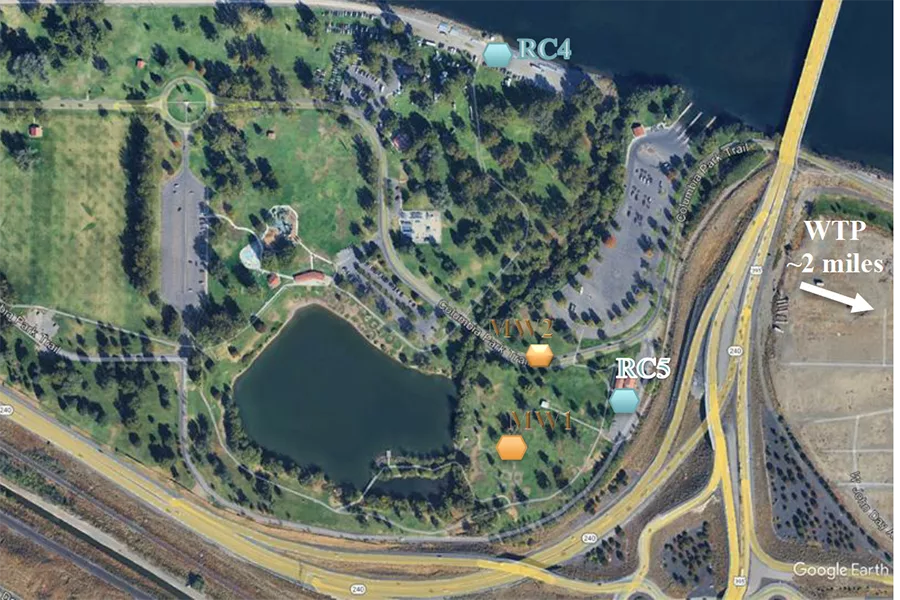
The city of Kennewick’s $33 million PFAS filtration plant (at RC5 on the map) will go out to bid this fall with plans to be up and running by summer 2028, ahead of the enforcement of new federal max contaminant levels for PFAS contamination.
Courtesy city of KennewickThe city of Kennewick plans a $33 million water treatment facility after detecting PFAS levels above Washington state action levels in March 2024 and March 2025.
City officials said there is no immediate health threat, but the project is driven by tightening state standards and upcoming federal regulations that will lower the maximum PFAS contaminant level to 4 parts per trillion (ppt).
Corrective action was required if rates were higher than 15 ppt.
In Kennewick, 17.9 ppt detected in 2024 and 16.7 ppt detected the following year triggered mandatory quarterly testing and public notification, said Jeremy Lustig, the city’s deputy public works director.
“One part per trillion is the equivalent of a single drop of PFAS in a volume of water equivalent to 20 Olympic-size swimming pools,” he said.
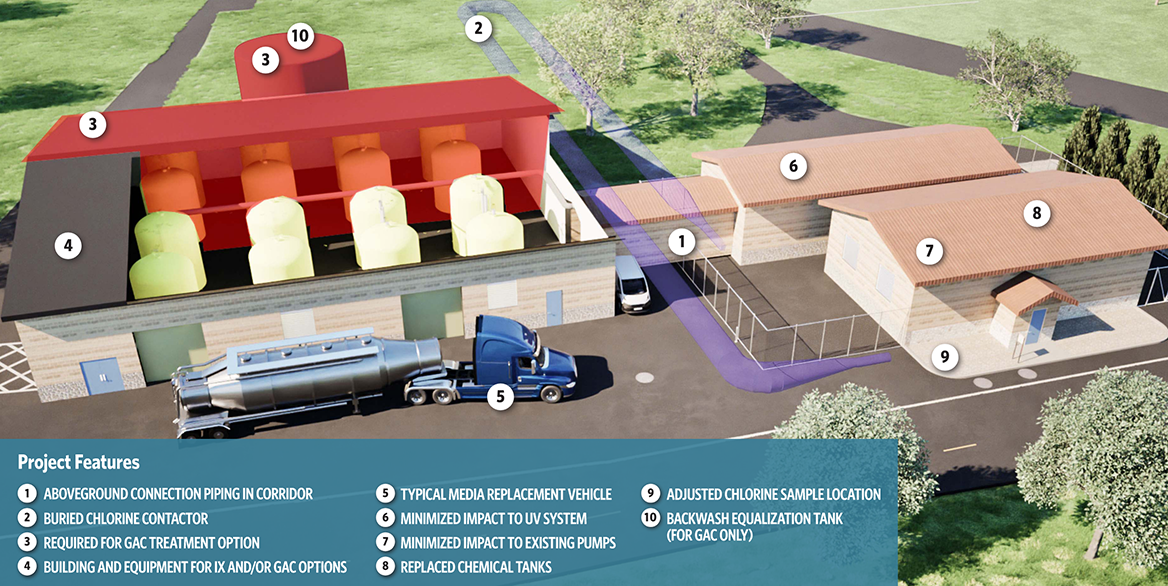
The city of Kennewick’s $33 million PFAS filtration plant will go out to bid this fall with plans to be up and running by summer 2028 ahead of the enforcement of new federal max contaminant levels for PFAS contamination.
| Courtesy city of Kennewick
Forever chemicals
PFAS, or per- and polyfluoroalkyl substances, are known as “forever chemicals,” and they’re widely used in consumer and industrial products and persist in the environment.
Kennewick, the Tri-Cities’ largest municipality, first detected low-level concentrations of PFAS in its water in July 2022.
The city said levels are influenced by seasonal conditions, including precipitation and agricultural activity.
The elevated readings were found at Ranney Collector 5 (RC5), a drinking water supply that provides about 60% of the city’s annual water demand and is used year-round. The water comes from ground and surface water. RC5 is located at Columbia Park’s southeastern corner, near Kennewick’s new dog park, Columbia River Dog Park, Columbia Park Pond and the Highway 240 blue bridge onramp.
The city’s water treatment plant, located about two miles away near the cable bridge, provides 40% of the city’s annual water needs and so far no PFAS has been detected at that facility. This water comes from the Columbia River. This plant goes offline during the winter when water demand is low.
“We had a plan this year to reduce (PFAS) via blending (in additional) water at RC5 to reduce the overall concentrations. Our concentration in March of ’26 was less than the state’s previous state action level of 15 ppt. However, they changed their state action levels in January 2026 to match the future EPA (maximum contaminant levels) at 4 ppt,” Lustig said.
The blending effort has been hampered by high turbidity caused by sediment released when the Bateman Island causeway was removed this winter.
Though the increased sediment has affected the efficiency of the water treatment process, it has not contributed to PFAS levels.
Lustig said he anticipates that until the new treatment facility is in place, Kennewick’s water will continue to average above the new state action level of 4 ppt.
Project bid
The city expects to put the project out to bid this fall, with construction scheduled for completion by summer 2028, ahead of the new federal limits.
The PFAS treatment facility will be built at RC5 and will use granular-activated carbon filtration, a process that removes PFAS by passing water through large carbon filter media. The filter material is expected to be replaced on a multi-year cycle.
A 2024 analysis identified treatment at RC5 as the lowest lifecycle cost option.
The city hired Hazen and Sawyer, an engineering firm specializing in water treatment, to design the facility.
The state has awarded $15 million toward the $33 million project through the Drinking Water State Revolving Fund, including $5 million in forgivable funding.
The city is continuing to pursue grants and low-interest financing. But for now, the remaining $18 million will be financed.
“The remainder will need to come from ratepayers,” Lustig said. “Those costs have already been included in a previous rate study.”
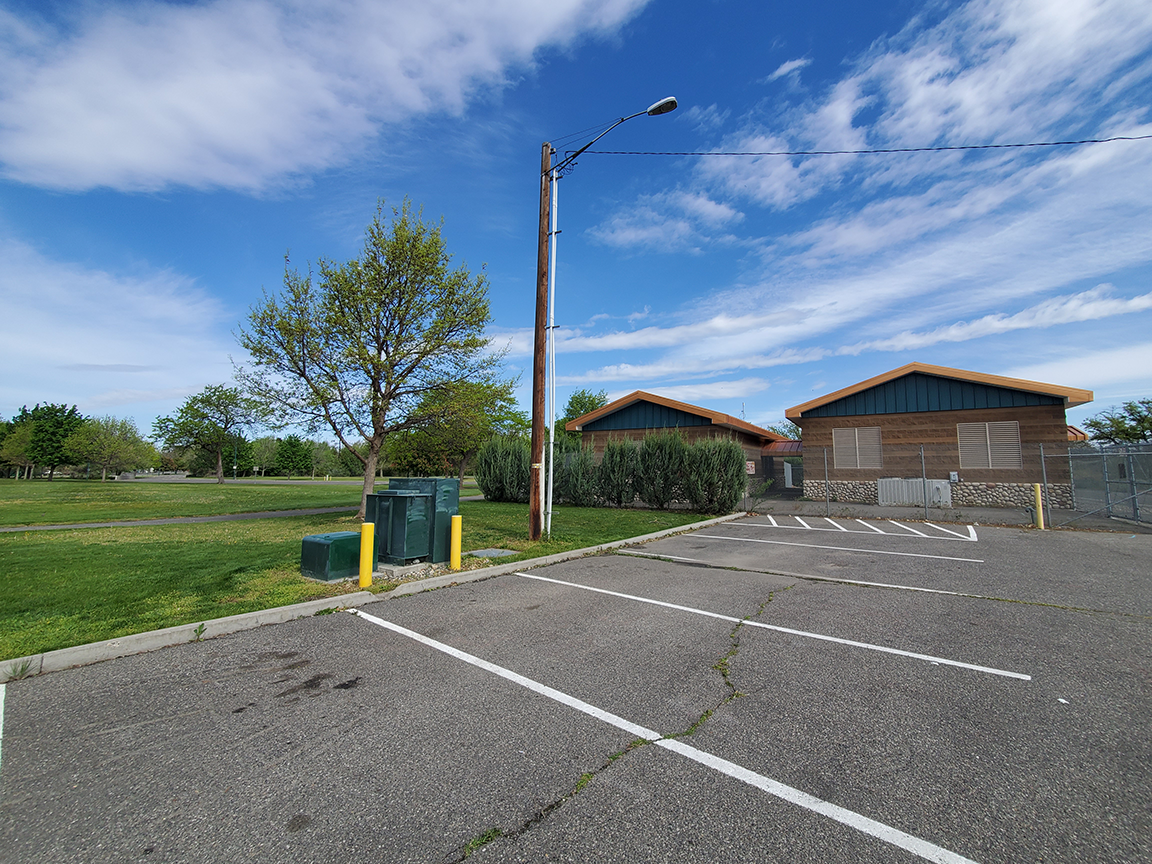
The new PFAS filtration plant will be built next to Ranney Collector 5, pictured above, a drinking water supply that provides about 60% of the city’s annual water demand and is used year-round. The collector is located at Columbia Park’s southeastern corner, near Kennewick’s new dog park, Columbia River Dog Park, Columbia Park Pond and the Highway 240 blue bridge onramp.
|Photo by Laura Kostad
PFAS in the region
PFAS water contamination has been identified elsewhere in the region. State data show no detections in Pasco’s water supply, while Richland has reduced levels through blending.
Downriver, the Burbank Business Park water system has collected samples contaminated above the state action level.
Kennewick is also investigating trace PFAS detections in its aquifer storage and recovery system near Southridge High School, which is used to store water underground for peak summer demand.
“It could be an indication of contamination of the groundwater there, but it’s 1,000 feet down, so hard to imagine it would be the problem,” Lustig said.
City officials said they are increasing the supply of water from the treatment plant – which has tested free of PFAS – to help dilute PFAS concentrations in the aquifer storage and recovery system.
Elsewhere, at Vista Field, the Port of Kennewick completed a cleanup plan after identifying a small area of soil contaminated with PFAS.
This past fall, the Pasco Fire Department helped Tri-Cities Airport dispose of firefighting foams onsite that contained PFAS through a state-sponsored program.
Information regarding the city of Kennewick’s most recent PFAS findings can be found at go2kennewick.com/1648/PFAS.