Landscape designer acquires local native plant nursery
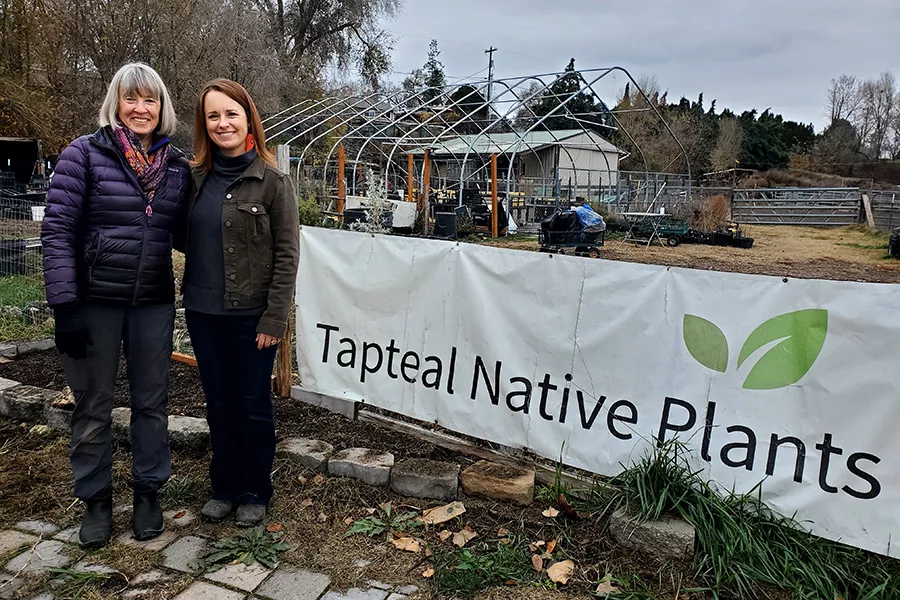
Ann Autrey, left, founder of Tapteal Native Plants, stands with new owner, Julie Wilson, at Tapteal’s greenhouse. Wilson will soon be moving operations to a new site in Richland and will carry on Autrey’s mission of making plants native to the Eastern Washington shrub-steppe available to residential and commercial customers.
Photo by Laura KostadTapteal Native Plants has plans to uproot this winter to move operations to a new location in Richland. But rest assured plant lovers, the spring plant sale is still on, and the nursery continues to take seed orders and plant reservations during the move.
Tapteal sells more than 10,000 plants per year to residential and commercial customers alike.
The specialty nursery was recently acquired by Julie Wilson, a landscape designer, general contractor and owner of Wild Root Landscapes, a niche landscape design-build firm focused on outdoor living spaces. She has a bachelor’s degree in landscape architecture.
Tapteal’s retiring founder, Ann Autrey, said the change of hands is the “perfect fit” since Wilson’s design focus is on highlighting hyper-local native plants.
“It’s Wild Root’s mission to help people see and make connections to our local shrub-steppe (habitat) that they haven’t experienced. ... It enriches their lives and expands their connection to nature and a sense of place,” Wilson said.
Opportunities to grow
Though Autrey has witnessed consistent growth since opening Tapteal Native Plants in 2017, the surrounding market has contracted with the closure of two Spokane-based native plant retailers.
“The market is wide open, especially with the expansion of the Heritage Garden Program,” Autrey said.
The program, administered through the conservation districts in Benton, Chelan, Franklin, Grant, Adams, Kittitas, Yakima, and Walla Walla counties, provides grant-funded free services to property owners that include technical advice and planting guidance for establishing a certified heritage garden.
When Autrey was just getting Tapteal off the ground, Wilson was planting the seeds of Wild Root while working at Musser Landscaping.
She ordered plants from Tapteal. Four years later, Autrey hired Wilson to design some elements of her backyard.
Wilson said she panicked when she found out Autrey was planning to retire, but then she found out about the opportunity to acquire the business.
The pair said they want the transition to be as seamless as possible for customers.
Wilson has not yet disclosed the location of Tapteal’s new base of operations in Richland since she isn’t able to offer retail sales there and will instead rely on pop-up sale events.
“Right now, I’m just making sure we have the right environment for the plants and that all of that is prepped and ready,” she said.
At the new location, Wilson plans to establish a native plant seed bank and plant all around it, with three shade houses, storage and a solar-powered irrigation system.
“We’re trying to keep everything going the way it would normally go with the same plants offered until we figure out if we want to offer new plants,” she said.
Fortunately, she’s not going it alone. Kelsey Kelmel, Autrey’s assistant, president of the Columbia Basin Native Plant Society and heritage garden program coordinator for Benton, Franklin and Yakima counties, will be continuing on with Tapteal.
“In my line of business, there aren’t a lot of opportunities to bounce ideas off of people and I’m really looking forward to more opportunities to collaborate with Kelsey. ... (She) has a lot of knowledge that I don’t have (about native plants) and I have more on the construction and irrigation side that she doesn’t have,” Wilson said.
Once Tapteal settles into its new digs, Wilson hopes to add a new arm to her business: maintenance services.
She said it will close the circle of offerings, bringing landscape design, sale and maintenance of native plant landscapes under one roof.
Beyond that, she said, “I’m brainstorming more ways to get native plants to people.”
“There is such a great community around native plants here in the Tri-Cities with Tapteal Native Plants, the Heritage Garden program, the Columbia Basin Native Plant Society, Tapteal Greenway Association and Wild Root, too. It’s a good synergy and I’m happy to see that community grow.”
Low maintenance landscaping
Wilson is a Tri-Cities native who “grew up running around freely in the sage.” She said she wants more people to know native plant gardens. “A lot of people move here and haven’t experienced the real beauty of this place. There is a hidden beauty here that people haven’t discovered yet. If people took the time to see it, it would change their perspective on what is beautiful,” she said.
Beyond aesthetics, native plants are inherently practical choices for local gardens as well.
Wilson said that “there is a shift happening in landscape architecture that’s moving away from really controlled designs and moving toward more environmentally-friendly and embracing the essence of a place … instead of creating a world disconnected from everything else around you.”
Landscaping with less water intensive options just makes sense, Wilson said, saying that in the coming years “it’s going to hit people in the pocketbook and they’re going to ask, ‘What else can I do?’”
Autrey agreed: “It seems like a lot of people are starting to realize our climate is not made for the standard landscaping plants. It takes a lot to keep them alive. But for native plants, this is what they have always known.”
Once established, native plant gardens are low maintenance. Plus, they enrich the ecosystem, providing not only microhabitat for native plants, but also for pollinators and wildlife.
As for Autrey, who turned 65 this year, she said she is looking forward to turning her attention to her own gardens, which, ironically, she hasn’t had as much time to work on while running the nursery.
She is also looking forward to spending more time with her grandchildren who live down the road and also with her horses exploring the beauty of the shrub steppe.
Tapteal Native Plants: taptealnativeplants.com, 509-578-6446.
Editor’s note (1/22/26): Julie Wilson is a landscape designer, general contractor and owner of Wild Root Landscapes. She has a bachelor’s degree in landscape architecture. The story has been updated to reflect her correct credentials.