West Richland OKs development that could bring thousands of homes
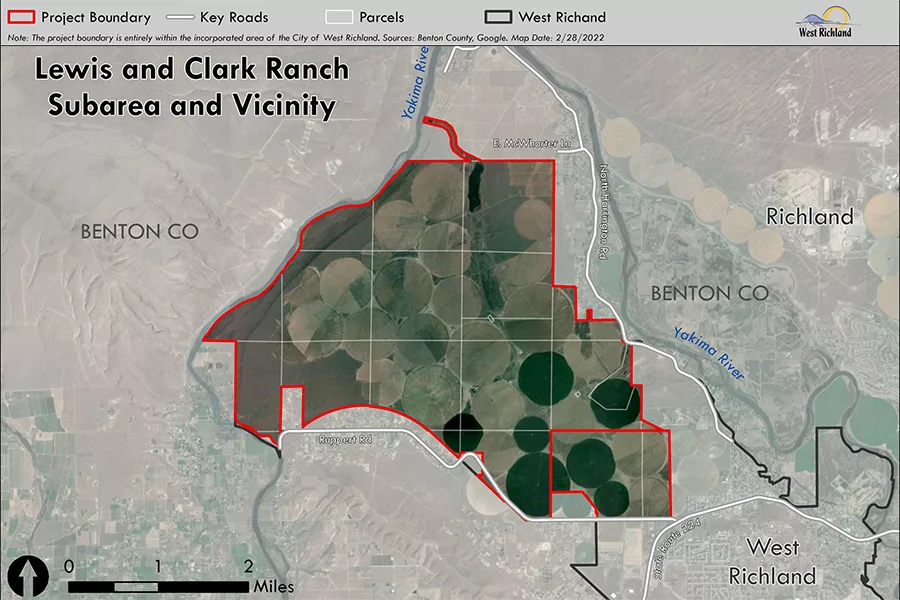
The Lewis & Clark Ranch development in West Richland could see nearly 3,800 homes and support more than 2,600 jobs once it is fully built-out over the next 20 years.
Courtesy city of West RichlandThe first 770 acres of development at the Lewis & Clark Ranch will be transformative for the city of West Richland.
Plans call for walkable medium-density residential and commercial areas and two park areas connected by a trail that could someday link up to the Twin Bridges at the Yakima River.
The development could see nearly 3,800 homes and support more than 2,600 jobs once it is fully built-out over the next 20 years.
The West Richland City Council unanimously approved the plan Aug. 12 as it considered all the information, analyses and community feedback on the state-required draft environmental impact statement for the project.
It’s not exactly the vision that developer Frank Tiegs LLC initially proposed but it’s one city officials said balances the developer’s goals with environmental and community impacts.
But if the first phase is transformative, the planned eventual build-out of the entire project – thousands of acres that will be home to tens of thousands of homes and businesses – will bring a paradigm shift for the Tri-Cities’ so-called bedroom community, which has grown steadily over the past five years and today has a population of more than 18,000.
It’s a future that some have expressed concerns about how it will affect their current lifestyles and the character of the city.
“I have some misgivings about the largest segments of high-density (housing) that are out there,” said Councilman John Smart. “We wouldn’t be the West Richland we are today, and I don’t think we’re going to stay that way, but it doesn’t even come close.”
However, Smart and the rest of the council approved the broader plan for the land over the next 100 years, knowing that only time will tell what’s to come.
“Much of what we’re doing – this is a picture that’s not permanent,” said Councilman Richard Bloom. “We’re not making an earth-shattering decision for the ranch and everything is subject to change.”
The Lewis & Clark Ranch, which consists of 7,600 acres of mostly agricultural land within the city of West Richland, is on a peninsula between the Yakima River and Ruppert Road.
Frank Tiegs LLC initially proposed development plans that would accommodate nearly 3,000 jobs and 3,900 homes during the first phase. Once fully built-out, the developer anticipated Lewis & Clark Ranch would support more than 20,000 jobs and nearly 34,000 homes.
City officials identified the development as a planned action, which provides a more comprehensive review of potential impacts rather than at the permitting stage. That led the city to draft an environmental impact statement as part of the State Environmental Policy Act, or SEPA, process.
City planners and consultants initially suggested an alternative development plan that would have created even fewer homes and jobs, both in the first phase and the overall project. But the plan presented to the council grew from further conversations with Frank Tiegs LLC that would be closer to its targets for the development.
“It could be strengthened to address some things we learned through the process,” Casey Bradfield, a project manager with BERK Consulting, told the council.
The revised alternative didn’t only increase the number of homes and potential jobs from the development, it also shifted any land for light industrial development into future construction phases and reduced land set aside for open spaces.
The bluffs above the Yakima River on the property, originally designated as park land, are instead zoned residential with a notation that those parcels may still have to be set aside in the future due to changing state prohibitions in developing critical habitat areas, Eric Mendenhall, the city’s community development director, told the council.
“Rather than identifying that and limiting it, we just want to leave it as is and in the future phases, as those get planned, they can address those as they approach and cross those lines,” Mendenhall said.
The city solicited feedback to all the alternatives as part of its process and most of it was positive or neutral. Mendenhall said some residents living along Harrington Road said they don’t want any of the development’s roads to connect with theirs as shown on the city’s diagrams. Those proposed connections would be with private roads and would require significant effort to establish and would not come for decades, he said.
Adding those connections also could provide a lot of benefits, such as improving emergency services response times, Mendenhall said.
While council members Kate Moran and Richard Bloom raised questions about the future plans for the bluffs as well as potential energy demands from such dense development, they also noted that those issues will continue to be revisited as the Lewis & Clark Ranch is built-out.
Smart acknowledged that he was the one council member most skeptical of the overall project and its impacts. He expressed concerns about “creating a Road 68 condition with a mile of commercial all in a row” and what he called large concentrated stretches of apartment buildings. But he said that the first phase appears to have an appropriate mix of zoning and land uses.