
New LIGO research facility to pave way for future space discovery
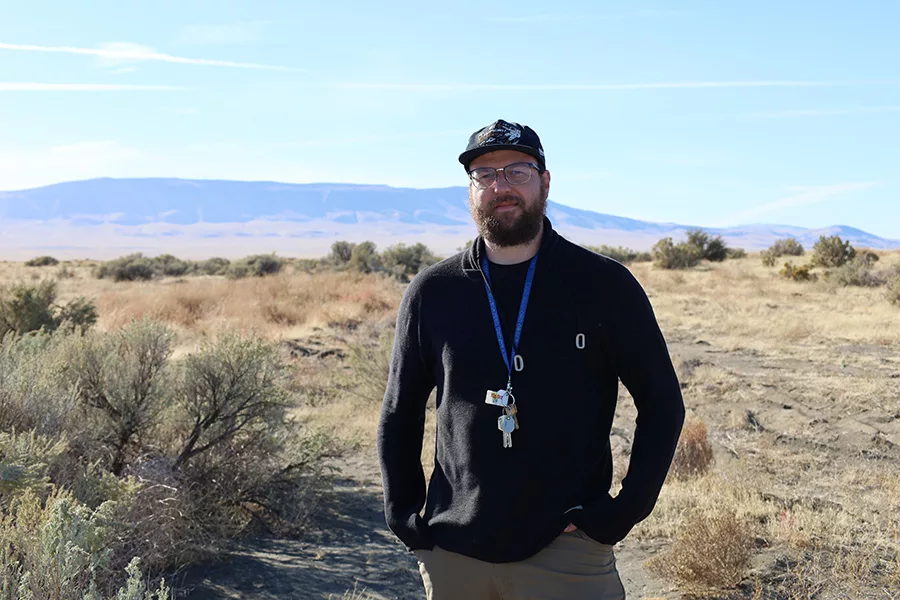
Janos Csizmazia, lead vacuum engineer at LIGO Hanford Observatory and co-principal investigator for Cosmic Explorer Beamtube Experiment, stands at the site north of Richland where a new research facility will be built.
Photo by Rachel VisickPlans are underway for a new research facility at the observatory scouring space for black holes and the experiments that are set to take place there will pave the way for future discoveries in space.
Located on the windy plains north of Richland, Laser Interferometer Gravitational-wave Observatory, or LIGO, Hanford Observatory, is a cluster of buildings at the center of two long, arm-like tubes extending outward in an L shape.
It’s an observatory that investigates space without the use of a telescope, detecting colliding neutron stars and black holes light-years away from Earth using lasers and sensitive instruments inside the tubes.
Cosmic Explorer
However, there are limitations to what LIGO, operated by the California Institute of Technology and the Massachusetts Institute of Technology, can detect.
That’s why a new observatory, the Cosmic Explorer, is being planned. At 10 times the size of LIGO, with arms 40 kilometers in length, the observatory would be highly sensitive. The scope of the new observatory’s detections would be vastly increased, allowing scientists to detect throughout the observable universe.
LIGO’s arms measure 4 kilometers, or 2.5 miles. It can detect neutron stars in a 400 million light-year radius, while black holes can potentially be seen at greater distances, said Janos Csizmazia, lead vacuum engineer at LIGO and co-principal investigator for Cosmic Explorer Beamtube Experiment, or CEBEX.
Like LIGO, the Cosmic Explorer would have a sister observatory, though slightly smaller, with 20-kilometer arms, to verify data.
Csizmazia said that they would expect to make three observations every five minutes, while LIGO currently makes perhaps two observations a week.
Beamtube research
To support that future project, a new research facility is being built at LIGO. It’s not the colossal new Cosmic Explorer observatory, but it’s called the Cosmic Explorer Beamtube Experiment building, or CEBEX.
Essentially, this building will be a place to experiment with and refine the tubes the lasers travel through.
The beamtube at LIGO is large, about 1.2 meters in diameter, and the interior must be an ultra-high vacuum. At 10 times the size of LIGO, it will be much harder to create the vacuum space for the Cosmic Explorer. The team at CEBEX will research optimized solutions for the challenges of such a large project.
The beamtube is made of stainless steel about 3.2 millimeters thick. While the material is great for bending and stress, Csizmazia said, the vacuum on the interior means that the tube needs rings around the exterior every half a meter for the whole length of the exterior to prevent it from buckling due to the difference in atmosphere.
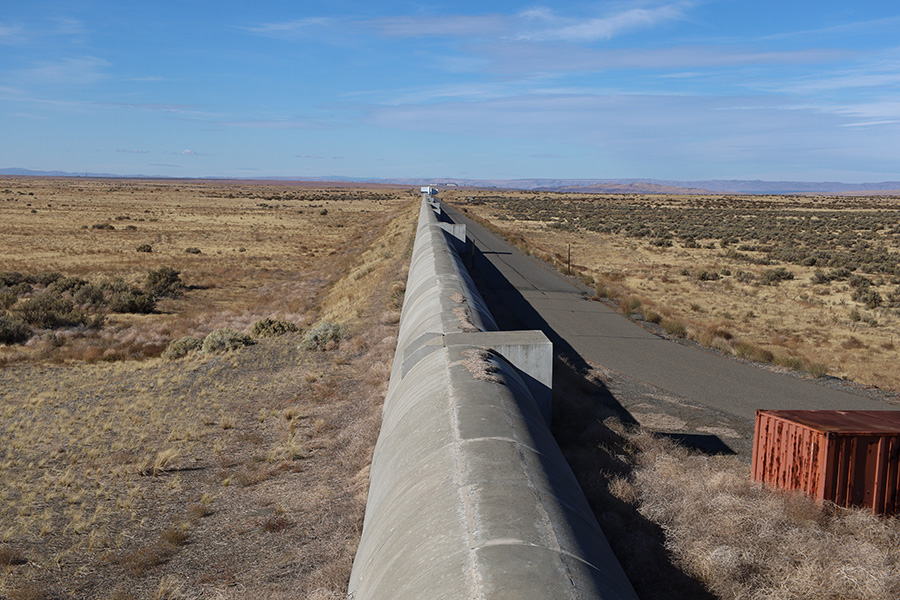
LIGO Hanford Observatory’s CEBEX research facility will experiment with ways to optimize the tube LIGO’s lasers travel through for a project 10 times the size of the current observatory.
| Photo by Rachel VisickThat’s a large additional cost, so one thing the CEBEX team will look at is the potential to prevent buckling in other ways, such as using a thinner but corrugated, or wavy, pattern of tube.
After the LIGO beamtube was built, it had to be pumped out while heated to a very high temperature to get rid of lingering water molecules in the tube. CEBEX would research other ways to eliminate the water molecules, such as through gas or plasma cleaning.
CEBEX also will investigate different materials.
Due to the atomic structure of stainless steel, hydrogen can bleed through. Using a different material, like carbon steel or ferritic stainless steel, would help decrease the amount of hydrogen bleeding through – but carbon steel rusts easily, Csizmazia said, so they will need to research how to prevent or clean the rust.
New facility construction
The new CEBEX facility will be built just outside of the mid-station of LIGO Hanford Observatory’s southwest arm.
It’s a project that will cost in the low $10 millions, Csizmazia said, including the 11,500-square-foot building, staff salaries, prototypes and more. The project is funded through a $17.7 million National Science Foundation grant for 2024-28.
Csizmazia said that the price tag is well worth it because of the ways in which the CEBEX research will reduce costs and materials for the future facility. “The added value here … compared to the investment is huge,” he said.
Construction will take place on a fairly “aggressive timeline,” Csizmazia said, with plans to start in November and wrap up by July 2026. The hope is to wrap up the building around the same time as the first prototype is ready.
While LIGO’s instrumentation is very sensitive, construction of a new facility will be mitigated in a couple of ways. First, by building near a mid-station of one of the long arms, the new building will be farther from the sensitive equipment on either end of the arm, meaning that potential disturbances will make the least impact at that location.
Also, LIGO typically runs various observation periods, and its current observation period is coming to a close in November. Csizmazia said that there are often large gaps, sometimes years, in between the observation periods, and the timing will give them a good window to complete the construction.
Being close to the mid-station also means that they will be close to existing utility lines for water and electricity.
LIGO has about 50 to 55 staff, and while some new staff will likely come on for the new facility, some, like Csizmazia, will just shift operations to CEBEX.
The research conducted at LIGO led to the first-ever detection of gravitational waves in 2015, winning a Nobel Prize in physics in 2017 for LIGO founder Rainer Weiss, along with Kip Thorne and Barry Barish.