New Pasco High program connects students to law, public safety careers
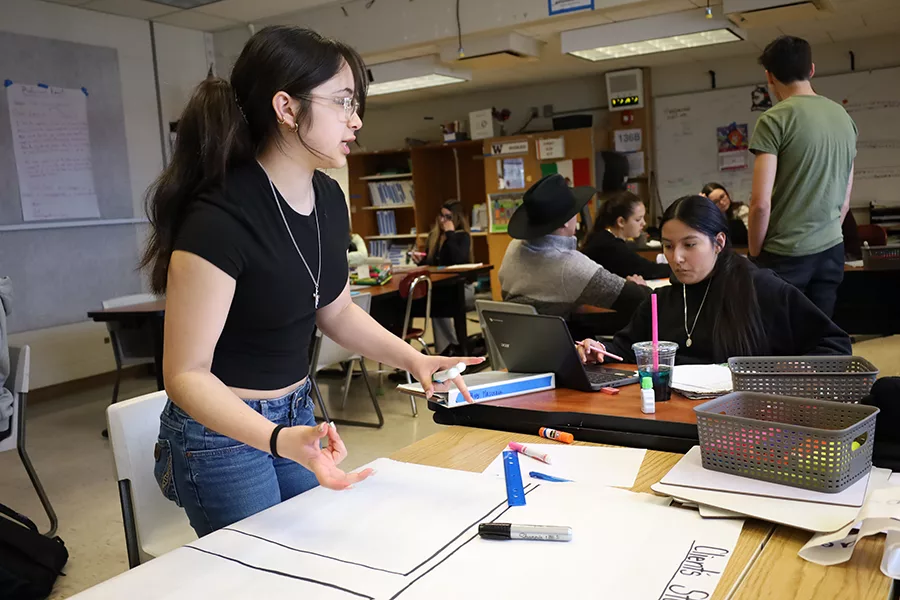
Diana Garcia, a 15-year-old freshman at Pasco High School, picked the school’s new Law and Public Safety course because she loves watching crime documentaries and hopes to study forensics.
Photo by Rachel VisickPasco High School students with an interest in criminal justice careers now have the option to get more exposure to the field before graduating high school.
The school’s new Law and Public Safety program launched this year, allowing students to learn interviewing skills, criminogenic factors and more and to interact with local professionals.
“Everything we learn we can apply to real life right away,” said Anera Martinez, 17, one of the students in this year’s inaugural class. Like several others in the class, she’s interested in going to law school.
But it’s not just about law school, or law enforcement. Students also have interests in politics, customs, forensics and more.
“A big part of the value of this program is it’s a little more open-ended,” said Brian Moreno, a community volunteer and business owner who helped facilitate the program. “It doesn’t just mean you have to be a police officer. You could be a records clerk, you can go into city government, you’ve been exposed to all these careers.”
Building a pathway
The concept has been in the works for several years and is the product not just of the Pasco School District, but also of community partners, including Pasco’s police and fire departments, Washington State Patrol, Benton County Juvenile Justice Center, Columbia Safety, Benton County Emergency Services, Columbia Basin College and the Franklin County Courthouse.
Laura Jones, Career and Technical Education, or CTE, director for the school district, said that building the course as a community was key, “rather than the CTE director and a teacher trying to figure out what we’re going to teach and just looking at a book or canned curriculum. It’s so much stronger when the community has a voice and we’re really targeting what students need to be successful in that career.”
The community partners serve on an advisory committee which meets to build and sustain the program.
The Intro to Law and Public Safety course was launched for the 2025-26 school year, lasting two of Pasco High School’s three trimesters. A total of 56 students enrolled in the first part of the course, with 45 students taking the second.
When the next school year begins, the high school will be launching a new course on criminal justice. The goal is to flesh out the program as a pathway, with a series of classes students could take.
Freshmen students like Diana Garcia, 15, who wants to study forensics, will be able to build on the introductory course over the next few years of high school.
Work is currently underway to develop junior and senior year classes.
Because the program has been built in coordination with community partners, it will align closely with CBC’s criminal justice program so that students have the chance to get credit or waive courses.
Community partnerships
The program’s community partners are vital to help students learn in a hands-on way. They’ve helped provide curriculum, case studies and even do some teaching.
Ramiro Gomez, juvenile probation counselor for the Juvenile Justice Center and part of the program’s advisory board, helped teach students interviewing skills, “giving them the perspective for real-life situations, kind of teaching them real skills if they need it in the law and public safety world,” he said.
He worked with the students’ teacher to adapt the material he teaches at juvenile case management academy, a weeklong mandatory course for all probation officers doing juvenile work. That way, the students got all of the same information that a regular employee would, Gomez said.
He also took students for a field trip to the Juvenile Justice Center for a tour, where students got the chance to speak with staff and reinforce what they had learned in class.
Gomez said that the class’s teacher, Stefanie Valencia, often teaches things he wishes he’d had more instruction on before going into the field, and she helps put it into real life situations – and he thinks it’s been successful.
“These students are really confident and motivated to pursue those careers,” he said.
Retired Pasco police Chief Ken Roske, who helped get the program started, said “by combining classroom learning with real world exposure, these programs build a solid foundation in professionalism, accountability, and service.”
“Early engagement like this plays an important role in shaping the next generation of law enforcement professionals, and it is encouraging to see students developing both an interest in the field and a commitment to making a positive impact,” he said in an email to the Tri-Cities Area Journal of Business.
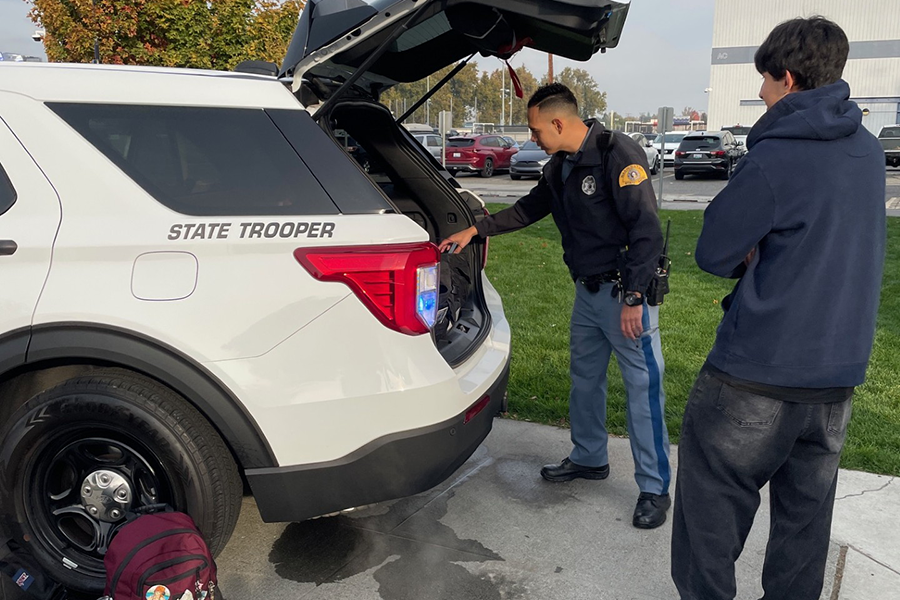
Through Pasco High School’s Law and Public Safety program, students get to have hands-on interactions in various fields, from law enforcement to criminal justice.
| Courtesy Pasco School DistrictSignature program
While community partners play a key role in the students’ education, the courses wouldn’t be possible without the qualifications of their teacher.
Jones said Valencia is a Pasco High alum who had worked as a lawyer for several years before becoming an English teacher. It’s been the perfect combination, because as the program gets under way, she can continue teaching English classes while starting to teach the new Law and Public Safety courses.
Valencia also has been instrumental in relaunching the school’s translation and interpretation class, now incorporated as a part of the Law and Public Safety program. Because of that tie, the translation aspect is rooted in real-world utilities, like court interpretation, and it plays into the strengths of bilingual students.
The Law and Public Safety course will be a “signature program” for Pasco High School, meaning it won’t necessarily expand to other schools in the district. It’ll be similar to the way Chiawana High School is home to a computer science program, and Pasco High School already is home to an automotive program because it’s the only high school with an auto shop.
In addition to spreading out the district’s signature programs, student interest also played a role in locating the program at Pasco High, Jones said.
It’s not the type of program that could easily be scaled up, since it’s closely tied to community partners – only so many students can participate in tours or other hands-on experiences.
Education meets employment
Moreno often helps serve as an intermediary, finding gaps in systems and helping to coordinate organizations to fill them.
The skill gap between graduating high schoolers and what employers are looking for is just one example of where that coordination can help to find a solution. In this instance, Moreno said that Roske’s vision for the partnership and the Pasco Police Department’s participation helped anchor the program.
“I’m really hoping more companies and organizations in our community realize you can be invested in these systems,” he said. “You just have to take a learning stance and be willing to invest the time.”
Moreno said that employers can no longer consider themselves consumers of education, but instead, should be partners with education – “otherwise, we just have these two siloed communities that don’t really know what the other’s needs are or have that relationship,” he said.