
New PNNL lab to focus on microbes with help from AI
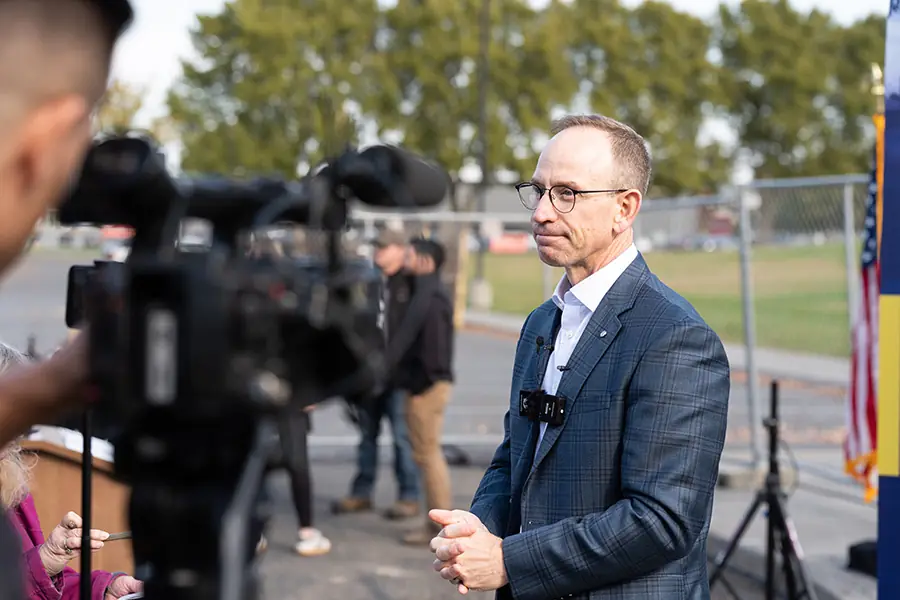
Douglas Mans, associate laboratory director, answered questions at the Oct. 20 groundbreaking of Pacific Northwest National Laboratory’s new laboratory, the Microbial Molecular Phenotyping Capability, or M2PC.
Courtesy Eddie Pablo, Pacific Northwest National LaboratoryLess than a year after unveiling a new automated lab, Pacific Northwest National Laboratory has broken ground on a larger scale version expected to come online by the end of 2029.
Called the Microbial Molecular Phenotyping Capability, or M2PC, the laboratory is expected to be 30,800 square feet and contain more than 100 automated instruments capable of growing, preparing samples and measuring the behavior of microbes.
The lab will use artificial intelligence to “analyze the results and guide the next experiments, allowing scientists to explore more questions faster than ever before,” said Deb Gracio, PNNL director, during the Oct. 20 groundbreaking event.
“Research that has taken years will become possible in months, and hopefully weeks in some cases,” she said.
The building will be at the corner of Horn Rapids Road and Innovation Boulevard on the PNNL campus, just north and east of the existing Environmental Molecular Sciences Laboratory, or EMSL.
Built from a prototype
M2PC will be similar to a first-of-its-kind automated biotechnology lab that opened at PNNL’s EMSL in December 2025.
The Anaerobic Microbial Phenotyping Platform, or AMP2, is a 1,800-square-foot lab with automated equipment and AI integration that helps scientists study microbes that can’t survive in oxygen.
U.S. Energy Secretary Chris Wright visited the lab to kick off its work on Dec. 4, 2025.
“The award-winning AMP2 is already an early win for the Genesis Mission, as if we saw Genesis coming six years ago” when PNNL and the Department of Energy began planning for the project, said Dorothy Koch, associate director of DOE Office of Science’s Biological and Environmental Research program.
Now, M2PC will build on that momentum as a larger scale version of that lab. Douglas Mans, associate laboratory director, said that AMP2 will remain up and running even once M2PC comes online.
While AMP2 focuses on microbes in conditions without oxygen, M2PC will be an aerobic lab.
Mans said that AMP2 is still onboarding, but the lab did a “first demonstration of a fully autonomous set of designs and experiments on that system.”
The lab was able to perform three cycles of designing and building the experiment, doing the testing and then learning from the results in 72 hours through AI working with researchers. Normally, that process would have taken researchers six months to plan, set up, run and analyze, Mans said.
Gingko Bioworks, which built AMP2’s automated system, is also the contractor for the automated portion of M2PC. It has a four-year, up to $47 million contract to co-design, build and integrate the system.
As the building structure is being put in place over the next three years, the automation components will be underway off site and ready to move in once the building is ready, Mans explained.
In the meantime, research departments at PNNL will begin planning some of the studies that they want to do and microbes to experiment with so that as soon as doors open in 2029, scientists can get in and get going, he said.
It’s purposefully designed to be upgradable, Mans said, so that the lab can stay at the forefront of biotechnology.
“This is going to be an anchor for PNNL going forward and for probably decades or more in terms of this capability,” he said.
Accelerating discovery
The new lab is anticipated to help accelerate scientific discovery and contribute to the nation’s needs.
“M2PC will bring together PNNL’s strengths in microbial science, automation, and computing to dramatically accelerate our understanding of what microbes can do and how we put those capabilities to work for the nation,” Gracio said.
When the new lab is launched, it will have 500 strain experiments per week, 100 microbiome experiments per week and a million measurements per month, including the ability to run remote protocols, Koch said.
That acceleration of experiments and discovery helps meet the federal government’s Genesis Mission initiative’s goal of doubling scientific productivity.
Gracio said that M2PC will be a “flagship element” of the Genesis Mission, thanks to its use of AI and automation, and the project “will strengthen the connection between scientific discovery and meeting the nation’s needs,” she said. “Learning how microbes work may suggest a new way to produce fuel, create a biomaterial or recover critical minerals.”
The attendees of the groundbreaking were excited for the potential the new lab embodies. Mans said it’s an investment in “a new capability for the next scientific frontier,” while Gracio called M2PC “the future of tomorrow.”
Koch said the lab will be “of vital importance to the dawn of this biotechnology revolution.”
“DOE and the broader research community, we eagerly await the opening of M2PC. Another three more years, and we’ll be watching month by month as the building and the facility take form,” she said.
People remain key
Despite the emphasis on automation and AI, Mans stressed the key involvement of humans. As technology changes and advances, the skillsets required to work with that technology also need to grow and adapt.
“We’ll need biologists and researchers who can work alongside agentic intelligent systems, automation engineers who can connect instruments, robotics and superintelligence computation, as well as high-skill focused technicians who can operate and maintain these sophisticated robotics. And just as importantly, we’ll need the skilled craftspeople who make so much of our science possible today,” he said.
Increasingly, those who can work across disciplinary boundaries will be key to putting the pieces together, Mans said.
The new laboratory represents an opportunity not just to bring on new workers in these different areas, but also to benefit students and new researchers, as well as existing PNNL staff, he said.


Stay Informed. It’s Free.
Subscribe to our newsletters and get the latest news and insights delivered to your inbox.
We respect your privacy.
Unsubscribe anytime.
Thank you!
You’re subscribed. Keep an eye on your inbox for the latest updates.