
Next-generation rooftop HVAC systems near commercial rollout
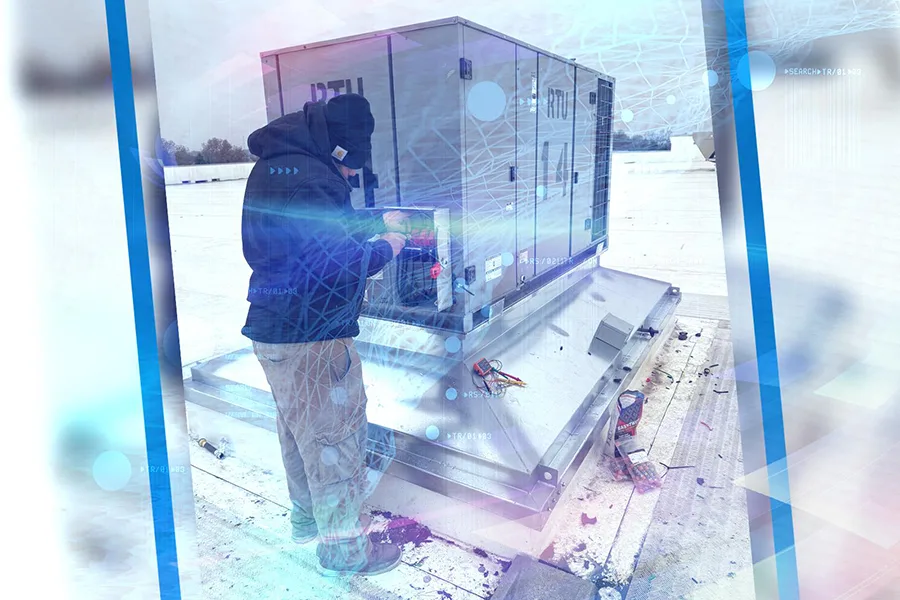
Next-generation RTUs on a Lowe’s in 2026.
Composite image by Stephanie King | Pacific Northwest National LaboratoryResearchers at Pacific Northwest National Laboratory and their partners have been engineering the next generation of heating, ventilation and air conditioning units and are now ensuring they provide the energy efficiency and reliability they were designed for.
The advanced rooftop HVAC units developed through the U.S. Department of Energy’s Better Buildings and Better Plants Initiative are currently being installed on some commercial buildings to test their real-world performance before being rolled out on the market, according to a release.
“By confirming performance before wide-scale rooftop installation – where a single crane lift can cost $30,000 – PNNL is helping manufacturers and building owners de-risk investment in new technologies that can lower their energy bills,” said Michael Myer, project lead at PNNL, in a statement.
Industry partners included HVAC manufacturers AAON, Bosch, Carrier, Daikin, Lennox, LG, Rheem and Trane. The National Laboratory of the Rockies, Oak Ridge National Laboratory and Argonne National Laboratory also contributed to the project.
Rooftop units currently provide HVAC to more than 2.5 million buildings in the United States. Improving their performance could significantly reduce energy use and lower costs for businesses.
These advanced, fuel-flexible rooftop units are designed to operate efficiently in sub-freezing temperatures and reduce costs by up to 50% compared to currently available systems.
However, new technology can be risky for manufacturers and installers to roll out and businesses to adopt given installation costs.
While PNNL and its partners have done their own extensive testing of the new technology in a lab setting, testing them out in the world – including at a Lowe’s in Zionsville, Indiana, and on PNNL’s own campus – will provide further efficacy.
“These field trials are the final step before launching a high-performance product designed to strengthen U.S. commercial buildings,” said Heidi Gehring, managing director of light commercial at Carrier.
Additionally, PNNL is supporting low-cost thermostat solutions for building owners who aren’t ready to replace their entire HVAC systems. While the technology has been on the market for years, it had not been widely adopted, leading researchers to study what barriers were preventing implementation.
“Faster and more successful retrofits benefit everyone,” said Meghan McNulty, PNNL project lead, in a statement. “Owners can see lower energy bills, installers can see increased profit margins, and everyone’s confidence in the new technology increases.”
This work was supported by DOE’s Office of Critical Minerals and Energy Innovation, Building Technologies Office.