
Nurse practitioner expands men’s clinic in response to growing patient demand
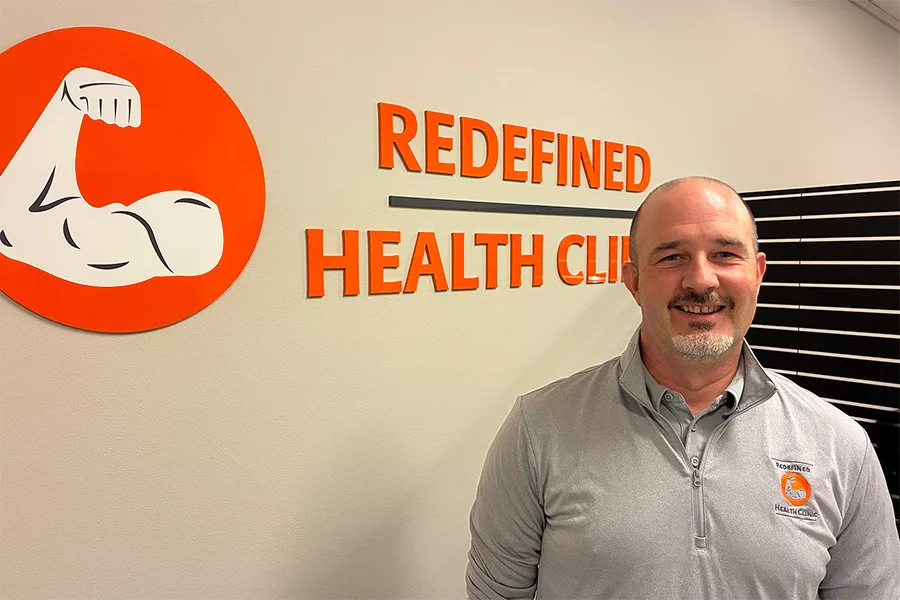
Nurse practitioner Bill Ruzicka founded Redefined Health five years ago as a telemedicine service. Now with a physical clinic, he’s eager to help more men through specialized health care.
Photo by Ty BeaverBill Ruzicka said his clinic, Redefined Health, really came about out of necessity.
The nurse practitioner had patients come to him for years as referrals from other health care providers. And they almost always came with the same circumstances:
- They were always tired, had brain fog, struggled to recover after workouts or to perform in the bedroom.
- Their testosterone levels were either just above or just below 400 nanograms per deciliter, the minimum level considered normal by urological experts and most insurance companies.
And that was the problem, Ruzicka recently told the Tri-Cities Area Journal of Business: the normal range for one man won’t necessarily be what another may need.
“Countless times I’ve had guys in here saying they have 350 and insurance won’t cover (testosterone replacement therapy),” he said.
Now, five years after founding Redefined Health as a telemedicine service and now having a physical location, Ruzicka said he’s eager to help more men while demonstrating hormone-based therapies as a valid means to improving men’s health.
“I’m not sure where the stigma comes from,” he said.
Growing clientele
Ruzicka, who grew up in Walla Walla, moved to the Tri-Cities in 2001 and started working as an operating room technician at Lourdes Health Center in Pasco. That led him to pursue a career in nursing and earn a Master of Science in family practice from Gonzaga University.
It was during his studies at Gonzaga that Ruzicka had a rotation with Total Care Clinics in Richland and where he first saw the potential of therapeutic hormone therapies. According to its website, Total Care offers hormone therapy aimed primarily at improving athletic performance and recovery.
Ruzicka joined Kadlec in 2017 as a family medicine provider. His familiarity with hormone therapies led him to suggest the option to some of his adult patients who struggled with a variety of symptoms that could be attributed to hormone deficiencies.
But it was men in particular who came to him on referral from other providers, including his Kadlec colleagues, largely because they were not knowledgeable or comfortable providing testosterone replacement therapy, or TRT, Ruzicka said.
That growing clientele led Ruzicka to launch Redefined Health in September 2020, in the middle of the Covid-19 pandemic, as a telemedicine service. He began seeing patients in his own clinic at 400 Columbia Point Drive in Richland about a year ago and held a grand opening in July.
“Once we opened a brick-and-mortar location, we more or less doubled our clientele,” he said.
The concept of specialized men’s health care is a relatively recent development precipitated by the development of Viagra in the late 1990s, according to a paper published in the Translational Andrology and Urology medical journal.
From 2001-11, testosterone use in the United States tripled. During the same period, total testosterone sales increased 12-fold globally, rising from $150 million in 2000 to $1.8 billion in 2011. Total testosterone use among men over 30 increased from 0.52% in 2002 to 3.20% in 2013.
“Given that interest in men’s health is relatively new, the definition of a men’s health clinic continues to evolve. Originally conceived as testosterone replacement centers, men’s health clinics are increasingly understood to encompass male endocrine, surgical, urologic, physical performance and psychological issues,” according to the medical journal.
The men’s health and wellness market was valued at $1.42 trillion in 2024, and the U.S. is seeing the most growth in the industry, according to a report from ResearchandMarkets.com.
“Men are now substantially more aware of their health post-pandemic,” the report said. “The global men’s health and wellness market is expected to surge in the future due to rising demand for personalized nutrition and supplements, tech-enabled health monitoring, social influence, telemedicine and digital health services, etc.”
Treating low testosterone, other issues
Hormone therapies have existed for decades and are perhaps best known for treating the symptoms of menopause in women. However, the role of hormones in medicine has grown to cover health care issues ranging from diabetes and endocrine disorders to cancer treatments and gender-affirming care.
Ruzicka said any number of issues can lead to men losing testosterone, from age and testicular cancer to physical injuries and accidents. And while there is a typical range, it shouldn’t be viewed as a one-size-fits-all standard.
He tests patients for two different counts of testosterone in the blood as well as for the protein it most frequently binds to, sex hormone binding globulin, or SHBG. Those results allow him to better tailor treatment to a patient’s needs, be it injections, patches or pills.
While many of Ruzicka’s patients come to him on their own after years of struggling to address symptoms, it’s not uncommon for wives and girlfriends to reach out on behalf of their partners.
The results after just a few months of treatment, though, are almost universal: increased focus and drive, better sleep, quicker recovery from workouts and improved sexual health.
“You’ll get men who have been depressed, have been on meds and nothing works,” Ruzicka said. “You can just see their life light up.”
Roughly 80% of Redefined Health’s business is providing TRT. Ruzicka also provides treatments for medical weight loss, erectile dysfunction and peptide therapy, which uses human growth hormone to help people recover from athletic training, injury and surgery.
And it’s all offered on a concierge care basis. Patients pay a monthly membership fee depending on the course of treatment, with TRT starting at $180. The model is similar to that used by a handful of other health care providers in the Tri-Cities to eliminate the hassles, energy and cost of dealing with insurance companies, while ensuring patients have more access to their providers.
TRT misconceptions
Ruzicka acknowledged that there are misconceptions about the risks and efficacy of TRT.
It is important to monitor patients’ red blood cell counts as it can lead to an increased risk of blood clots, he said. Perhaps counterintuitively, it can also lead to infertility by suppressing sperm count, though that is often reversible.
However, recent studies have shown that TRT does not necessarily increase the risks of prostate and testicular cancers as previously thought, Ruzicka said.
As for efficacy, the Urology Care Foundation of the American Urological Association includes TRT as a valid treatment for low testosterone, noting that there are clinics offering the therapy without the proper care or training.
These less-than-reputable medical practices have affected people’s view of TRT, Ruzicka said. However, he sees that changing.
“I think you’ll see a more gradual shift to more clinics offering it,” he said.
And while he intends to focus on his male patients, Ruzicka already has plans to expand the clinic’s offerings to also treat estrogen deficiency in women.
“(My patients’) wives are seeing the improvements their husbands are seeing and they come to us to see if we can do the same for them,” he said.
Redefined Health: 400 Columbia Point Drive, Suite 201-B, Richland, 509-246-6764, redefinedhealthclinic.com.