Residential market
Homebuilders face headwinds amid difficult year

Two-story townhomes under construction in the gated Sunridge community in the Southridge area of Kennewick.
Photo by Scott Butner PhotographyTri-City homebuilders and real estate agents entered 2025 with renewed optimism.
The prior year was a banner year, with tens of millions of dollars more in residential building permits issued in 2024 compared to previous years. Voters overturned state restrictions on providing natural gas in new residential construction. And the region was continuing to grow, with thousands of families looking for homes.
The hopeful outlook only made the harsh realities of 2025 feel more disappointing.
Residential construction, as of early September, flatlined compared to the same period a year prior, particularly for single-family homes and multifamily projects such as apartments. The reason? There are a slew, including the state’s new rent stabilization law, federal policies that led to layoffs at federally-funded employers such at Richland’s Pacific Northwest National Laboratory and the Hanford site, as well as high tariffs on virtually all imported building materials.
“This has been one of the most difficult years,” said Jeff Losey, executive director for Home Builders Association of the Tri-Cities, during a Sept. 9 panel discussion on the housing market hosted by the Tri-City Development Council, or TRIDEC. “It’s caused a lot of turmoil. It definitely caused some pause (of construction).”
That’s not to say there haven’t been silver linings, particularly for homebuyers. As of early September, there were roughly 1,200 homes listed for sale in the Tri-Cities region, the most in more than a decade, and interest rates for a 30-year mortgage were just below 6%, their lowest in about a year. Home prices had stabilized after climbing for years.
“There’s more opportunity for buyers, no doubt about it, compared to six months ago,” said Craig Smith, senior vice president of operations for Bend-based Hayden Homes.
Numbers show slowdown
Building permit data for the region bears out this lull.
As of Aug. 31, 2025, 890 permits for single-family homes were issued for detached homes and townhouses. Additionally, builders filed for permits for 79 duplexes, 21 mobile homes, 16 accessory dwelling units, or ADUs, and six multifamily projects, according to the Home Builders Association of Tri-Cities.
By comparison, permits for 1,184 single-family homes and townhomes were issued by the end of August 2024. Fewer permits were filed for duplexes but 11 times as many were sought for multifamily projects and almost twice as many for ADUs and mobile homes each.
Losey said the numbers looked even worse in the spring, with residential construction down 22%, until builders were able to reclaim some lost ground through the summer.
The tariffs imposed by President Donald Trump on many imported products have driven up costs. Tariffs are imposed on the importer, who must pay the tariff to receive the products. Meanwhile, domestic producers raised their prices due to demand though they are unlikely to ever fully meet it.
The producer price index for materials and services used in nonresidential construction rose 0.2% in August 2025 compared to the prior month and 2.5% from a year ago, according to an analysis of government data conducted by the Associated General Contractors of America.
Three major construction materials drove the increase in costs. Aluminum mill shapes rose 5.5% in August 2025 over the previous month and 22.8% year-over-year while steel mill products rose 1.5% in August 2025 over the previous month and 13.1% year-over-year. Lumber and plywood increased 0.5% for the month August 2025 over the previous month and 4.8% year-over-year.
Those increases align with tariffs on steel and aluminum being raised by 50% on June 4, following an earlier increase to 25% in March. A 50% tariff on copper products and components took effect on Aug. 1. In addition, broad tariffs covering most imports from nearly all major suppliers of construction materials were activated in early August, making additional cost increases likely, according to the Associated General Contractors.
That, Losey said, is why inflation on construction costs currently ranges between 5% and 7%.
“Builder confidence is shaken,” he said.
Listings growing
With homebuilding stagnant, why are more homes on the market? After years of new homes making up the bulk of those for sale, more homeowners are putting their existing homes on the market, real estate experts said.
Matt Heuer with the Tri-City Association of Realtors attributed it to life cycle changes in the community – retirees downsizing, families growing or seeking to clear the estate of a loved one. Many townhomes being built in the region are being occupied by older people, he said.
April Connors, a Tri-Cities Realtor who is also a state representative, said two prospective buyers for one of her recent listings were both older couples looking to downsize.
Another reason more homes are on the market could be because landlords are reducing their holdings in response to the state’s new law capping rent increases. The law limits rent increases to a maximum of 10% per year, which could lead some owners to reduce their inventory to manage costs.
“I had a client who had seven rental properties, and he has sold four,” Connors said, adding that the flip side is developers are avoiding starting new housing projects such as apartments or other rental properties because of the rent caps.
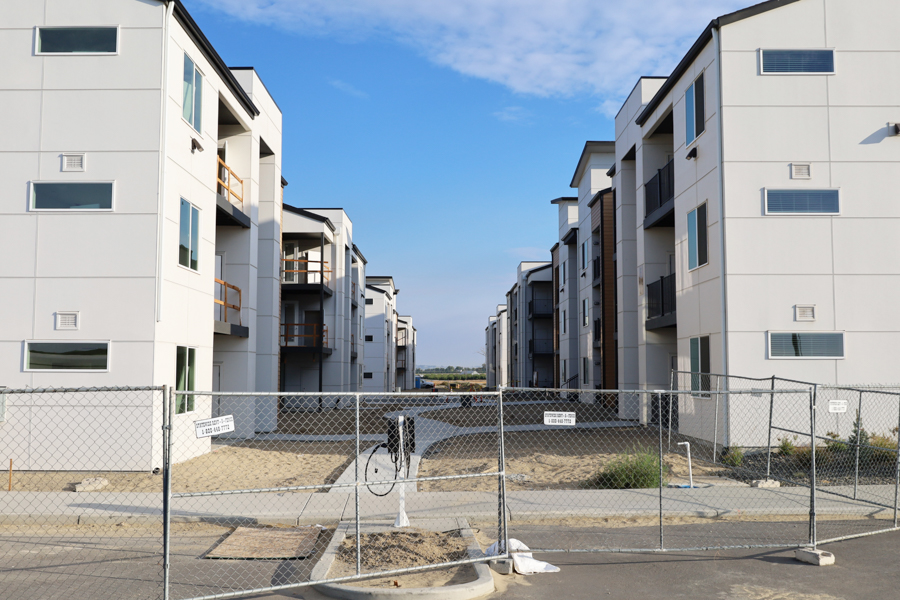
Construction is nearly complete on this latest phase of the Brisa Heights apartments at 10181 Burns Road in Pasco.
| Photo by Nathan FinkeAffordability challenges
The growth in home listings hasn’t led to steep price drops, though it appeared to stabilize them. While down from an all-time high of $487,300 in average sold price in February 2025, average sold prices have fluctuated between $474,000 and $479,000 in recent months, according to data from the Tri-City Association of Realtors.
Yet growth in the number of homes sold is anemic. In the first eight months of 2025, the Realtors association reported 2,363 home sales. While above the 2,194 sold two years ago in the same period, that’s two fewer sales than was reported for the first eight months of 2024.
While interest rates are hovering around the best they’ve been in a year or so in early September 2025, they are still above the historic lows of several years ago. It’s why those two recent prospective buyers for a home Connors was representing were so reticent to make an offer, as they had mortgages with 3% interest rates.
“It’s tough to get less house for the same monthly payment,” she said.
Stabilized home prices do not translate to affordability. Benton and Franklin counties have long ranked higher in housing affordability compared to the rest of the state, according to data from Benton-Franklin Trends, a project of Eastern Washington University’s Institute for Public Policy & Economic Analysis.
However, the region’s affordability has declined steadily over the past decade, dropping below the “break even” score of 100 in the beginning of 2022. A score of 100 would indicate a market where 25% of a household’s income goes toward the costs of a median-priced mortgage.
As of the second quarter of 2025, the region had a listed affordability score of 78.5. That means the average household in Benton and Franklin counties currently has 78.5% of the income required to pay for a median-priced home.
“A home purchase is usually the most important one in our lifetime,” according to Benton-Franklin Trends. “Obviously, the price needs to be manageable to our income flows. Otherwise, financial hardship can easily follow, as the events of the 2008-09 Great Recession illustrated.”
Unclear future
The Tri-Cities region continues to grow – adding roughly 2,700 more people in the past year for a total population of more than 322,000, according to 2025 data from the state Office of Financial Management. However, that growth has slowed in recent years and dipped below the state’s average growth rate for the first time since 2017.
But with the region’s housing market being underbuilt for so many years, there’s still plenty of demand for homes, and developers have projects lined up to meet it.
The city of West Richland recently signed off on the first phase of construction for Lewis & Clark Ranch in the shadow of Red Mountain. That initial project will build nearly 3,800 homes and support more than 2,600 jobs once it’s fully built out over the next 20 years, and is only a fraction of the tens of thousands of homes the development could eventually see.
Meanwhile, in Pasco, four housing developments near Burns Road and the recently opened Sageview High School will welcome 1,500 homes of varying sizes and price points to the area over the coming years.
The Southridge area in Kennewick continues to grow, as do the communities near Badger Mountain.
The question is, how quickly those homes will be built and whether builders will be able to offer them at a price people won’t balk at.
“Trump holds the key to how much the tariffs will be,” Losey said. “Tariffs are a regulation. And 25% of the cost of a home are regulations.”